Меню
Разработки

Present Perfect

14.09.2026

Содержимое разработки

PRESENT PERFECT TENSE Настоящее совершённое время
PRESENT PERFECT TENSE

Настоящее совершённое время

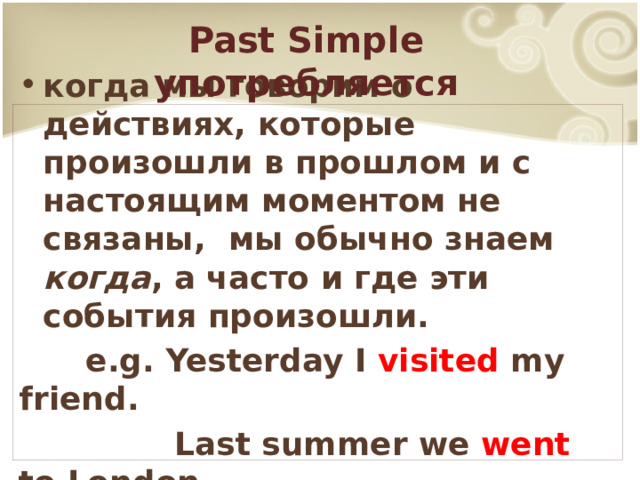
Past Simple употребляется когда мы говорим о действиях, которые произошли в прошлом и с настоящим моментом не связаны, мы обычно знаем когда , а часто и где эти события произошли.  e.g. Yesterday I visited my friend.  Last summer we went to London.
Past Simple употребляется

  • когда мы говорим о действиях, которые произошли в прошлом и с настоящим моментом не связаны, мы обычно знаем когда , а часто и где эти события произошли.

e.g. Yesterday I visited my friend.

Last summer we went to London.

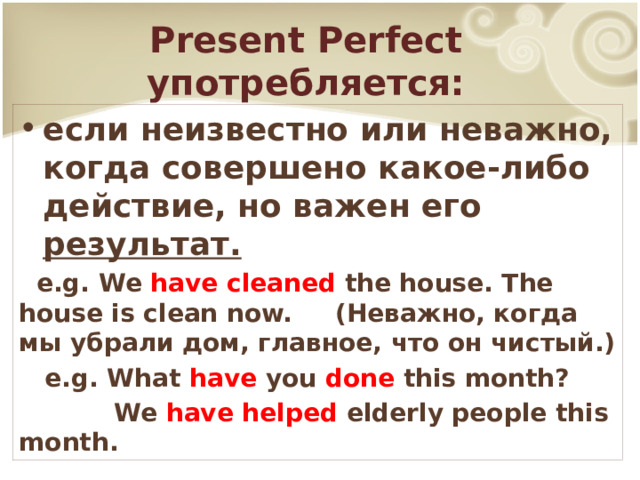
Present Perfect употребляется: если неизвестно или неважно, когда совершено какое-либо действие, но важен его результат.  e.g. We have cleaned the house. The house is clean now. (Неважно, когда мы убрали дом, главное, что он чистый.)  e.g. What have you done this month?  We have helped elderly people this month.
Present Perfect употребляется:

  • если неизвестно или неважно, когда совершено какое-либо действие, но важен его результат.

e.g. We have cleaned the house. The house is clean now. (Неважно, когда мы убрали дом, главное, что он чистый.)

e.g. What have you done this month?

We have helped elderly people this month.

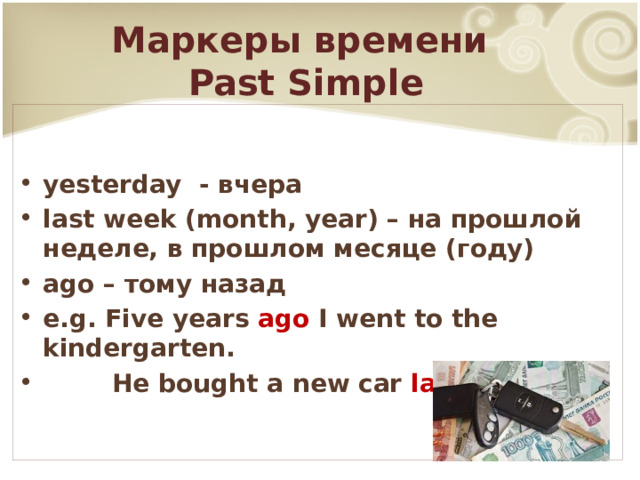
Маркеры времени  Past Simple yesterday - вчера last week (month, year) – на прошлой неделе, в прошлом месяце (году) ago – тому назад e.g. Five years ago I went to the kindergarten.  He bought a new car last month .

Маркеры времени Past Simple

  • yesterday - вчера
  • last week (month, year) – на прошлой неделе, в прошлом месяце (году)
  • ago – тому назад
  • e.g. Five years ago I went to the kindergarten.
  • He bought a new car last month .
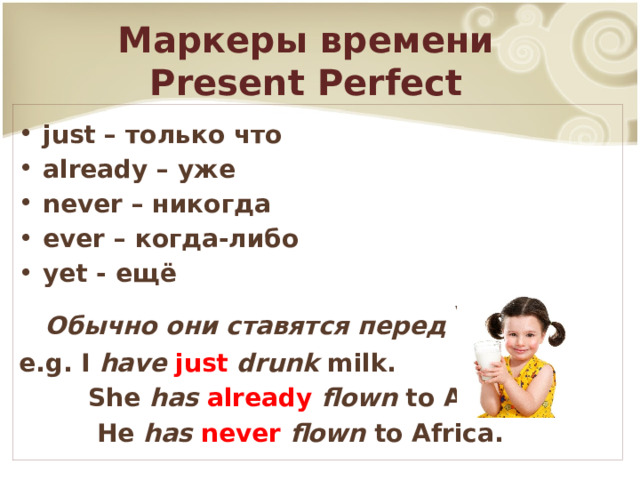
Маркеры времени  Present Perfect just – только что already – уже never – никогда ever – когда-либо yet - ещё  Обычно они ставятся перед V 3 e.g. I have  just  drunk milk.  She has  already  flown to America.  He has  never  flown to Africa.
Маркеры времени Present Perfect

  • just – только что
  • already – уже
  • never – никогда
  • ever – когда-либо
  • yet - ещё

Обычно они ставятся перед V 3

e.g. I have just drunk milk.

She has already flown to America.

He has never flown to Africa.

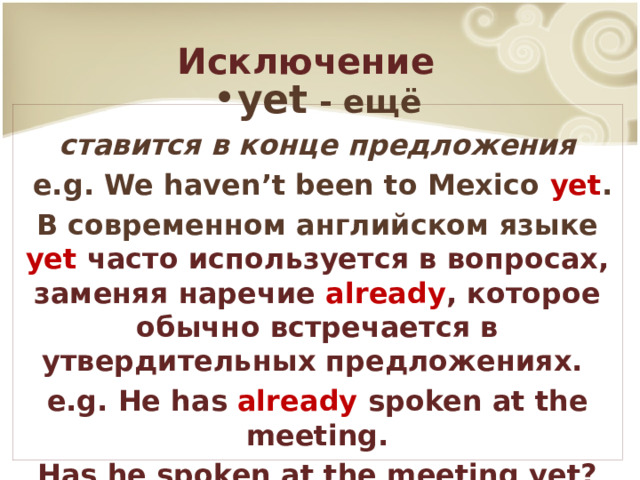
Исключение yet - ещё ставится в конце предложения  e.g. We haven’t been to Mexico yet . В современном английском языке yet  часто используется в вопросах, заменяя наречие already ,  которое обычно встречается в утвердительных предложениях. e.g. He has already spoken at the meeting. Has he spoken at the meeting yet?
Исключение

  • yet - ещё

ставится в конце предложения

e.g. We haven’t been to Mexico yet .

В современном английском языке yet часто используется в вопросах, заменяя наречие already , которое обычно встречается в утвердительных предложениях.

e.g. He has already spoken at the meeting.

Has he spoken at the meeting yet?

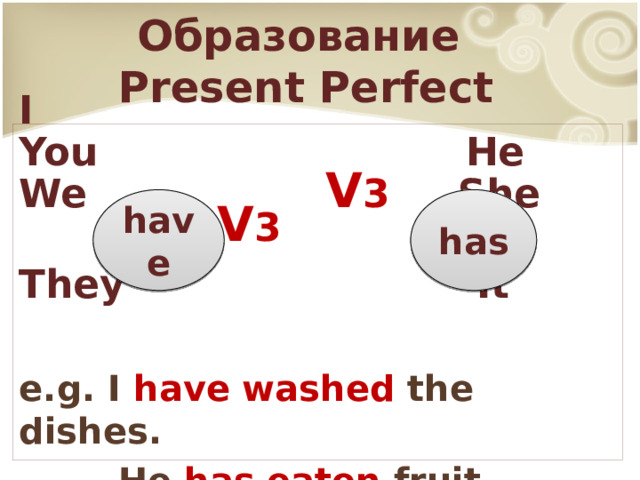
Образование  Present Perfect I  You  He We  V 3 She  V 3 They  It e.g. I have washed the dishes.  He has eaten fruit. have has
Образование Present Perfect

I

You He

We V 3 She V 3

They It

e.g. I have washed the dishes.

He has eaten fruit.

have

has

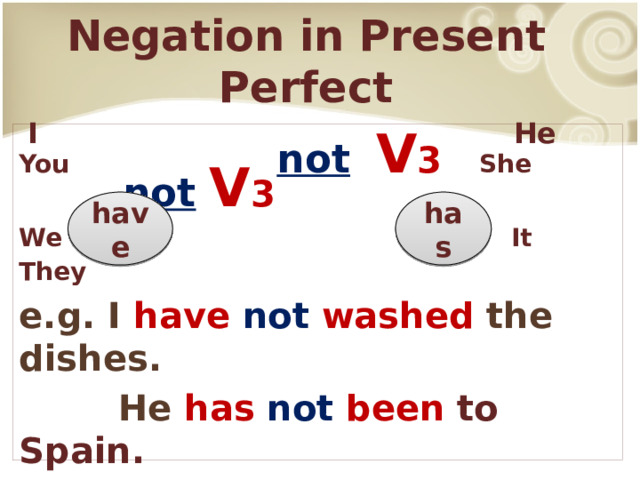
Negation in Present Perfect  I He You not  V 3 She not  V 3   We It They e.g. I have not washed the dishes.  He has not been to Spain. have has
Negation in Present Perfect

I He

You not V 3 She not V 3

We It

They

e.g. I have not washed the dishes.

He has not been to Spain.

have

has

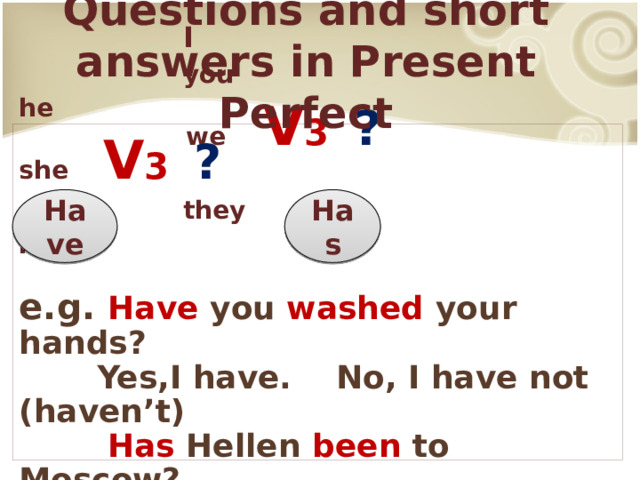
Questions and short answers in Present Perfect  I  you he  we V 3 ?  she V 3 ?  they it e.g. Have you washed your hands?  Yes,I have. No, I have not (haven’t)  Has Hellen been to Moscow?  Yes, she has. No, she has not (has’t) Have Has
Questions and short answers in Present Perfect

I

you he

we V 3 ? she V 3 ?

they it

e.g. Have you washed your hands?

Yes,I have. No, I have not (haven’t)

Has Hellen been to Moscow?

Yes, she has. No, she has not (has’t)

Have

Has

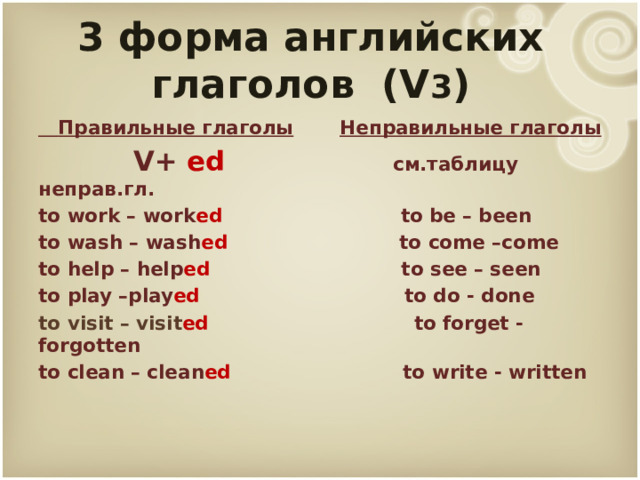
3 форма английских глаголов (V 3 )  Правильные глаголы  Неправильные глаголы  V+ ed  см.таблицу неправ.гл. to work – work ed to be – been to wash – wash ed to come –come to help – help ed to see – seen to play –play ed to do - done to visit – visit ed to forget - forgotten to clean – clean ed to write - written
3 форма английских глаголов (V 3 )

Правильные глаголы Неправильные глаголы

V+ ed см.таблицу неправ.гл.

to work – work ed to be – been

to wash – wash ed to come –come

to help – help ed to see – seen

to play –play ed to do - done

to visit – visit ed to forget - forgotten

to clean – clean ed to write - written

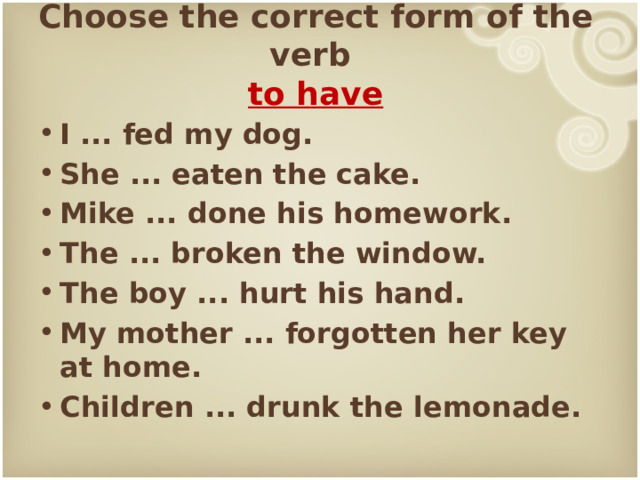
Choose the correct form of the verb  to have I ... fed my dog. She ... eaten the cake. Mike ... done his homework. The ... broken the window. The boy ... hurt his hand. My mother ... forgotten her key at home. Children ... drunk the lemonade.

Choose the correct form of the verb to have

  • I ... fed my dog.
  • She ... eaten the cake.
  • Mike ... done his homework.
  • The ... broken the window.
  • The boy ... hurt his hand.
  • My mother ... forgotten her key at home.
  • Children ... drunk the lemonade.
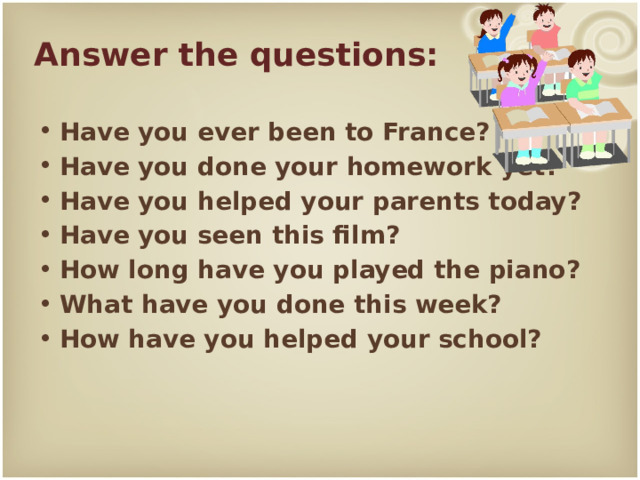
Answer the questions: Have you ever been to France? Have you done your homework yet? Have you helped your parents today? Have you seen this film? How long have you played the piano? What have you done this week? How have you helped your school?

Answer the questions:

  • Have you ever been to France?
  • Have you done your homework yet?
  • Have you helped your parents today?
  • Have you seen this film?
  • How long have you played the piano?
  • What have you done this week?
  • How have you helped your school?
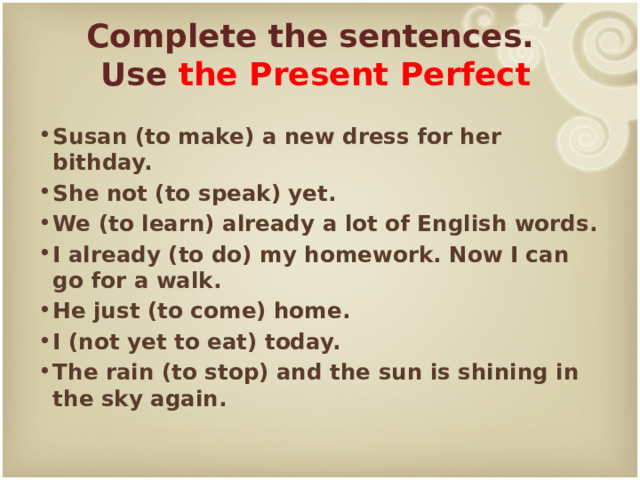
Complete the sentences.  Use the Present Perfect Susan (to make) a new dress for her bithday. She not (to speak) yet. We (to learn) already a lot of English words. I already (to do) my homework. Now I can go for a walk. He just (to come) home. I (not yet to eat) today. The rain (to stop) and the sun is shining in the sky again.
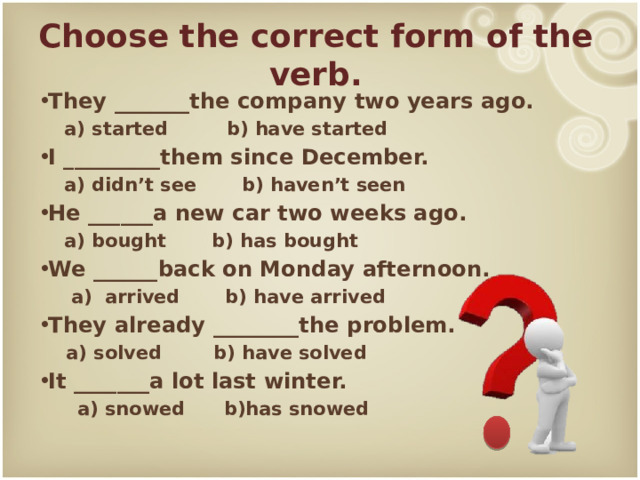
Complete the sentences. Use the Present Perfect

  • Susan (to make) a new dress for her bithday.
  • She not (to speak) yet.
  • We (to learn) already a lot of English words.
  • I already (to do) my homework. Now I can go for a walk.
  • He just (to come) home.
  • I (not yet to eat) today.
  • The rain (to stop) and the sun is shining in the sky again.
Choose the correct form of the verb. They _______the company two years ago.  a) started b) have started I _________them since December.  a) didn’t see b) haven’t seen He ______a new car two weeks ago.  a) bought b) has bought We ______back on Monday afternoon.  a) arrived b) have arrived They already ________the problem.  a) solved b) have solved It _______a lot last winter.  a) snowed b)has snowed
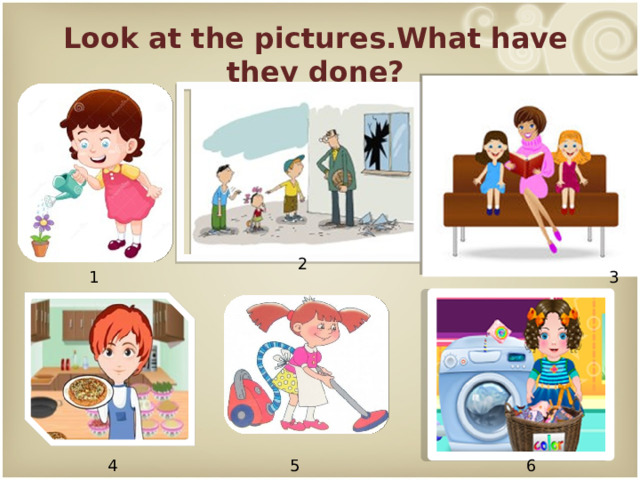
Choose the correct form of the verb.

  • They _______the company two years ago.

a) started b) have started

  • I _________them since December.

a) didn’t see b) haven’t seen

  • He ______a new car two weeks ago.

a) bought b) has bought

  • We ______back on Monday afternoon.

a) arrived b) have arrived

  • They already ________the problem.

a) solved b) have solved

  • It _______a lot last winter.

a) snowed b)has snowed

Look at the pictures.What have they done? 2 1 3 4 5 6
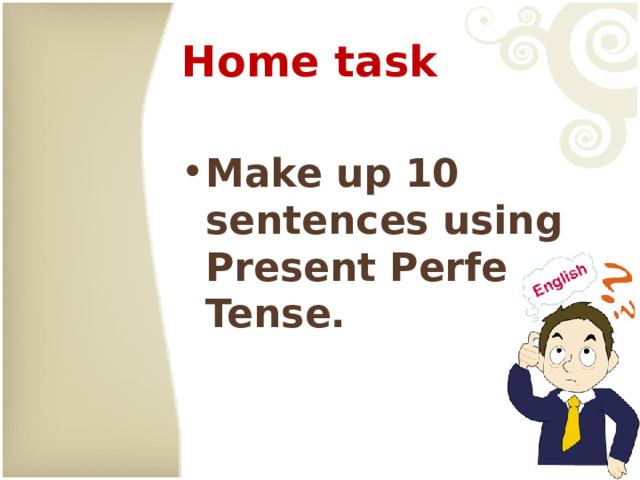
Look at the pictures.What have they done?

2

1

3

4

5

6

Home task Make up 10 sentences using Present Perfect Tense.

Home task

  • Make up 10 sentences using Present Perfect Tense.
-80%
Курсы повышения квалификации

Психология межличностных отношений и общения

Продолжительность 144 часа
Документ: Удостоверение о повышении квалификации
6000 руб.
1200 руб.
Подробнее
Сохранить у себя:
Present Perfect (3.15 MB)

Комментарии 0

Чтобы добавить комментарий зарегистрируйтесь или на сайт

Вы смотрели