Demonstrative Lesson
Theme: Going to Britain
For 7 grade students
Aim: to know more about the country
of the learnt language
Tasks: learn to collect country study information
improve speaking and grammar skills
let pupils interest in language
Lesson Plan
Beginning of the lesson
Greetings of the pupils
Preliminary moment
Present lesson theme
Reading and speaking sector
Grammar sector
Phonetic drills and vocabulary skills
Procedure of the lesson
Dear boys and girls. Today we are going to travel about English- speaking country. We are going to travel about Great Britain. You know that this country is the main country the language of which we study at school. And you know that nowadays English is the most popular language in the world. Our task today is to learn and to know it very well in order to be the most successful people.
Now I want you to look at the map of Great Britain. The full name of this country is THE UNITED KINGDOM OF GREAT BRITAIN AND NORTHERN IRELAND. If you look at the map of the country you will see 4 parts of it. Every part has its own name. Their names are: ENGLAND, SCOTLAND, WALES, NORTHERN IRELAND (the teacher shows the countries on the map).
ENGLAND is in the South
SCOTLAND is in the North
WALES is in the South-West
NORTHERN IRLAND is in the North-West side
As you see at the map Great Britain is washed by 2 oceans: ATLANTIC and PACIFIC. Now we shall talk about the capitals of these countries. Children, please, tell me:
WHAT IS THE CAPITAL OF GREAT BRITAIN? (London)
And now we shall learn what the names of other capitals are. May be somebody knows them? Don’t you?
ENGLAND LONDON
SCOTLAND EDINBURGH
WALES CARDIFF
N. IRELAND BELFAST
Children, do you know any English-speaking countries? Can you name them?
(children give names of the countries they remember: the USA, New Zealand, Africa, Australia, India, Canada).Please, children, answer the question:
What is the capital of the USA? (Canada, New Zealand, Australia, India, Africa)
Children, you know that there are a lot of nations in the world. And now we shall study the slide 1 THE COUNTRY/ THE NATIONALITY where you should find the right variant of the country and nationality.

Now we shall speak about things with the help of which the country is famous for…
Look at the next slide 2 WHAT THEY ARE FAMOUS FOR… and make up sentences with the expressions.

OK, children. Thank you for your sentences. Now you know which nationality is famous for. Can you add some information, some more examples on the topic? ( children give their examples). And now, children, look at the next slide. You can see in it the next task for you.
Slide 3 NATIONAL CURRENCY. You know that every country has its own money they use. Your task is to put the suitable currency to the correct country (children do the task).
Now, children, you should remember the story I have told you about Great Britain and the countries that are the part of it. So, look at the next slide.

Slide 4. COMPLETE THE SENTENCES. Your task is to look at them and finish them.
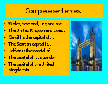
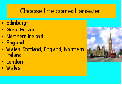
Slide 5 CHOOSE THE CORRECT ANSWER Look at the answers of the sentences and check up your own answers to the task. Are they correct? If they are not, then correct them.
OK, children. We have come to the TEXT which is worth to read in order to learn more information about Great Britain (children read the text and translate it – work with the book).
So, children, we have read the text, understood it and now we should look at the next slide.
Slide 6 DETAILS ABOUT THE TEXT. Your task is to read the sentences from the slide and finish them or put the correct word from the text. Please, children, do this task in your exercise-books. OK. Did you do the task? Then let’s check up your answers in the next slide.


Slide 7 FIND THE CORRECT ANSWER . Look at the answers in your exercise-books and compare them with the answers in the slide. Now we shall check up your knowledge of the text content, children.
Slide 8 ANSWER THE QUESTIONS. Your next task is to look at the following slide and show your skills in speaking by giving the right answers to the questions about the text. If you do the task correctly it will mean that the text is understood. Thank you for your job on the task.

And now we have come to the GRAMMAR STATION. Today we are going to study Modal Verbs- MUST должен
HAVE TO обязан, придется
NEED. The meanings of these verbs are: нужен, нуждаться
(проводится объяснение грамматического материала, употребление модальных глаголов в предложениях, их функция в предложении и роль).
Now look at the next slide and read the sentences. Then you should translate them using the grammar rules and your vocabulary.
Slide 9 GRAMMAR IN USE (children do the task in their exercise-books or if they wish they can do it orally. They should put the Modal verbs in brackets). The following slide will help pupils to do the task correctly.
Slide 10 PUT VERBS INTO SENTENCES This slide will teach you to put the correct Modal verbs into the correct sentences. Your task is to guess the right verb and put it in the right sentence. The following slide will show the children which verb and where to put correctly.


Slide 11 CHOOSE THE CORRECT WORD
OK, the grammar station has been done by you correctly. Now I want you to be attentive and correct because the following slide is going to teach you to read words and to show us your skills in reading.
Slide 12 READ THE WORDS CORRECTLY The task of the slide is: the children should read the words from the slide with the SOUNDS: SH, CH


Well, children. Are you ready to read the words? Are you ready to divide them into 2 groups? Do you know the translation of these words? Who will translate the words? (children give the translation of the words).
SH CH
British cheap
show change
should teach
sure each
shoulder chair
shelf chip
peach
cherry
OK, children. I think our lesson was very interesting and you have worked very hard. You have got a great pleasure of the lesson, haven’t you? So, our lesson is over. Thank you very much for your answers and your work. All of you have got excellent marks.
Your home task is: learn grammar, make up 5 sentences on Modal verbs.

 Получите свидетельство
 Вход
Вход




 Урок английского языка "Going to Britain" (1.62 MB)
 0
0 1330
1330 144
144 Нравится
0
Нравится
0


