
 Получите свидетельство
 Вход
Вход



Date:
The form: 9
The theme: Music keeps me happy
The aim: to teach about music
The mission: 1) to give explanation of kinds of music
2) to educate them by behavior
3) to develop their thinking
The type of the lesson: giving new material
The method: conversational, questionnaire
The plan of the lesson: I. Organizational moment
Phonetic drill
Revising irregular verbs
II. Checking homework
III. New theme
IV. Giving home task
The procedure of the lesson: I. Organizational moment/ Good morning, how are you? What day is it today? What date is today?
Phonetic drill
I can to swim
I can to run
I can speak English too
I love the learning English
And what about you?
Revising irregular verbs
II. Checking up the homework
III. New theme
6 (b) Writing
Your mood leaves much to be desired… Everything around is getting difficult to do… It seems that this will last forever and there are no changes for better to wait for. But still there’s one thing that may make you happier. This is your favourite music. Why not write about this in your music essay?
Write a small composition: Music keeps me happy
7 a) Read the texts about museums in Almaty.
The State Museum of National Musical Instruments
The State Musum of National Musical Instruments was created in 1980. It is one of the cultural sights of “ The Soputhern Capital”. Kazakh musical instruments have been collected in the Museum from all regions of Kazakhstan, as well as from the CIS countries and other parts of the world. The collection includes personal dombras of poets, zhyrau and composers, such as: Abai, Zhambyl, Makhambet. Amre, Dina and other figures of the musical arts. The Museum is located in a traditional Russian wooden building, dating to 1907.
The A. Kasteyev State Museum of ArtsThe State Arts Museum named after A.Kasteyev includes over 20 thousand exhibits in its collection (painting, graphics, sculpture, thetre, and decorative art.) It is a member of ICOM, the International Confederation of Museums. There are fourteen permanent, IV. Giving home task Ex 7c translate. 7 b, ex 8 p 54
Date:
The form:9
The theme: Art
The aim: to teach about art, describe the meaning.
The mission: 1) to teach about art, give information about art
2) to educate being in good manners
3) to develop their manners, behavior
The plan of the lesson: I. Organizational moment
Phonetic drill
Revising irregular verbs
II. Checking home work
III. New theme
IV. Giving home task
The procedure of the lesson: I. Organizational moment Good morning, I’m glad to see you! What day is it today? Who is on duty today? Who is absent today?
Phonetic drill
Six honest serving men
They taught all I knew
Their names are what and why
Where and who
Revising irregular verbs
II. Checking up the home work. What exercise will be given for?
III. New theme
Ex. 1 Read and answer the question: What’s the text about?
#19
Art gives people the ideas that life could be more beautiful, bigger and better. In the 21 century everyone can enjoy art, and we don’t have to go to museums or art galleries to find it. Art is everywhere – on the streets, in the cinemas, on TV. It can last for three minutes - e.g. pop record or for many years - a painting or a photograph. It can be made by anyone for everyone.
2. Read and complete the sentences below.
A – I think it’s terrible to paint pictures on walls.
B – I think it’s fun!
A – But most of them are not very good and make the streets look dirty!
B – But I think it’s good to see what people do. To me it makes the streets more interesting!
What do you think?
I agree with__________________________________________________
My parents agree with__________________________________________
A – Do you call this pop music “art”?
B – Yes, and millions of people love it.
A – That doesn’t mean it’s good.
B – Well, I think if many people like something it’s good.
What do you think? I agree with_______________________________________________
My parents agree with_______________________________________
Conclusion we have studied the theme art.
IV. Giving home task ex6 p 56
Date:
The form: 9
The theme: Art
The aim: to teach about art and kinds of arts
The mission: 1) to give explanation to kinds of arts to the pupils
2) to educate them by their behavior
3) to develop their speaking
The plan of the lesson: I. Organizational moment
phonetic drill
revising irregular verbs
II. Checking home work
III. New theme
IV. Giving home task
The procedure of the lesson: I.Organizational moment Good day, how are you? I’m glad to see you!
Who is on duty today? Who is absent today?
phonetic drill
Four little kittens
Lost their mittens
They don’t know what to do
What is their mother do?
revising irregular verbs.
II. Checking home work
III. New theme
#20
3. Put the correct word from the following list in each space below.
On at to by of about
I often go_________discos and parties.
We stayed_________a cheap hotel.
She sunbathes________the beach.
I’m very keen________music.
I spend a lot of time________concerts.
He stays_____his aunt’s.
He wants to learn _________other countries.
He wants to learn _________other countries.
I’m very fond________the open air.
We stopped _______camsite.
They prefer to be close ________nature.
I’m going there_______plane.
Practise your grammar
4. Matching. Make sentences from the chart.
| A | B | C | D |
| I couldn’t answer the question I was angry I was pleased I was tired My father is furious My mother was worried |
because I
|
had hadn’t | eaten all day. studied well. slept badly. visited him for a long time. passed my driving test. |
#20
5. Write each pair of sentences in your notebook, one sentence using the Past Perfect and because.
1. They run out of food. Paul had a party the night before.
They ran out of food because Paul had had a part the night before.
2. The class was empty. Everybody went home early.
_____________________________________________
3. She found the book. Marat told them where it was.
_____________________________________________
4. We got up early. My aunt told us she was coming to see us at ten.
_______________________________________________
5. He had an argument with Mary. She didn’t send him the money.
_________________________________________________
6. She couldn’t go to the canteen. She left her pocket – money at home.
__________________________________________________
Reading
6. Answer the following questions.
a) What are your favourite types of programme?
b) How do you watch television? (do you plan carefully, record, watch everything)
c) How many hours a day do you watch television?
Conclusion. I hope that you understand the theme art.
IV. Giving home task ex.9 p 57
#21
Date:
The form: 9
The theme: dream vacation
The aim: to teach about speak dream vacation, their thinking, ideas
The mission: 1) to teach speak about their opinions
2) to educate them by behavior
3) to develop their intonation, to improve their pronunciation
The type of the lesson: new lesson
The method: explaining, group work, individual work
The plan of the lesson: I. Organizational moment
Phonetic drill
Revising irregular verbs
II. Checking home work
III. New theme
IV. Giving home task
The procedure of the lesson: I. Organizational moment. Good morning, how are you? Who is on duty today? Who is absent today?
Phonetic drill
If the weather is wet
We must not fret.
When the weather is cold
We must not scold
When the weather is warm
We must not storm –
But be thankful together
Whatever the weather
b.revising irregular verbs
II. Checking home work
#21
III. New theme
Think of your dream vacation: what kind of places will you visit? Who will you take with you?
Example:
Omar: I will visit Venice, it’s in Italy. I will take my mother because I love her and know that her dream is to see this unusual city.
Asel: I think I will visit St. Peterburg. I wish to see its famous museum Hermitage. Who shall I take with me? I can take Marina. She is a good friend and we like spending our free time together.
2. Read. “Dream vacation”
Kuralai: When I go on my dream vacation I am going to fly all over the world. I will mainly see large cities. Maybe I will begin my trip in New York. There I hope to see the Statue of Liberty.
Then I’m going to fly to Paris. Probably I will to see the Eiffel Tower, the Louvre and Notre Dame Cathedral. I’m also going to eat croissants.
Next I will fly to Rio-de-Janeiro and Cairo. In Rio I will definitely learn to dance samba. When I get to Cairo I will see the Nile River. Maybe I will see the Pyramids at Giza.
Then I am going to fly –to Melbourne, but probably I will stay only a few days in the city. I want to travel in the country and see the special animals like kangaroos and koala bears. Then I am going to fly to Tokio. I hope to see the traditional city of Kyoto. Maybe I will try on a kimono there.
My last country will be Kazakhstan because this is where I live. I will be happy to be home again because “East or West Home is best!”
IV. Giving home task ex 3.4 p62
Date:
The form:9
The theme: London
The aim: to teach about London
The mission: 1) to teach and give information about London.
2) to educate them being active
3) to develop their listening skills
The type of the lesson: educational
The method: group work, explanation, inductive-deductive
The plan of the lesson: I. Organizational moment
Phonetic drill
Revising irregular verbs
II. Checking home work
III. New theme
IV. Giving home task
The procedure of the lesson: I. Organizational moment. Good morning, how are you? What day is it today?
Phonetic drill
Six little kittens
Lost their mittens
It’s so pity
They were so pretty
Revising irregular verbs
II. Checking home work
III. New theme
#23
Reading
Listen and read. Transport in London.
If it has two floors it’s called a double-decker and you can get a good view from the top. If it has only one floor it’s called a single-decker.
Buses have a two person crew it’s a driver who drives, of course, and the conductor (or the conductress if it’s a woman) who takes your money. Keep your ticket as the inspector might want to check it. You catch a bus at bus stop.
For longer distances take a long –distance bus called a coach which is slower but cheaper.
A double decker bus has an upstairs (top) and a downstairs (inside).
The use of the word “inside” for the lower deck dates from the early days when the top was open, so that only passengers on the lower deck was open, so that only passengers on the lower deck were inside. People queue for buses in Britain.
But you shouldn’t jump the queue: people don’t like it. Only a limited number is allowed to stand inside. And no one may stand on top. Smoking in allowed on top but you cannot smoke inside.
What is the difference between …
Conductor and conductress,
Inspector and bus driver,
Single – decker and double – decker,
Bus and coach
Make the sentences as shown in the example.
The bus having only one floor is a single-decker.
The bus______________is a double-decker.
The person ____________ is adriver.
The man ____________is aconductor.
The man ___________ is an inspaector.
#23
Conclusion. Today we have a theme about London. This city is a capital of Great Britain.
IV. Giving home task ex3 p67
Date:
The form:9
The theme: London
The aim: to teach and give new information about London
The mission: 1) to give information about London.
2) to educate them being cultural
3) to develop their listening skills
The type of the lesson: educational lesson
The method: group work, explanation, inductive-deductive
The plan of the lesson: I. Organizational moment
Phonetic drill
Revising irregular verbs
II. Checking home work
III. New theme
IV. Giving home task
The procedure of the lesson: I. Organizational moment. Good morning, how are you? What day is it today?
a.Phonetic drill
Little Bill, sit still
Will you sit still, little Bill?
If you sit still, little Bill,
Jimmy Nill bring you to a big hill.
b. revising irregular verbs
II. Check up the home work.
5. Study this activities. Use a dictionary.
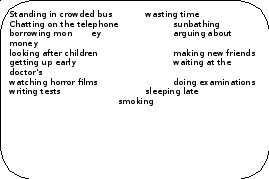

6. Make sentences about yourself.
1. You usually try to avoid. I usually try to avoid standing in crowded buses.
2. You dislike … .
Avoid - қашқақтау
3. You enjoy … .
4. You often feel like … .
5. You would like to give up …
6. You don’t mind … .
7. You often try to put off …
8. You don’t like to risk … .
7. Interview a partner. Report to the class about him / her. Don’t tell the name. The class should guess.
For example:
Omar: The person I interviewed enjoys watching horror films.
But he dislikes writing tests and doing examinations.
Prepositions 8. Read Going…
by car, bus, taxi, plane, sea, ship, bike;
in a bus, a train, an elevator, a car;
for a walk, a drive, a ride, a run, a swim;
on a subway, a cruise, a tour, an outing, foot, a bike, a plane.
Talk to your partner. Ask each other these questions. Use the phrases above to answer them.
How exactly did you get to school today?
What did you do last weekend?
How would you get from school all the way to the top of the Hotel “Kazakhstan”?
What’s your favorite way of travelling? IV. giving home task ex7 p 68 learn by heart ex8 p
Date:
The form:9
The theme: Transport
The aim: to teach about transport
The mission: 1) to teach and give information about kinds of transport.
2) to educate them being active
3) to develop their listening skills
The type of the lesson: discussion
The method: group work, explanation, inductive-deductive
The plan of the lesson: I. Organizational moment
a.Phonetic drill
b.Revising irregular verbs
II. Checking home work
III. New theme
IV. Giving home task
The procedure of the lesson: I. Organizational moment. Good morning, how are you? What day is it today?
a.Phonetic drill
Solomon Grundy
Solomom Grundy
Born on Monday
Christened on Tuesday
Married on Wednesday
Ill on Thursday
Worse on Friday
#25
Died on Saturday
Buried on Sunday
That was the end
of Solomon Grundy
Revising irregular verbs
II. Checking up home work
III. New theme
Trains
Speaking
1.Choose one kind of transport and complete the table. Which statements are true for the transport you’ve chosen?
Write √ or x.
Example:
| Transport taxi | √ | x |
| √
√ √
|
x
x |
| Transport |
| x |
|
|
|
Discuss your answers with your partner. Make sentences like this:
Travelling by taxi is comfortable but expencive.\These are adjectives describing public transport. Can you add some more adjectives. Complete the chart of opposite pairs, add 3 more adjectives. Draw a table of this kind in your notebook. IV. Giving home task Ex 2 Texts A, B. p70
Date:
The form:9
The theme: Transport
The aim: to teach about transport
The mission: 1) to teach and give information about kinds of transport.
2) to educate them being active
3) to develop their listening skills
The type of the lesson: discussion, continuing with new materials
The method: group work, explanation, inductive-deductive
The plan of the lesson: I. Organizational moment
a.Phonetic drill
b.Revising irregular verbs
II. Checking home work
III. New theme
IV. Giving home task
The procedure of the lesson: I. Organizational moment. Good morning, how are you? What day is it today?
a.Phonetic drill
Mother and Father
Mother is the dearest
Of all the friends I know
She helps me work and helps me play
That’s why I love her so
Father is the kindest
Of all friends I know
#26
He likes to take me out with him
That’s why I love him so.
Revising irregular verbs
II. Checking the home work
III. New theme
Can you guess the meaning of these words? Why? What do they mean in your language?
Brilliant restaurant company
Express journalist politician
technology maximum diplomat
5. These are the answers. Make questions.
1. …members of European Royal Families.
2 … because travelling by air became cheaper.
3. … France, Germany and Britain.
4. …The top of speed of TGV is 200, APT is 160, Transrapid is 250.
7. Grammar: Articles
Mind the use of the article “the”
Can you add more examples to each list?
Mountain groups: the Rockies, the Tyan –Shyan, …
Oceans: seas, rivers: the Atlantic, the Kapchagai, the Seine …
Hotels: the “Hilton”, the :Kazakhstan”
Museums and Galleries: the National Gallery, the British museum …
Countries: France, Kazakhstan …
States: Texas, Maryland …
Cities: Toronto, Astana …
#26
Streets: Wall Street ..
Lakes: Balkash ..
Conclusion, today we have studied about transports in London and our transports, we get to know about articles.
IV. Giving home task ex 7 . 8 p72
Date:
The form:9
The theme: Air travelling
The aim: to teach about travelling by air
The mission: 1) to teach and give information about flights.
2) to educate them being active
3) to develop their listening skills
The type of the lesson: discussion
The method: group work, explanation, inductive-deductive
The plan of the lesson: I. Organizational moment
a.Phonetic drill
b.Revising irregular verbs
II. Checking home work
III. New theme
IV. Giving home task
The procedure of the lesson: I. Organizational moment. Good morning, how are you? What day is it today?
a.Phonetic drill
Pussy –cat
Pussy – cat, pussy – cat, where have you been?
I’ve been to London to look at the queen.
Pussy – cat, pussy – cat what did you there?
I frightened a little mouse under the chair.
b. revising irregular verbs
b.Revising irregular verbs
#27
II. Checking home work
III. New theme
Speaking
Get into groups of three people and discuss the following questions.
Are planes really safer than cars? (A British study shows that flying is 176 times than walking, 15 times safer than driving and 300 times safer than motorbike.)
What are the advantages of travelling by airplane?
Have you ever seen a female pilot? Why do you think that most pilots are men?
Do you know someone who is afraid of flying in an airplane?
How old were when you went on your first flight? Where did you go?
What was the longest flight you have ever taken?
Vocabulary
Read the questions and match the definitions for the boldfaced words:
Questions about flying
Definitions
Is there a flight to London, please?
Is it a direct flight, or do I have to change planes?
Do they serve food? What terminal does it leave from?
Is there an airport bus?
Can I have a window / aisle seat?
What time does it take off?
What time does it land?
Reporting your presence at an airport
An instance of travelling by air
Station where transport vehicles load or unload passengers or goods
Depart from the ground
Passageway between seating areas as in a passenger vehicle
The act of coming down to the earth
A flight with one or more intermediate stops but no change of aircraft
Help with food or drink
Look at the title and read these words. What connection do you think they have with the text?
Engine trouble cannibalism football
Nervous Nassreddin drink heavily
Africa pilot Scotland
Read
Group A reads text A.
Group b reads text B.
Conclusion we have studied the travelling by air. You understood that you should be careful.
V. Giving home task ex 3.4 p 75
Date:
The form:9
The theme: A typical day at school
The aim: to teach about school’s day
The mission: 1) to teach and give information about schools
2) to educate them by behavior
3) to develop their speaking and reading
The type of the lesson: complex and fixing
The methods: questionnaire discussion
The plan of the lesson: I. Organizational moment
a.phonetic drill
b.revising irregular verbs
II.Checking up home work
III.New theme
IV.Giving home task
The procedure of the lesson: I. Organizational moment. Good morning, how are you? Who is on duty today? Who is absent today?
a.Phonetic drill
Ebenezer Sneezer
Topsy –Turvey man
Rises upon his elbows
Every time he can
Whistles Yankee doodle
Every time it pours
Wraps himself in paper
#35
Every time he shores
Oh, E-b-e-nee-zer –Snee-zer
What a man, A-choo!
b.revising irregulllar verbs
II.Checking home work
III. New theme
Speaking
1). a) Talk to your partner. Speak about your typical day at school.
b) What questions would you like to ask about a typical day in this school. Write as many questions as possible.
Example: When do your lessons start?
_______________________________________________________________
5. Talk to your partner.
Speak about a typical school day in Great Britain.
Example: A typical day at school starts at 8:40 a.m.
6.Make a list of things which are different from your school and compare your sentences with partners.
Example: They have a long break for lunch.
7.Look at the conventional British school timetable.
| 9.00
9.30-10.45 10.45-11.00 11.00 | Morning children arrive for registration Lessons Morning break lessons
| 1.15-2.15
2.15-3.30 2.30-3.30 3.30 | Afternoon lessons
afternoon break lessons children do home |
#35
It’s mainly primary schools, for children of 5-11 years, which have an afternoon break.
8.Make a timetable of your school day similar to the timetable for the conventional British school.
Conclusion. Today we have talked about a typical school days. I hope that everybody of yours can speak about it.
IV.Giving home task Ex.13 p.91
Date:
The form: 9
The theme: The most important thing in a job
The aim: to teach and give information about jobs
The mission: 1) to teach and give them grammar materials
2) to educate them being disciplined
3) to develop their knowledge
The type of the lesson: fixing lesson
The method: questionnaire, pair work
The plan of the lesson: I. Organizational moment
a.phonetic drill
b.revising irregular verbs
II.Checking home work
III.New theme
IV.Giving home task
The procedure of the lesson: I. Organizational moment. How are you? What date is it today? What month is today?
Who is on duty today? Who is absent today? a.Phonetic drill
Why did you talk and not listen?
Why did you eat and not drink?
What really should I think?
Come and go; smile and cry
In and out whisper and shout
Now you can tell me
What’s all about… b.revising irregular verbs
II.Checking home work
Let’s to check up your home work. What task was you given for?
III.New theme
7.Complete the interview questions and match to the answers.
What is _________name? I’m sixteen.
How much__________ get? Yes, I love my job.
What_________you do? $60 every week.
(What__________your job?) I deliver letters
(____you like your job?) 3 days a week.
How ____days a week do you work? My name is Jennnifer. How __are you? Conti.
8.Talk to your partner / class.
a. Is it easy to find a job?
b. Is selling newspapers, magazines an easy job?
c. Is it a full-time or a part-time job?
10. Choose the right answer.
1.He has been living on the street
a. for a month
b. for 2 years
c. for a year
2. Why did he come to London?
a. to live there
b. to look for a job
c. to study at the London University
3. What magazine has he been selling foe six months?
a. The Times b. The Big Issue c. The Fashion
4. What people can’t he stand?
a. who talk a lot b. who sleep a lot c. who drink or take drugs
5. How many copies does he sell a day?
a. usually about 10 b. usually about 50 c. usually about 100
Conclusion we have studied about part –time jobs
IV.Giving home task ex 14 p 158 ex 17 p 159
Date:
The form:9
The theme: Earth
The aim: to teach about earth and its ecological problems
The mission: 1) to teach and give information about ecology and nature
2) to educate them by behavior and being active
3) to develop their speaking and reading
The type of the lesson: new lesson
The methods: group work
The plan of the lesson: I. Organizational moment
a.phonetic drill
b.revising irregular verbs
II.Checking up home work
III.New theme
IV.Giving home task
The procedure of the lesson: I. Organizational moment. Good morning, how are you? Who is on duty today? Who is absent today?
a.Phonetic drill
Me
In space there is a galaxy
In the galaxy there is a sun
Near the sun there is a planet
On the planet there is a ocean.
Near the ocean there is a continent.
On the continent there is a country.
In the country there is city.
In the city there is park.
In the park there is house.
On the house there is a bedroom.
In the bedroom there is a bed.
And in the bed there is me.
#48
b.revising irregular verbs.
II.Checking home work
III.New theme
1.Talk to your partner.
a.Do you celebrate Earth Day in your city / town / village?
b.Which country celebrates earth Day?
c.Which country is it on the map?
Mark the capital of this country on the map.
2.Match a line in A with a line in B.
| A | B |
| Reduce Protect Make Predict Solve Test Save Сelebrate Participate in | an investment in the Energy Star Programme pollution the ecological problems the public health the environment money demonstration millions of tons of harmful pollutants |
Date:
The form:9
The theme: School problems
The aim: to teach about school problems
The mission: 1) to teach and give information about problems which happens on school
2) to educate them by behavior and being active
3) to develop their speaking and reading
The type of the lesson: complex
The methods: questionnaire discussion
The plan of the lesson: I. Organizational moment
a.phonetic drill
b.revising irregular verbs
II.Checking up home work
III.New theme
IV.Giving home task
The procedure of the lesson: I. Organizational moment. Good morning, how are you? Who is on duty today? Who is absent today?
a.Phonetic drill
Yankee – Doodle went to London
Riding on a pony
Stuck a feather in his hat
And called it macaroni
Yankee –Doodle keep it up
Yankee –Doodle dandy
#37
Mind the music and the steps
And with the girls be handy!
b.revising irregular verbs
II.Checking up home work
III. New theme
 1.Schoolchildren often have complaints about school. What can they complain about? Draw a table of this kind in your notebook.





School complaints
2.Compare your diagram with others.
Speaking3.Talk to your partner. What kind of complaints do you have about your school?
* teachers
* rules
*school uniform
*timetable
*after –school activities
*discipline
*location
4.Talk to your partner.Do you have any problems with your parents, teachers, classmates?
Conclusion. Today we have discussed about school problems.
IV. Giving home task ex5 p92
Date:
The form:9
The theme: School problems
The aim: to teach about school problems
The mission: 1) to teach and give information about problems which happens on school
2) to educate them by behavior and being active
3) to develop their speaking and reading
The type of the lesson: complex and fixing
The methods: questionnaire discussion
The plan of the lesson: I. Organizational moment
a.phonetic drill
b.revising irregular verbs
II.Checking up home work
III.New theme
IV.Giving home task
The procedure of the lesson: I. Organizational moment. Good morning, how are you? Who is on duty today? Who is absent today?
a.Phonetic drill
I’m a little tea –pot
Short and stout
Here is my handle,
Here is my spout
When you tip me over, then
Look up!
#38
Hip, Hurray! The water is out!
b.revising irregular verbs
II.Checking up home work
III.New theme
 5 b) Meet with your group to discuss the problems and your roles.


c) after the discussion in a group, organize a meeting to discuss the case in a School Court.
* What other problems would you suggest for discussion in School Court?
* write a list of problems you would like to discuss. Compare them with your classmates’ list.
Number and Dates
7.Say the numbers.
14 207 169 40 53 98
80 13 18 450 1,245 4,000 700,000 6,000,000
Conclusion Today we have talked about school problems you have played roles.
IV.Giving home task ex9 p95
Date:
The form:9
The theme: First conditional
The aim: to teach about conditionals
The mission: 1) to teach and give information about grammar rules
2) to educate them by behavior and being active
3) to develop their speaking and reading
The type of the lesson: new lesson
The methods: questionnaire discussion
The plan of the lesson: I. Organizational moment
a.phonetic drill
b.revising irregular verbs
II.Checking up home work
III.New theme
IV.Giving home task
The procedure of the lesson: I. Organizational moment. Good morning, how are you? Who is on duty today? Who is absent today?
a.Phonetic drill
Snow came in the night
Without a sound
Like a white cloud trembling
Down to the ground
b.revising irregular verbs
II.Checking up home work
III.New theme
#39
1.Read.
Asel needs a dictionary.
She’ll go to a bookshop if she has time.
If she’ll go to a bookshop if she has time.
If she finds a dictionary, she’ll buy it.
2.Match the two halves of these sentences.
They’ll come and visit us we’ll stay at home.
If the weather is nice, if I am not busy.
I’ll go to the cinema we’ll go out for a walk.
If it rains, if we invite them.
First conditional
Future Simple + if + Present Simple
I will go if I have time.
The First conditional expresses a possible situation and its result.


If it rains
I’ll stay at home.
=the condition
=possible and real
=
the result
Conclusion today we have studied about conditionals. I hope that you understood it.
IV.Giving home task ex3 p95
Date:
The form:9
The theme: Сonditionals
The aim: to teach about conditionals
The mission: 1) to teach and give information about grammar rules
2) to educate them by behavior and being active
3) to develop their speaking and reading
The type of the lesson: new lesson
The methods: questionnaire discussion
The plan of the lesson: I. Organizational moment
a.phonetic drill
b.revising irregular verbs
II.Checking up home work
III.New theme
IV.Giving home task
The procedure of the lesson: I. Organizational moment. Good morning, how are you? Who is on duty today? Who is absent today?
a.Phonetic drill
Rain, rain go away
Come again another day
Rain, rain go away
Little Johny wants to play
b.revising irregular verbs
II.Checking home work
III.New theme
#40
7.Talk to your partner. Lokk at the picture on page96. What are Bolat’s other dreams?


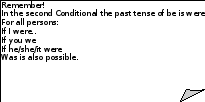
Second Conditional
The Second Conditional expresses an unreal situation and its result.
If I had much money,
I would (I’d) travel all over the world.
=the condition
=impossible and unreal
the result
8.Talk to your partner.
How would your life change if your father became a millionaire? If my father became a millionaire we … .
Studying abroad.
Every year many students go abroad to study.
9. Talk to your partner.
If you had a chance to study abroad
a.Which country would you go?
b.What subjects would you study?
c.What things would you have to do before you leave?
d.What things would you need to take with you?
e.What kind of things would you have to buy?
f.Would you stay at a hostel or with a family?
g.What problems would you have?
h.How would you keep in touch with your parents?
Conclusion. Today we have studied about Second Conditional sentence. Now you have known that we can use sentences when we want to tell about our dreams, unreal situations.
IV.Giving home task ex 10, 11 p98 -99
Date:
The form:9
The theme: Choosing schools
The aim: to teach about schools
The mission: 1) to teach and give information about types of schools
2) to educate them by behavior and being active
3) to develop their speaking and reading
The type of the lesson: discussion
The methods: group work
The plan of the lesson: I. Organizational moment
a.phonetic drill
b.revising irregular verbs
II.Checking up home work
III.New theme
IV.Giving home task
The procedure of the lesson: I. Organizational moment. Good morning, how are you? Who is on duty today? Who is absent today?
a.Phonetic drill
Spades for digging, pens for writing
Cars for hearing, teeth for biting
Eyes for seeing, legs for walking
Tongues for tasting and for talking
b.revising irregular verbs
II.Checking home work
III.New theme
1.Talk to your partners. Work in groups.
#42
Think back to when you were at primary school. What can you remember about your classmates, teachers and classrooms. What differences would you notice if you went into a typical primary school classroom now?
Which school: State or Private (Independent)
There are state and private schools in Britain. Private schools are also called public. The most famous public schools in Britain are Eton [‘i:tán] and Harrow [‘hærou]. Only children can pay high fees go to these schools. 90 per cent of children go to state schools.
2.Read these advertisements for independent schools.
Manor school
Independent Boarding School of boys 10-17 years.
We offer
Small classes and qualified staff, much individual
Good accommodation
Good facilities, including a well-equipped computer centre, three science laboratories
A full games programme including rugby, soccer, hockey, swimming, athletics
Please write or telephone for a copy of the school procpectus
St Luke’s School
Boarding and day school for Boys and Girls
Continuous Education, 8-18 years
Entry possible at any age
Qualified staff
Maximum class size 20 pupils
Good family atmosphere
Reasonable fee
Good sports facilities
Apply for prospectus: admission officer
Conclusion. Today we have talked about schools in Britain.
IV. Giving home task ex 6, 7 p101-102
Date:
The form:9
The theme: Choosing schools
The aim: to teach about schools
The mission: 1) to teach and give information about types of schools
2) to educate them by behavior and being active
3) to develop their speaking and reading
The type of the lesson: fixing lesson
The methods: group work
The plan of the lesson: I. Organizational moment
a.phonetic drill
b.revising irregular verbs
II.Checking up home work
III.New theme
IV.Giving home task
The procedure of the lesson: I. Organizational moment. Good morning, how are you? Who is on duty today? Who is absent today?
a.Phonetic drill
30 days has September, April, June
And November
All the rest have 31
Excepting February alone
Which has 28 days clear
And 29 in each leap year
b.revising irregular verbs
II.Checking up home work
III.New theme
Task1. Writing
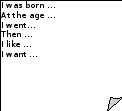
Imagine you’ve won a competition to continue your education in England. You need to write about yourself. What would you write?
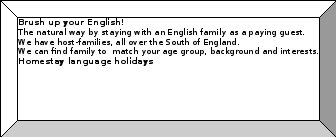
Task 3. You would like to go abroad to improve your English. You’ve seen these advertisements in a magazine.
Date:
The form:9
The theme: Ecology
The aim: to teach about ecology
The mission: 1) to teach and give information about ecology and nature
2) to educate them by behavior and being active
3) to develop their speaking and reading
The type of the lesson: new lesson
The methods: group work
The plan of the lesson: I. Organizational moment
a.phonetic drill
b.revising irregular verbs
II.Checking up home work
III.New theme
IV.Giving home task
The procedure of the lesson: I. Organizational moment. Good morning, how are you? Who is on duty today? Who is absent today?
a.Phonetic drill Cuckoo clock
My uncle has a cuckoo clock To tell us all the time He pops out of his little house And always sings this rhyme
“Cuckoo, cuckoo” The cuckoo says it’s two o’clock It’s telling us the time. .revising irregular verbs
II.Checking home work
III.New theme
Save the nature
1.Work in groups of four. Talk about the environment that you live in.
Do you care about the environment?
Do you protect the environment?
How do you help the environment?
Do you plant trees?
Do you plant flowers?
Do you keep your schoolyard clean?
Do you know the problems of the environment?
Do people fight pollution of the environment?
Does the government control air pollution, water pollution?
What does the environment need today?
4.Tick the sentences you can use to describe the environment that you live in and add some more.

Soil is polluted
Water is polluted
meat


Animals
are killed for
oil


skin


Pollution
Air is polluted
fur


 die from
pollution


Food is not healthy
Forests are destroyed (trees are cut) for building …
plants
Conclusion today we have talked about ecology and its problems.
IV.Giving home task ex 5 p111
Date:
The form:9
The theme: Air travelling
The aim: to teach about travelling by air
The mission: 1) to teach and give information about flights.
2) to educate them being active
3) to develop their listening skills
The type of the lesson: complex
The method: group work, explanation, inductive-deductive
The plan of the lesson: I. Organizational moment
a.Phonetic drill
b.Revising irregular verbs
II. Checking home work
III. New theme
IV. Giving home task
The procedure of the lesson: I. Organizational moment. Good morning, how are you? What day is it today?
a.Phonetic drill
Roadways
By John Masefield
One road leads to London
One road runs to Wales
My road leads me seawards
To the white dipping sails
One road leads to the river
#28
As it goes linging slow
My road leads to shipping
Where the bronzed sailors go
My road calls me, lures me
West, east, south and north
Most roads men homewards
My road leads me forth
b. revising irregular verbs
II. Checking the home work
III. New theme
6. b
Read
Story without ending
…Jane got to the airport early in order to check in, she didn’t need a trolley for her bags as she was travelling light – with a hand bag only. When the flight was called she boarded her plane and took a window seat.
Everything was OK, she didn’t even feel airsick. But when she left that something was wrong, something was missing. She opened her bag. There was her purse, her small bag with her passport and …suddenly she knew what was wrong. She almost screamed!
7. Match the words in column A with the words in column B.

A B
To check in sick because of the movement of the plane
A trolley to get into a bus, plane
Travelling light the place at the airport where you report your
arrival
To board a small box on wheels used to carry heavy things
#28
To feel airsick travelling without much luggage
8. Finish the story
Group A. Make the story funny.
Group B. Make the story sad.
You should answer these questions.
What was missing?
Did she find it?
Was her trip successful?
Conclusion, we understtod that air travellig is safe way of travelling, but in different cases it will be dangerous.
IV. Giving home task ex 9 p 78
#29
Date:
The form:9
The theme: Tours you will never forget
The aim: to teach about travelling
The mission: 1) to teach and give information about travel agencies.
2) to educate them being active
3) to develop their listening skills
The type of the lesson: discussion
The method: group work, explanation, inductive-deductive
The plan of the lesson: I. Organizational moment
a.Phonetic drill
b.Revising irregular verbs
II. Checking home work
III. New theme
IV. Giving home task
The procedure of the lesson: I. Organizational moment. Good morning, how are you? What day is it today?
a. Phonetic drill
The Itsy Bitsy Spider
Walked up the water spout
Down came the rain
And washed the spider out
Out came the sun
Ana dried up all the rain
And the Itsy Bitsy Spider
#29
Walked up the spider again
b. revising irregular verbs
II. Checking up the home work
III. New theme
Tours you will never forget
1.What do travel brochures advertise?
Do you think travel agencies help tourists?
2. Read.
Work in most countries of the world

Help people to arrange trips


Make reservations for hotel rooms
Plan sightseeing tours
Help customers with passports and visas
Arrange tours for individuals and for groups
3. Talk to your partner.
Speak about travel agencies using the diagram.
What else do travel agencies organize?
#29
4. Make these questions.
1) agency, is, kind of business, what, travel, a;
2) does, arrange, who, it, for, tours;
3) money, does, where, come, from.
Now answer in pairs.
Conclusion today we have taught about travel agencies.
IV. Giving home task ex 5 p79, ex 6 p 80
#30
Date:
The form:9
The theme: Tours
The aim: to teach about travellings
The mission: 1) to teach and give information about tours.
2) to educate them being communicative
3) to develop their listening skills
The type of the lesson: fixing lesson
The method: group work, explanation, inductive-deductive
The plan of the lesson: I. Organizational moment
a. Phonetic drill
b.Revising irregular verbs
II. Checking home work
III. New theme
IV. Giving home task
The procedure of the lesson: I. Organizational moment. Good morning, how are you? What day is it today?
a.Phonetic drill
It’s raining, it’s pouring
The old man is snoring
He bumped his head
At the foot of the bed
And couldn’t get up in the morning!
b. revising irregular verbs
II. Checking up home work
#30
III. New theme
More than a just a tour!
See koala at one of our wildlife parks. Enjoy green bush lands areas of the Blue Mountains. Australia has everything you’re looking for.
In our main cities you can enjoy all the best in food, fashion, the arts, theatre and sports.
Australia has a variety of unique trees, plants and wildlife. Discover them at our magnificent wildlife preserves and parks. In Australia you’ll find a lot of things to delight you. So surf or ski, relax at our beautiful beaches, see Aboriginal rock art painted thousands of years ago, and met interesting people. Don’t wait. It’s always a good time to visit Australia.
8. Read these words. Put n (noun), v (verb), adj (adjective) near each word.
Exciting surf
Fabulous delight
Win relax
Night club enjoy
Preserve opera
Pool show
Luscious Wildlife Park
Tropical theatre
These words are used in travel brochures.
Make some sentences with them.
Example: Enjoy our tropical island!
You will never forget our wildlife parks.
Relax by the pool, forget your problems.
Conclusion we have studied about and fixed the lesson about travelling.
IV. Giving home task ex 2 p81
#18
Date:
The form:9
The theme: test
The aim: to control the knowledge of pupils on English
The mission: 1) to control and check the knowledge of English
2) to educate them correct writing
3) to develop their knowledge
The type of the lesson: controlling
The method: explanation
The plan of the lesson: I. Organizational moment
a. Phonetic drill
b. revising irregulllar verbs
II. Checking up the home work
III. Test
The procedure of the lesson: I. Organizational moment
Good morning, how are you? Who is on duty today? Who is absent today?
a. Phonetic drill
Blue is the sea
Blue is the sea
Green is the grass
White are the clouds
As they slowly pass
Black are the crows
Brown are the trees
#18
Red are the sails
Of a ship in the breeze.
b.revising irregular verbs
II. Checking the home work
III. Test
Unit one
II. Reading
Read the text and choose the right answer.
1. People like to think that life was better in the past. The air was cleaner, the water was purer, life was safer and certainly, it was cheaper. But were the good old days so good? Probably not. Many of today’s problems existed in the past, and there were other problems then that we rarely face today.
2. Pollution was a very important problem for city governments in the 19th century, particularly with regards to water supplies. They had some idea that water could be polluted, but they didn’t know how. Trying to get pure water was a big problem.
3. The cities of the 19th century were dirty. There was a lot of pollution from horses and other animals. And people were careless about throwing out litter. Communicable diseases were a big problem. There was malaria, cholera, and typhoid. A lot of children died when they were very young. While there were no cars to kill people, they were many fatalities and injuries caused by runaway horses.
1. According to the 1-st paragraph:
a. The life was better in the past because there were a few problems.
b. Today we don’t face the problems which existed in the past.
c. People also faced some problems in the past.
2. According to the 2-nd paragraph:
a. The only problem that city governments had was water poluution.
b. They knew the reason of water pollution.
c. The city governments’ problem was getting clean water.
#18
3. According to the 3-rd paragraph:
a. A lot of children died of catching diseases.
b. People didn’t throw out litter.
c. All the diseases were caused by horses.
III. Vocabulary
Choose the right word.
1. I had a high _____. I knew I would be all right if I avoided pneumonia.
A. fever
B. inflammation
C. temperature
2. When I came to the doctor he asked me to strip to the waist and began to_____.
A. study
B. examine
C. look
3. My son broke his ankle while he was roller skating so he had his ankle_______.
A . x-rayed
B. tested
C. treated
4. She is short of breath and has chest_________.
A. aches
B. illnesses
C. pains
5. Some people worry about their______ and use a balanced diet.
A . skin
B . weight
#18
C . appearance
6. My daughter likes _____ food such as crisps, sweets and fizzy drinks.
A . junk
B . plain
C . fat
7. He fell over and _____ his wrist.
A . ached
B . injured
C . hurt
IV. Grammar
Choose the right answer.
1.I …you should go to the doctor.
A . am thinking\
B . think
C . have been thinking
2. He ________his ankle while he …tennis.
A . sprained, was playing
B . spained, played
C . was spraining, was playing
3.I____just ______about your accident.
A . was hearing
B . have heard
C . didn’t hear
4. My father _____patients since he left University.
A . has been trating
#18
B . was treating
C . treated
6. I am wet, because I _____.
A . am swimming
B. have been swimming
C. swam
7. “I’ve got a headache. Have you got any aspirin?”
“Yes, they are in the bathroom. I___some for you?”
Am getting
Am going get
Will get
#32
Date:
The form:9
The theme: test
The aim: to control the knowledge of pupils on English
The mission: 1) to control and check the knowledge of English
2) to educate them correct writing
3) to develop their knowledge
The type of the lesson: controlling
The method: explanation
The plan of the lesson: I. Organizational moment
a. Phonetic drill
b. revising irregulllar verbs
II. Checking up the home work
III. Test
The procedure of the lesson: I. Organizational moment
Good morning, how are you? Who is on duty today? Who is absent today?
a. Phonetic drill
We are happy
I am happy
You are happy
He is happy
She is happy
We are happy
You are happy
#32
They are happy too.
b. revising irregular verbs
II. Checking the home work
III. Test
Reading
Read the text and answer the questions below.
Jane: I came here last year to teach English and it was the first timew I’d ever gone to work in a country whose language I didn’t know. After a while I realized that in order to get along I would need to know the language, I mean Kazakh, because although some people speak English in Kazakhstan, this doesn’t get you very far. Even at work not everybody understands that I give in English – when I want photocopying and so on. So learning Kazakh just helps to contact with generally.
True or false
1.Jane is learning the language of the country where she lives.
True False
2.People in the country don’t speak English at all.
True False
3.Jane took up Kazakh because she needed the language at work only.
True False
III. Vocabulary
Fill in the gaps with one of the words below.
1.The lecturer asked students to ____at the board.
a.watch
b.see
c.look
2.A continuing television story which is about the heroes’ private troubles is called_____.
#32
a.soap opera
b.western
c.comedy
3.He does most of his _____in night-clubs.
a.leisure
b.body
c.entertaining
4.You shouldn’t _____this film; the rights don’t belong to you!
a.leisure
b.hobby
c.entertaining
#33
Date:
The form:9
The theme: primary, secondary schools
The aim: to teach about schools
The mission: 1) to teach and give information about schools
2) to educate them by behavior
3) to develop their speaking and reading
The type of the lesson: complex
The methods: questionnaire discussion
The plan of the lesson: I. Organizational moment
a.phonetic drill
b.revising irregular verbs
II.Checking up home work
III.New theme
IV.Giving home task
The procedure of the lesson: I. Organizational moment. Good morning, how are you? Who is on duty today? Who is absent today?
Phonetic drill
If many men know what many men know
If many men went where many men go
If many men did what many men do
The world would be better I think so, don’t you?
b.revising irregular verbs
II. Checking home work
III.New theme
#33
Speaking
1.Look at the pictures.
* Can you guess what subjects are being taught in each pictures?
* Do you study these subjects at school?
* What are your favourite subjects?
* Which do you prefer, practical work or theoretical work?
* What are your plans after leaving school?
*Do your school subjects educate you for life?
2. Complete the table. Draw a table of this kind in your notebook.
| Questions I’d like to ask about schools in England |
|
|
|
|
|
|
|
|
4.Talk to your partner.
Could you find answers to your questions?
5.Complete the sentences: 1. Primary schools are those_______.
2.Infant schools are__________.
3.Junior schools__________.
4.Comprehensive schools_________.
5.Grammar schools____________.
IV. Giving home task ex 4 read and translate p86 ex6 write p87
#34
Date:
The form:9
The theme: primary, secondary schools
The aim: to teach about schools
The mission: 1) to teach and give information about schools
2) to educate them by behavior
3) to develop their speaking and reading
The type of the lesson: complex and fixing
The methods: questionnaire discussion
The plan of the lesson: I. Organizational moment
a.phonetic drill
b.revising irregular verbs
II.Checking up home work
III.New theme
IV.Giving home task
The procedure of the lesson: I. Organizational moment. Good morning, how are you? Who is on duty today? Who is absent today?
a.Phonetic drill
A sailor went to sea
To see what he could see
But all he could see
Was sea, sea, sea.
b.revising irregular verbs
II.Checking home work
III.New theme
#34
7. Talk to your partner. List and discuss the similarities and differences between elementary and secondary schools in England and in your country.
Example: In England children go to schools between the ages of 5 and 16 years, but in Kazakhstan …_________________________________________________________
 _____________________________________________________________________
At the of 16-18 young people go to university.
Can, may stay on at school.
Look for a job.
Do voluntary work.
Go to the sixth form college.
Travel and work abroad.
Move away from home.
Go to school of further education.
8.Talk to your partner.
What will you do after the 9th form?
IV.Giving home task ex 9 p88
#35
Date:
The form:9
The theme: A typical day at school
The aim: to teach about school’s day
The mission: 1) to teach and give information about schools
2) to educate them by behavior
3) to develop their speaking and reading
The type of the lesson: complex and fixing
The methods: questionnaire discussion
The plan of the lesson: I. Organizational moment
a.phonetic drill
b.revising irregular verbs
II.Checking up home work
III.New theme
IV.Giving home task
The procedure of the lesson: I. Organizational moment. Good morning, how are you? Who is on duty today? Who is absent today?
a.Phonetic drill
Ebenezer Sneezer
Topsy –Turvey man
Rises upon his elbows
Every time he can
Whistles Yankee doodle
Every time it pours
Wraps himself in paper
#35
Every time he shores
Oh, E-b-e-nee-zer –Snee-zer
What a man, A-choo!
b.revising irregulllar verbs
II.Checking home work
III. New theme
Speaking
1). a) Talk to your partner. Speak about your typical day at school.
b) What questions would you like to ask about a typical day in this school. Write as many questions as possible.
Example: When do your lessons start?
_______________________________________________________________
________________________________________________________________
5. Talk to your partner.
Speak about a typical school day in Great Britain.
Example: A typical day at school starts at 8:40 a.m.
6.Make a list of things which are different from your school and compare your sentences with partners.
Example: They have a long break for lunch.
7.Look at the conventional British school timetable.
| 9.00
9.30-10.45 10.45-11.00 11.00 | Morning children arrive for registration Lessons Morning break lessons
| 1.15-2.15
2.15-3.30 2.30-3.30 3.30 | Afternoon lessons
afternoon break lessons children do home |
#35
It’s mainly primary schools, for children of 5-11 years, which have an afternoon break.
8.Make a timetable of your school day similar to the timetable for the conventional British school.
Conclusion. Today we have talked about a typical school days. I hope that everybody of yours can speak about it.
IV.Giving home task Ex.13 p.91
Date:
The form:9
The theme: Ecology
The aim: to teach about ecology
The mission: 1) to teach about passive and active voices
2) to educate them by behavior and being active
3) to develop their speaking and reading
The type of the lesson: fixing lesson
The methods: group work
The plan of the lesson: I. Organizational moment
a.phonetic drill
b.revising irregular verbs
II.Checking up home work
III.New theme
IV.Giving home task
The procedure of the lesson: I. Organizational moment. Good morning, how are you? Who is on duty today? Who is absent today?
a.Phonetic drill
30 days has September, April, June
And November
All the rest have 31
Excepting February alone
Which has 28 days clear
And 29 in each leap year.
b.revising irregular verbs
II.Checking up home work
III.New theme
Active Voice
People kill animals for meat, oil, skin and fur.
A lot of industrial companies pollute the air.
People destroy forests for building …
Passive voice
Animals are killed by people for meat, oil, skin and fur.
The air is polluted by a lot of industrial companies.
Forests are destroyed by people for building …
Word formation
7.Complete this table. Write all possible forms you can think.
| Noun | Verb | Adjective |
|
| pollute | - |
|
| - | environmental |
|
| - | industrial |
| harm | - |
|
| Protection |
| - |
| health |
|
|
| survival |
| - |
| organization |
| - |
8.Work in groups of four and answer the questions.
What happened to the fish?
Is the water polluted?
Do you think oil industry is important for our future?
What is Mike doing?
Is he cleaning the bird from the oil?
What worries our people today?
Conclusion today we have studied the using of sentences on passive and active voices.
IV. Giving home task ex 10, 11 p 113
Date:
The form:9
The theme: Earth
The aim: to teach about earth and its ecological problems
The mission: 1) to teach and give information about ecology and nature
2) to educate them by behavior and being active
3) to develop their speaking and reading
The type of the lesson: new lesson, discussion
The methods: group work
The plan of the lesson: I. Organizational moment
a.phonetic drill
b.revising irregular verbs
II.Checking up home work
III.New theme
IV.Giving home task
The procedure of the lesson: I. Organizational moment. Good morning, how are you? Who is on duty today? Who is absent today?
a.Phonetic drill
Whole duty of children
A child should always say what’s true
And speak when he is spoken to
And behave mannerly at table
At least as far as he is able.
Robert Louis Stevanson
b.revising irregular verbs
II.Check up home work
III. New theme
1.Mark the places on the map of Kazakhstan where there are ecological problems. Write the word “SOS” in pencil.
2.Compare your map with your partners.
3.Talk to your partner: Are people happy to live there?
#46
Example: In my opinion the people of this region (district) are not happy to live there because there are a lot of ecological problems.
The water, air, land are polluted …
Read the statements and continue:
What should we do What shouldn’t do?
We should walk a lot. We shouldn’t use the
We should keep the country tidy. cars a lot.
We should grow flowers. We shouldn’t throw
We should water flowers. litter into the streets.
We should save water flowers. We shouldn’t cut trees,plants, trees and pick flowers.
They may be recycled. When we pick wild flowers we shouldn’t take them all.
We shouldn’t be litterbugs …
Conclusion today we have talked about the Earth and its problems. It’s very
important problem is litter. We mustn’t be a litterbug.
IV. Giving home task ex 7, p118.
#47
Date:
The form:9
The theme: Earth
The aim: to teach about earth and its ecological problems
The mission: 1) to teach and give information about ecology and nature
2) to educate them by behavior and being active
3) to develop their speaking and reading
The type of the lesson: discussion
The methods: group work
The plan of the lesson: I. Organizational moment
a.phonetic drill
b.revising irregular verbs
II.Checking up home work
III.New theme
IV.Giving home task
The procedure of the lesson: I. Organizational moment. Good morning, how are you? Who is on duty today? Who is absent today?
a.Phonetic drill
Hearts, like doors, will open with ease.
To very, very little keys.
And don’t forget that two of these.
Are “I thank you” and “If you please”
From “Mother Goose Rhymes”
b.revising irregular verbs
II.Checking home work
III.New theme
9. Match the Russian words to the right English words.
Protect влиять
Leak сохранять
Conserve защищать
Heritage отбросы, отходы
#47
Waste течь
Affect наследство
10. Read the diagram. Draw a diagram of this kind in your notebook. Add some
more if you have.


Natural heritage
environment
litter
builts heritage
industry
Over waste
Air pollution
noise
Water pollution
Conclusion we must to save the Earth and not pollute it.
IV.Giving home task ex 13 p 120.
#48
Date:
The form:9
The theme: Earth
The aim: to teach about earth and its ecological problems
The mission: 1) to teach and give information about ecology and nature
2) to educate them by behavior and being active
3) to develop their speaking and reading
The type of the lesson: new lesson
The methods: group work
The plan of the lesson: I. Organizational moment
a.phonetic drill
b.revising irregular verbs
II.Checking up home work
III.New theme
IV.Giving home task
The procedure of the lesson: I. Organizational moment. Good morning, how are you? Who is on duty today? Who is absent today?
a.Phonetic drill
Me
In space there is a galaxy
In the galaxy there is a sun
Near the sun there is a planet
On the planet there is a ocean.
Near the ocean there is a continent.
On the continent there is a country.
In the country there is city.
In the city there is park.
In the park there is house.
On the house there is a bedroom.
In the bedroom there is a bed.
And in the bed there is me.
#48
b.revising irregular verbs.
II.Checking home work
III.New theme
1.Talk to your partner.
a.Do you celebrate Earth Day in your city / town / village?
b.Which country celebrates earth Day?
c.Which country is it on the map?
Mark the capital of this country on the map.
2.Match a line in A with a line in B.
| A | B |
| Reduce Protect Make Predict Solve Test Save Сelebrate Participate in | an investment in the Energy Star Programme pollution the ecological problems the public health the environment money demonstration millions of tons of harmful pollutants |
#50
Date:
The form:9
The theme: Garbage disposal
The aim: to teach about garbage and it’s recycling
The mission: 1) to teach and give information about garbage
2) to educate them by behavior and being active
3) to develop their speaking and reading
The type of the lesson: new lesson
The methods: group work
The plan of the lesson: I. Organizational moment
a.phonetic drill
b.revising irregular verbs
II.Checking up home work
III.New theme
IV.Giving home task
The procedure of the lesson: I. Organizational moment. Good morning, how are you? Who is on duty today? Who is absent today?
a.Phonetic drill
Coffee and Tea
Molly, my sister, and I fell out
And what do you think it was about?
She loved coffee and I loved tea.
And that was the reason we couldn’t agree.
b.revising irregular verbs
II.Checking home work
III.New theme
1.Make a list of words which are connected with environmental problems.
Compare your list with your partners. Guess the following words.
p……e
p…….n
p……..t
2.Read and talk to your partner.
Is garbage pisposal a problem in your village (city/town)?
What is garbage?
What is garbage disposal?
Garbage – 1.food wastes
2.trash
3.Work in groups of four. Look at the title of the text. Which of these things do
you expect to be mentioned in the text?
How to control air pollution?
How to solve garbage disposal problems
6.Complete the table. Write all possible forms you can think.
| Noun | Verb | Adjective |
| production |
| - |
|
| dispose | - |
|
| operate | - |
| poison | - |
|
| - | - | combustible |
|
| contain | - |
|
| Equip |
|
Conclusion we habe talked about garbage disposal. We have known about garbage recycling.
IV.Giving home task ex4,5 p126-127
#51
Date:
The form:9
The theme:Garbage disposal
The aim: to teach about garbage redusing
The mission: 1) to teach and give information about garbage
2) to educate them by behavior and being active
3) to develop their speaking and reading
The type of the lesson: fixing lesson
The methods: group work
The plan of the lesson: I. Organizational moment
a.phonetic drill
b.revising irregular verbs
II.Checking up home work
III.New theme
IV.Giving home task
The procedure of the lesson: I. Organizational moment. Good morning, how are you? Who is on duty today? Who is absent today?
a.Phonetic drill
TEN GREEN BOTTLES
Ten green bottles hanging on the wall
Ten green bottles hanging on the wall
If one green bottle should accidentally fall
There’d be 9 green bottles hanging on the wall.
b.revising irregular verbs
II.Checking home work
III.New theme
8.Read the diagrams and draw a diagram of this kind in your notebook. Complete it with the information from the text.
Everything is recycled. The centre provides work for handicapped people.\
a)
recycled


garbage
burned
landfills

Garbage disposal
In Machida in Tokyo, Japan:
An unusual way
Family divide their garbage into 6 categories


2
Kitchen garbage
Plastic tools
Plastic toys
batteries
bottles


Metal containers
furniture


-garbage that can be easily burned (combustible) garbage

-garbage that cannot be recycled
-poisonous products or cause pollution
That can be recycled
-That can be recycled
large items
Conclusion we have studied about garbage disposal it’s recycling.
IV.Giving home task ex 9, 10, p129 ex20 p131
#52
Date:
The form:9
The theme: control test
The aim: controlling children’s grammar, reading
The mission: 1) to teach about grammar
2) to educate them being disciplined
3) to develop their knowledge
The type of the lesson: control
The method: questionnaire
The plan of the lesson: I. Organizational moment
a.phonetic drill
b.revising irregular verbs
II.Checking home work
III.Test
The procedure of the lesson: I. Organizational moment
a.phonetic drill
Little red engine
Ten little red engine is puffing alone
He comes to a great big hill.
He says “ I must puff and never stop.
I must puff, puff, puff”
“Till I reach the top”
I think I can
And he puffs right over the hill.
b.revising irregular verbs
II.Checking home work
#52
III.Test
I.Reading Why are animals are in danger?
Read the text and choose the right answer.
A million years ago there were a lot more species of animals that
there are now. Of course, some species disappear faster than
before. Rhinocers die because people want their horns.
Animals are in danger from natural accidents; some animals die because of small changes in the weather.
(abridged from the book “Animals are in Danger” by Joe Potter, Oxford, 1998)
1.Species of animals are disappearing __________.
a.slowly
b.faster than before
c.rarely
2.Rhinocers die because people want their _____________.
a.skin
b.horns
c.meat
3.Animals do not die from __________.
a.fire
b.changing weather and accidents
c.food
4.Some people hunt animals for________.
a.food
b.they like hunting
c.they hate animals
#52
5.Which problem is getting worse?
a.heat
b.pollution
c.people’s behavior
II.Vocabulary
Choose the right word:
1.When the air is very dirty we usually say it is _________.
a.nasty
b.polluted
c.not clean
2.The thing which pollutes the air and the soil is __________.
a.fertilizer
b.pollutant
c.pollution
3.We should protect ______________.
a.the environment
b.pollutants
c.soil
4.Ecological problems can be ___________.
a.solved by people
b.done
c.thought by business
5.A person who does not eat meat is _________.
a. a strong person b.a vegetarian c. a person who hates animals.
#53
Date:
The form:9
The theme: Let’s think of the future
The aim: to teach children to speak about the future
The mission: 1) to teach for speaking giving opinion
2) to educate them being disciplined
3) to develop their knowledge
The type of the lesson: discussion
The method: questionnaire, individual working, group work
The plan of the lesson: I. Organizational moment
a.phonetic drill
b.revising irregular verbs
II.Checking home work
III.New theme
IV.Giving home task
The procedure of the lesson: I.Organizational moment .
How are you? What date is today? What month is it today? Who is on duty today? Who is absent today?
a.phonetic drill
Willy
Willy broke the window pane
Willy spilled the ink
Willy left the water pipe
Running in the sink!
Did his mother punish him?
No! I’ll tell you why.
#53
Willy, he owned up to it,
And didn’t tell a lie!
Willy told his mother
Before she found it out
He said: “I am so sorry!”
She said: “I have no doubt!”
b.revising irregular verbs
II.Checking home work
III.New theme
Exercise 1. Read and talk to your partner.
There are a lot of dangers threatening the Earth and it’s population. There are things we can do to help the Earth and ourselves.
What do you think? Do you walk a lot? Do you drive a lot? …………..
b) Read the text and mark the things which you can do.
Omar’s father is a friend of the Earth
Omar’s father. What do I usually do? I’ve changed my lifestyle to become a friend of the Earth. It means I’m helping myself. I usually walk a lot, especially when I do shopping. I ride my bicycle as much as possible. I use my car less, I use public transport; I usually go trolleybus. My car runs on unlead petrol. It’s cheaper and it keeps the air cleaner.
c)Talk to your partner; Are you a friend of the Earth?
Conclusion we have talked about the future now you can speak and tell your opinions about it.
IV.Giving home task ex 2b) p133 ex4 p 134
#54
Date:
The form:9
The theme: Let’s think of the future
The aim: to teach children by grammar, reading
The mission: 1) to teach grammar materials
2) to educate them being disciplined
3) to develop their knowledge
The type of the lesson: fixing lesson
The method: questionnaire, pair work
The plan of the lesson: I. Organizational moment
a.phonetic drill
b.revising irregular verbs
II.Checking home work
III.New theme
IV.Giving home task
The procedure of the lesson: I. Organizational moment. How are you? What date is it today? What month is today?
Who is on duty today? Who is absent today?
Phonetic drill
Three little kittens
They lost their mittens
And they began to cry
“Oh, mother dear, she sadly fear
Our mittens we have lost”
“What? Lost your mittens?
You naughty kittens
Then you will have no pie.
b.revising irregular verbs.
II.Checking home work
III.New theme
6. a) Talk to your partner.
What have you done to be more friendly to the environment? Omar’s father says that people should try to be friendly to the environment. He says that people should try to be friendly to the environment. He says “ A good beginning is half the battle”. A) What do you usually do to protect the planet? B) What should you do to help the environment?
 Example:
I walk a lot. B.I should walk a lot
I ride a bycicle I should……….
I plant trees, flowers I should……
b.What do you think of the proverb “A good beginning is half the battle”?
* Do you have such a proverb in your mother tongue?
c) Compare the proverb:
“Добрый человек всегда приходит ко времени»
Сonclusion today we have continued and fixed our lesson about speaking of the future.
IV.Giving home task ex 9 b) p 135ex 13 p137
#55
Date:
The form: 9
The theme: Job description
The aim: to teach about jobs
The mission: 1) to teach about job and give materials
2) to educate them being disciplined
3) to develop their knowledge
The type of the lesson: new lesson
The method: questionnaire, pair work
The plan of the lesson: I. Organizational moment
a.phonetic drill
b.revising irregular verbs
II.Checking home work
III.New theme
IV.Giving home task
The procedure of the lesson: I. Organizational moment. How are you? What date is it today? What month is today?
Who is on duty today? Who is absent today?
a.Phonetic drill
The three little kittens
They found their mittens
And they began to cry,
“Oh mother dear, see here, see here,
Our mittens we have found!
“Put on your mittens
You silly kittens
And you will have no pie!”
b.revising irregular verbs
II.Checking up home work
III.New theme
1.Match the pictures to the sentences.
a.

b.
c.
 d.
d.
e.
Conclusion we get to know about different kinds of jobs. I hope that you will to choose for yourselves.
IV. Giving home task ex 3 p 143
#56
Date:
The form: 9
The theme: Job description
The aim: to teach children by grammar, reading
The mission: 1) to teach grammar materials
2) to educate them being disciplined
3) to develop their knowledge
The type of the lesson: fixing lesson
The method: questionnaire, pair work
The plan of the lesson: I. Organizational moment
a.phonetic drill
b.revising irregular verbs
II.Checking home work
III.New theme
IV.Giving home task
The procedure of the lesson: I. Organizational moment. How are you? What date is it today? What month is today?
Who is on duty today? Who is absent today?
a.Phonetic drill
The three little kittens
Put on their mittens
And soon ate up the pie.
“Oh mother dear, we greatly fear.
Our mittens we have soiled
What? Soiled your mittens,
You naughty kittens
#56
And they began to cry.
b.revising irregular verbs
II.Checking home work. Let’s to check your home work! What was your home task?
III.New theme
4.Read this job description
If you don’t have a part – time job, remember your parents’ job. Draw a table of this kind in your note book.
payment

 Have you had any training? Is training planned?
training


 How much do you earn? Do you work extra hours?
How much does he / she earn? Does s/he work extra hours?
Do they pay for extra hours?
Job description


holidays
working hours


satisfaction
responsibility
Do you enjoy your work?
Does s/he enjoy his/her work?
5.Read the chart below, draw a chart of this kind in your notebook and talk to your partner.
Which job do you like most? Why? When you think of a job don’t forget about a job description.
Remember!
Much
Many more most
Little less least
Good better best
Bad worse worst
Conclusion we have understood that we can choose what job we liked.
IV.Giving home task ex 6, 10 p 144-145
#58
Date:
The form: 9
The theme: The most important in a job
The aim: to teach children by grammar, reading
The mission: 1) to teach grammar materials
2) to educate them being disciplined
3) to develop their knowledge
The type of the lesson: new lesson
The method: questionnaire, pair work
The plan of the lesson: I. Organizational moment
a.phonetic drill
b.revising irregular verbs
II.Checking home work
III.New theme
IV.Giving home task
The procedure of the lesson: I. Organizational moment. How are you? What date is it today? What month is today?
Who is on duty today? Who is absent today?
a.Phonetic drill
The 3 little kittens
They washed their mittens
And hang them out to dry
“Oh motherer dear, do you not hear?
Our mittens we have washed”.
“What? Washed your mittens,
You good, little kittens.
#58
Now you will have some pie.”
b.revising irregular verbs
II.Checking home work. Let’s to check your home work! What was your home task?
III.New theme
1.A guessing game
* You don’t walk. You don’t talk to the people in your cabin.You’re in the air. What job is it?
You look after people in hospital. You sometimes work day and sometimes night. What job is it?
You build houses, buildings. What job is it?
You mend cars. What job is it?
You interview people. You write articles for newspapers. What job is it?
You teach pupils, students. Your job is difficult but you have a long holiday. What job is it? Please continue this game.
2.Match a job in A with the information in B.
A B
a clerk helps people buy and sell buildings and land
an architect wears and shows new fashions
a disc jockey does general office work
a geologist decides cases in a court law
a judge introduces music and songs on the radio
a model designs and draws plans for new buildings
a civil servant studies rocks, soil, mountains
a realtor works for the government
Conclusion we had begin to study about most important things in a job.
IV.Giving home task ex3 p 147
#59
Date:
The form:9
The theme: The most important thing in a job
The aim: to teach and give information about jobs
The mission: 1) to teach and give them grammar materials
2) to educate them being disciplined
3) to develop their knowledge
The type of the lesson: fixing lesson
The method: questionnaire, pair work
The plan of the lesson: I. Organizational moment
a.phonetic drill
b.revising irregular verbs
II.Checking home work
III.New theme
IV.Giving home task
The procedure of the lesson: I. Organizational moment. How are you? What date is it today? What month is today?
Who is on duty today? Who is absent today?
a.Phonetic drill
What is it all about?
First you come and then you go
Then you smile and then you cry
Then you whisper and then you shout
Can’t you tell me what’s all about?
b.revising irregular verbs
II.Checking home work. Let’s to check your home work! What was your home task?
#59
III.New theme
6. a) Read the text and find the new words in the text:
Давать право на что-л - Entitle, v
Consume, v – потреблять
Claim, v – требовать
A crucial age
Now 18 is the crucial age. But what does becoming an adult mean? What rights do you get at 18 that you didn’t have before? One of the most frequently pointed out ironies is that you can join the Army, Air Force or Navy at the age of 16 (or 17 if you are a woman) but you are not entitled to vote. This privilege only comes at the age of 18.
Smoking, drinking and going to the pub is a complex piece of law. The familiar RU 18 (are you 18?) sign can be seen in pubs. That means you have to be 18 before you can buy and drink alcohol in BAR. Between the ages of 14 and 16 you can go to a pub but you can only consume soft drinks. In Britain you must show your identity card. The law states that children may work from the age of 13 onwards provided that: a. it is part – time job
b.it doesn’t take place in school hours
c. it doesn’t involve lifting or carrying anything heavy.
Conclusion we have talked about crucial age.
IV.Giving home task ex 10 p 150
#60
Date:
The form:9
The theme: The most important thing in a job
The aim: to teach and give information about jobs
The mission: 1) to teach and give them grammar materials
2) to educate them being disciplined
3) to develop their knowledge
The type of the lesson: new lesson
The method: questionnaire, pair work
The plan of the lesson: I. Organizational moment
a.phonetic drill
b.revising irregular verbs
II.Checking home work
III.New theme
IV.Giving home task
The procedure of the lesson: I. Organizational moment. How are you? What date is it today? What month is today?
Who is on duty today? Who is absent today?
a.Phonetic drill
Why do you sit and then stand?
Why do sleep and then wake?
Why do walk and then run?
This really isn’t very much fun?
Why did you go up and not come down?
b.revising irregular verbs
II.Checking home work
#60
Let’s to check your home work.
III. New theme
A part – time job
1.Guess the words of job.
a) e)
d…..r
n…e
b) f)
r…..r
l….r
c) g)
m…r
d) h)
a……..r
m….e
Talk to your partner.
Do kids work in Kazakhstan?
Do kids of your village work?
Do kids of your city (town) work?
Do kids of your school work?
Do kids of your yard work?
Do you have a part – time job?
B)Read the text. Which job do you want to have?
Conclusion we have talked about part – time jobs and kids at work.
IV.Giving home task ex 4 p 154
#61
Date:
The form: 9
The theme: The most important thing in a job
The aim: to teach and give information about jobs
The mission: 1) to teach and give them grammar materials
2) to educate them being disciplined
3) to develop their knowledge
The type of the lesson: fixing lesson
The method: questionnaire, pair work
The plan of the lesson: I. Organizational moment
a.phonetic drill
b.revising irregular verbs
II.Checking home work
III.New theme
IV.Giving home task
The procedure of the lesson: I. Organizational moment. How are you? What date is it today? What month is today?
Who is on duty today? Who is absent today?
a.Phonetic drill
Why did you talk and not listen?
Why did you eat and not drink?
What really should I think?
Come and go; smile and cry
In and out whisper and shout
Now you can tell me
What’s all about…
#61
b.revising irregular verbs
II.Checking home work
Let’s to check up your home work. What task was you given for?
III.New theme
7.Complete the interview questions and match to the answers.
What is _________name? I’m sixteen.
How much__________ get? Yes, I love my job.
What_________you do? $60 every week.
(What__________your job?) I deliver letters
(____you like your job?) 3 days a week.
How ____days a week do you work? My name is Jennnifer.
How __are you? Conti.
8.Talk to your partner / class.
a. Is it easy to find a job?
b. Is selling newspapers, magazines an easy job?
c. Is it a full-time or a part-time job?
10. Choose the right answer.
1.He has been living on the street
a. for a month
b. for 2 years
c. for a year
2. Why did he come to London?
a. to live there
b. to look for a job
#61
c. to study at the London University
3. What magazine has he been selling foe six months?
a. The Times
b. The Big Issue
c. The Fashion
4. What people can’t he stand?
a. who talk a lot
b. who sleep a lot
c. who drink or take drugs
5. How many copies does he sell a day?
a. usually about 10
b. usually about 50
c. usually about 100
Conclusion we have studied about part –time jobs
IV.Giving home task ex 14 p 158 ex 17 p 159
#62
Date:
The form:9
The theme: The most important thing in a job
The aim: to teach and give information about jobs
The mission: 1) to teach and give them grammar materials
2) to educate them being disciplined
3) to develop their knowledge
The type of the lesson: new lesson
The method: questionnaire, pair work
The plan of the lesson: I. Organizational moment
a.phonetic drill
b.revising irregular verbs
II.Checking home work
III.New theme
IV.Giving home task
The procedure of the lesson: I. Organizational moment. How are you? What date is it today? What month is today?
Who is on duty today? Who is absent today?
a.Phonetic drill
Hot cross buns
Hot cross buns,
Hot cross buns.
One a penny,
Two a penny,
Hot cross buns.
If you have no daughters
#62
Give them to your sons.
One a penny
Two a penny
Hot cross buns.
b.revising irregular verbs
II.Checking home work
III.New theme
1.Look at the picture. What is this spider doing?
He’s joining the words.
Example: air the rooms.
Conclusion we nave begin to study about jobs of the future
IV.Giving home task ex 2 a, b p 161 ex 4 b p 162 translate and read
#63
Date:
The form:9
The theme: The most important thing in a job
The aim: to teach and give information about jobs
The mission: 1) to teach and give them grammar materials
2) to educate them being disciplined
3) to develop their knowledge
The type of the lesson: fixing lesson
The method: questionnaire, pair work
The plan of the lesson: I. Organizational moment
a.phonetic drill
b.revising irregular verbs
II.Checking home work
III.New theme
IV.Giving home task
The procedure of the lesson: I. Organizational moment. How are you? What date is it today? What month is today?
Who is on duty today? Who is absent today?
a.Phonetic drill
Five brown buns in the baker’s shop
Round and fat with sugar on the top
A little boy came with a penny one day
He bought one bun and took it right away.
4 brown buns in the baker’s shop
Round and fat with sugar on the top
#63
A little girl came with a penny 1 day
She bought 1 bun took it right away
b.revising irregular verbs
II.Checking home work What home task was you given?
III.New theme
14 b) Read the text. Choose the job you like.
Some new jobs in tomorrow’s world
After Clive Riche
There will be many new professions in Tomorrow’s World to keep people busy. Here are some ideas for new professions.
Collector: People will collect things such as stamps, cards, matchboxes. They wil put them on shows of their work for people to look at.
Painters: People will paint pictures on buildings and walls.
Story –tellers: People will tell stories to groups of people.
Life-advisers: Life will be much ,ore difficult for everyone to understand easily.
People persons: People will visit other people and see that they have no problems. They will look after someone’s baby, help with the housework, or go shopping.
Critics: People will watch television, listen to the radio, visit the theatre and cinema, and then write about it in special newspapers.
Holiday-makers: People will go on holiday, and then write about it in special newspapers.
Consumers: People will buy and use things and then write about how good or bad they were.
Work designers: These will be people who design work for other people.
Conclusion we have talked and read about new jobs.
IV.Giving home task ex 15 p 165 ex 18, 20, 22 read and translate p 166-167.
#65
Date:
The form:9
The theme: The most important thing in a job
The aim: to teach and give information about jobs
The mission: 1) to teach and give them grammar materials
2) to educate them being disciplined
3) to develop their knowledge
The type of the lesson: fixing lesson
The method: questionnaire, pair work
The plan of the lesson: I. Organizational moment
a.phonetic drill
b.revising irregular verbs
II.Checking home work
III.New theme
IV.Giving home task
The procedure of the lesson: I. Organizational moment. How are you? What date is it today? What month is today?
Who is on duty today? Who is absent today?
a.Phonetic drill
3 brown buns in the baker’s shop
No brown buns in the baker’s shop
Round and fat with sugar on the top
A little boy came with a penny one day
There were no down buns for him to take away.
b.revising irregular verbs
II.Checking home work
#65
III.New theme
Job interview
1.Read the job advertisement
Apply, v 1.to ask for: I want to apply for the job;
To be about or important to: The school rules apply to us all,
To put on: The doctor applied some medicine to the wound.
Qualiofication, n – special training or knowledge
Require, v-to need
Conclusion we have begin to study about job interview.
IV.Giving home task ex7 p 170
#66
Date:
The form:9
The theme: The most important thing in a job
The aim: to teach and give information about jobs
The mission: 1) to teach and give them grammar materials
2) to educate them being disciplined
3) to develop their knowledge
The type of the lesson: fixing lesson
The method: questionnaire, pair work
The plan of the lesson: I. Organizational moment
a.phonetic drill
b.revising irregular verbs
II.Checking home work
III.New theme
IV.Giving home task
The procedure of the lesson: I. Organizational moment. How are you? What date is it today? What month is today?
Who is on duty today? Who is absent today?
a.Phonetic drill
Five little ducks went swimming one day
Over the pond and far away
Mother quack said: “Quack, quack, quack, quack”
But only four little ducks came back
Four little ducks went swimming one day
Over the pond and far away
#66
Mother quack said: “Quack, quack, quack, quack”
But only 3 little ducks came back.
Four little ducks went swimming one day
Over the pond and far away.
b.revising irregular verbs.
II.Checking home work
III.New theme
8.Are the following sentences true or false? True False
 a.The real aim of an interview is to obtain the job you want. ___ ____
b. You are trying to find a job that satisfies you. ___ ____
c. Change your mind if you want to ___ ____
d. You try to dominate the conversation with the interviewer. ___ ____
e. You’re aggressive during the interview. ___ ____
f. You’re very respectful of your interviewer. ___ ____
9. What do you think of the following tips? Do you agree to them?
A good job-hunter never tells an employer how much she’ll be paid: this might make a bad impression on the employer.
I don’t know the answer to a question, don’t say “ I don’t know”. Say what you think is a probable answer: it may be right.
10. Do you want to add some more tips?
_________________________________
Conclusion we have fixed up the theme about job interview.
IV.Giving home task ex 11 p 171
#67
Date:
The form:9
The theme: Controlling of reading and speaking
The aim: to control of the reading and speaking
The mission: 1) to control them by reading, speaking
2) to educate them being disciplined
3) to develop their knowledge
The type of the lesson: fixing lesson
The method: questionnaire, dialogues
The plan of the lesson: I. Organizational moment
a.phonetic drill
b.revising irregular verbs
II.Checking home work
III.Tasks
IV.Giving home tasks
The procedure of the lesson: I. Organizational moment. How are you? What date is it today? What month is today?
Who is on duty today? Who is absent today?
a.Phonetic drill
Quack, quack, quack, quack
But only 3 little ducks came back
One little duck went swimming one day
Over the pond and far away
Mother quack said:
Quack, quack, quack, quack
And five little ducks came swimming back.
b.revising irregular verbs
II.Checking home work. What task was you given?
III.Tasks
16. Talk to your partner (the whole class)
What do you know about William Shakespeare?
Have you read “Hamlet”?
What words from “Hamlet” do you remember?
Did Shakespeare work when he was at school?
17. b) Read the text and mark the information which is new to you.
William Shakespeare
“To or not to be – that is the question”. Those words come from “Hamlet”, a play that William Shakespeare wrote in 1603. Shakespeare is the most famous British playwright in history. People know his name in almost every country in the world. But who exactly was William Shakespeare? That is the question!
Shakespeare was born in Stratford – upon –Avon on 23 April, 1564. Families were big in those days. William had seven brothers and sisters. But his parents weren’t poor; his father, John Shakespeare, was a successful businessman who bought and sold leather and wool. His mother was the daughter of a rich farmer.
He learnt Latin and studied the literature of Ancient Rome. But he was probably more interested in the groups of actors who travelled from town to town and put on plays in schools, churches, halls and public houses. These plays were very popular and William probably went to see them after school.
When Shakespeare left school, he went to work for his father. But soon after, he met and fell in love with Ann Hathaway, the daughter of a farmer. They got married in December 1582, and just five months later, their first daughter, Susanna, was born. William was 18. An was 25.
What did Shakespeare do for the next ten years? We don’t know exactly. We don’t know why he gave up a good job in his father’s business and moved to London.
IV.Giuving home task ex 18 p175
#68
Date:
The form:9
The theme: Control test
The aim: to control of the reading and speaking, grammar
The mission: 1) to control them by reading, speaking
2) to educate them being disciplined
3) to develop their knowledge
The type of the lesson: fixing lesson
The method: questionnaire, dialogues
The plan of the lesson: I. Organizational moment
a.phonetic drill
b.revising irregular verbs
II.Checking home work
III.Control test
The procedure of the lesson: I. Organizational moment. How are you? What date is it today? What month is today?
Who is on duty today? Who is absent today?
a.Phonetic drill
My dog
I’ve got a dog
Her name is Pat
She can do this
She can do that
Look at my dog!
Tricks she can do
I love my dog
She loves me, too.
b.revising irregular verbs
Test
Choose the right word
When the air is very dirty we usually say it is____.
Nasty
Polluted
Not clean
The thing which pollutes the air and the soil is _____.
Fertilizer
Pollutant
Pollution
We should protect ___________.
The environment
Pollutants
Soil
Ecological problems can be __________.
Solved by people
Done
Thought by business
A person who doesn’t eat meat is ________.
A strong person
A vegetarian
A person who hates animals
If you protect the environment you are ________.
A vegetarian
An environmentalist
A person who hates animals
If we want to reuse things or materials we usually _________.
Recycle them
Wash them
Sell them
If you love nature you are_______.
A fighter
A green person
A gardener
Garbage that can be easily burned is _________.
Non-compustible
Combustible
Reusable
Garbage that can’t be burned is _________.
Combustible
Reusable
Noncompustible







 "Music keeps me happy" (794.38 KB)
 0
0 798
798 15
15 Нравится
0
Нравится
0


