Меню
Разработки
Разработки  /  Английский язык  /  Презентации  /  Презентация по английскому языку "Past Simple"

Презентация по английскому языку "Past Simple"

Презентация разработана для УМК М.З.Биболетовой «Enjoy English», может использоваться как дидактический материал при работе с другими УМК.
22.02.2014

Описание разработки

Презентация разработана для УМК М.З.Биболетовой «Enjoy English». Представляет грамматический материал по теме «Past Simple». Также может использоваться как дидактический материал при работе с другими УМК.

презентация Past Simple

Фиксированные действия в прошлом (yesterday, two days ago, last year, in1915).

Yesterday I wrote a letter to my sister.

(вопросы, начинающиеся с when).

When did you write a letter?

(today, this week, ever, never, yet + слова, фиксирующие действия в прошлом).

I never wrote such letters when I was a child.

Регулярно повторяющиеся или последовательные действия в прошлом(every day, often, usually, at first, then, after).

I wrote letters to my sister every week.

Содержимое разработки

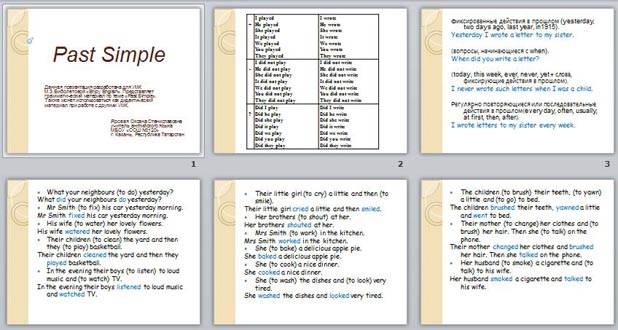
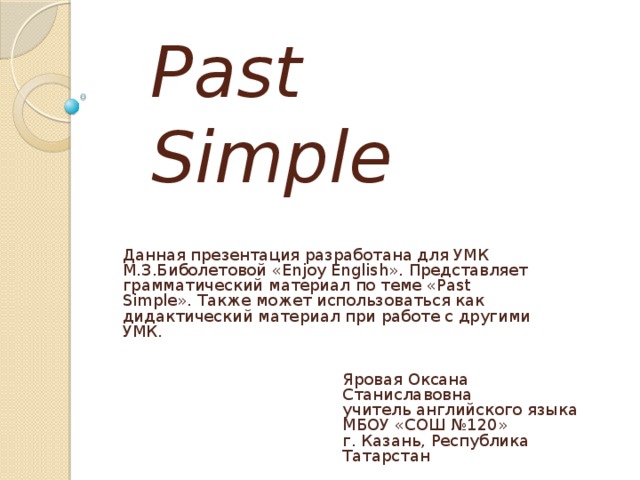
Past Simple Данная презентация разработана для УМК М.З.Биболетовой «Enjoy English». Представляет грамматический материал по теме «Past Simple». Также может использоваться как дидактический материал при работе с другими УМК. Яровая Оксана Станиславовна  учитель английского языка  МБОУ «СОШ №120»  г. Казань, Республика Татарстан

Past Simple

Данная презентация разработана для УМК М.З.Биболетовой «Enjoy English». Представляет грамматический материал по теме «Past Simple». Также может использоваться как дидактический материал при работе с другими УМК.

Яровая Оксана Станиславовна учитель английского языка МБОУ «СОШ №120» г. Казань, Республика Татарстан
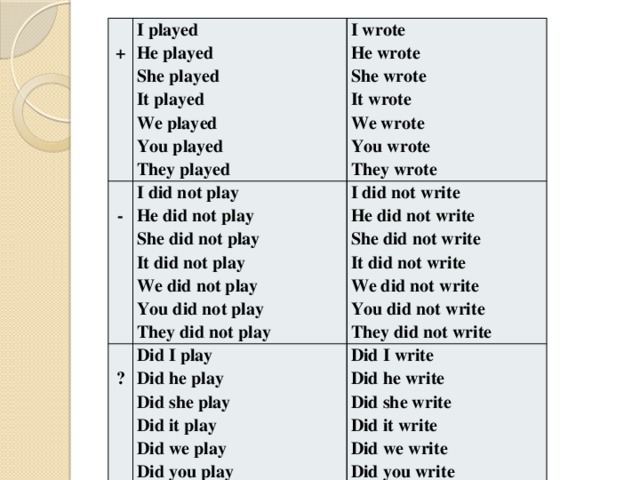
  I played + He played  I did not play - I wrote Did I play ? He did not play I did not write He wrote She played Did he play He did not write Did I write She did not play It played She wrote Did she play It did not play We played Did he write She did not write It wrote We did not play You played Did it play We wrote It did not write Did she write You did not play They played Did we play We did not write Did it write You wrote They did not play Did you play You did not write They wrote Did we write Did they play They did not write Did you write Did they write
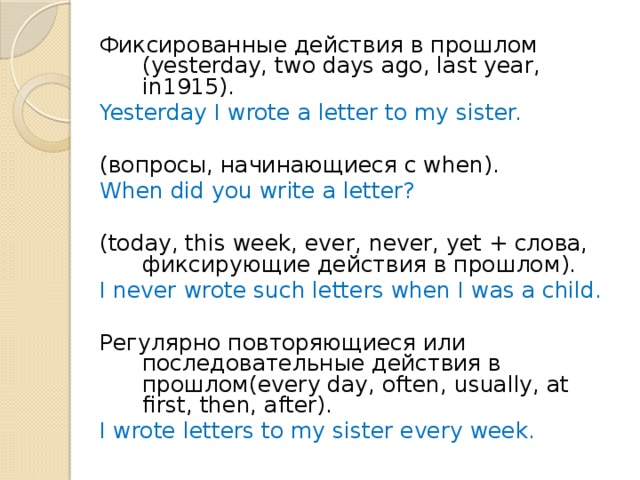
I played

+

He played

I did not play

-

I wrote

Did I play

?

He did not play

I did not write

He wrote

She played

Did he play

He did not write

Did I write

She did not play

It played

She wrote

Did she play

It did not play

We played

Did he write

She did not write

It wrote

We did not play

You played

Did it play

We wrote

It did not write

Did she write

You did not play

They played

Did we play

We did not write

Did it write

You wrote

They did not play

Did you play

You did not write

They wrote

Did we write

Did they play

They did not write

Did you write

Did they write

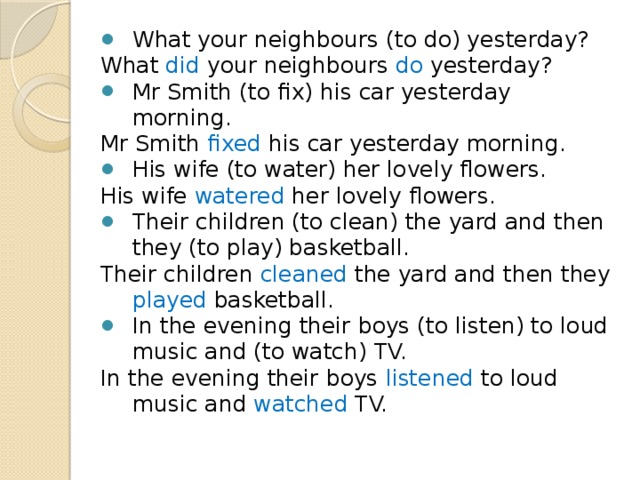
Фиксированные действия в прошлом (yesterday, two days ago, last year, in1915). Yesterday I wrote a letter to my sister. (вопросы, начинающиеся с when). When did you write a letter? (today, this week, ever, never, yet + слова, фиксирующие действия в прошлом). I never wrote such letters when I was a child. Регулярно повторяющиеся или последовательные действия в прошлом(every day, often, usually, at first, then, after). I wrote letters to my sister every week.
Фиксированные действия в прошлом (yesterday, two days ago, last year, in1915).

Yesterday I wrote a letter to my sister.

(вопросы, начинающиеся с when).

When did you write a letter?

(today, this week, ever, never, yet + слова, фиксирующие действия в прошлом).

I never wrote such letters when I was a child.

Регулярно повторяющиеся или последовательные действия в прошлом(every day, often, usually, at first, then, after).

I wrote letters to my sister every week.

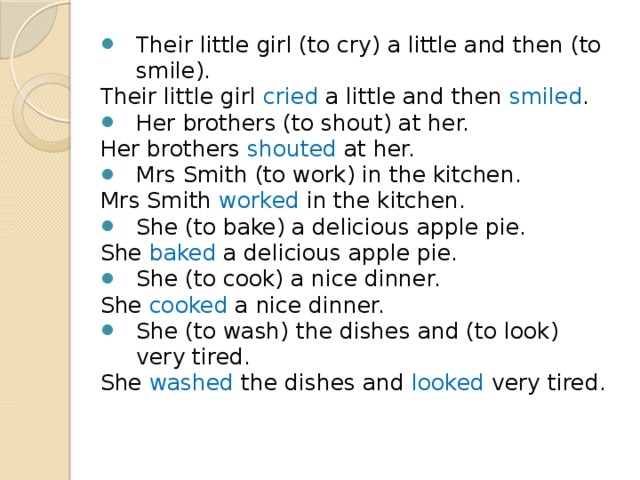
What your neighbours (to do) yesterday? What did your neighbours do yesterday? Mr Smith (to fix) his car yesterday morning. Mr Smith fixed his car yesterday morning. His wife (to water) her lovely flowers. His wife watered her lovely flowers. Their children (to clean) the yard and then they (to play) basketball. Their children cleaned the yard and then they played basketball. In the evening their boys (to listen) to loud music and (to watch) TV. In the evening their boys listened to loud music and watched TV.
  • What your neighbours (to do) yesterday?

What did your neighbours do yesterday?

  • Mr Smith (to fix) his car yesterday morning.

Mr Smith fixed his car yesterday morning.

  • His wife (to water) her lovely flowers.

His wife watered her lovely flowers.

  • Their children (to clean) the yard and then they (to play) basketball.

Their children cleaned the yard and then they played basketball.

  • In the evening their boys (to listen) to loud music and (to watch) TV.

In the evening their boys listened to loud music and watched TV.

Their little girl (to cry) a little and then (to smile). Their little girl cried a little and then smiled . Her brothers (to shout) at her. Her brothers shouted at her. Mrs Smith (to work) in the kitchen. Mrs Smith worked in the kitchen. She (to bake) a delicious apple pie. She baked a delicious apple pie. She (to cook) a nice dinner. She cooked a nice dinner. She (to wash) the dishes and (to look) very tired. She washed the dishes and looked very tired.
  • Their little girl (to cry) a little and then (to smile).

Their little girl cried a little and then smiled .

  • Her brothers (to shout) at her.

Her brothers shouted at her.

  • Mrs Smith (to work) in the kitchen.

Mrs Smith worked in the kitchen.

  • She (to bake) a delicious apple pie.

She baked a delicious apple pie.

  • She (to cook) a nice dinner.

She cooked a nice dinner.

  • She (to wash) the dishes and (to look) very tired.

She washed the dishes and looked very tired.

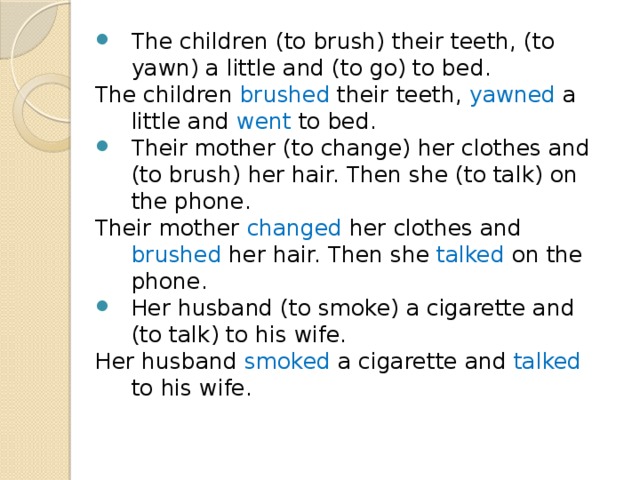
The children (to brush) their teeth, (to yawn) a little and (to go) to bed. The children brushed their teeth, yawned a little and went to bed. Their mother (to change) her clothes and (to brush) her hair. Then she (to talk) on the phone. Their mother changed her clothes and brushed her hair. Then she talked on the phone. Her husband (to smoke) a cigarette and (to talk) to his wife. Her husband smoked a cigarette and talked to his wife.
  • The children (to brush) their teeth, (to yawn) a little and (to go) to bed.

The children brushed their teeth, yawned a little and went to bed.

  • Their mother (to change) her clothes and (to brush) her hair. Then she (to talk) on the phone.

Their mother changed her clothes and brushed her hair. Then she talked on the phone.

  • Her husband (to smoke) a cigarette and (to talk) to his wife.

Her husband smoked a cigarette and talked to his wife.

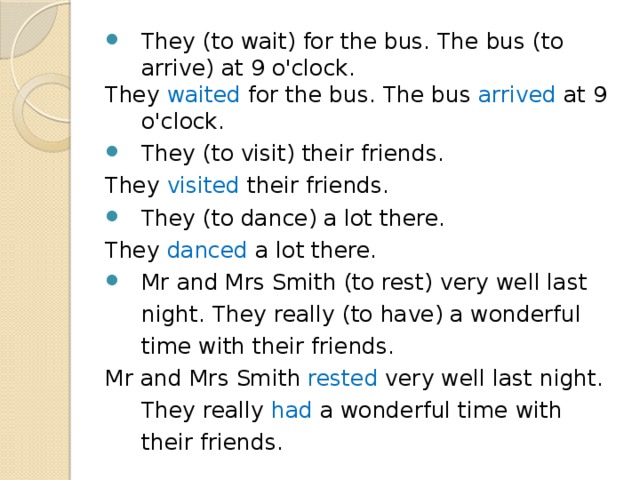
They (to wait) for the bus. The bus (to arrive) at 9 o'clock. They waited for the bus. The bus arrived at 9 o'clock. They (to visit) their friends. They visited their friends. They (to dance) a lot there. They danced a lot there. Mr and Mrs Smith (to rest) very well last night. They really (to have) a wonderful time with their friends. Mr and Mrs Smith rested very well last night. They really had a wonderful time with their friends.
  • They (to wait) for the bus. The bus (to arrive) at 9 o'clock.

They waited for the bus. The bus arrived at 9 o'clock.

  • They (to visit) their friends.

They visited their friends.

  • They (to dance) a lot there.

They danced a lot there.

  • Mr and Mrs Smith (to rest) very well last night. They really (to have) a wonderful time with their friends.

Mr and Mrs Smith rested very well last night. They really had a wonderful time with their friends.
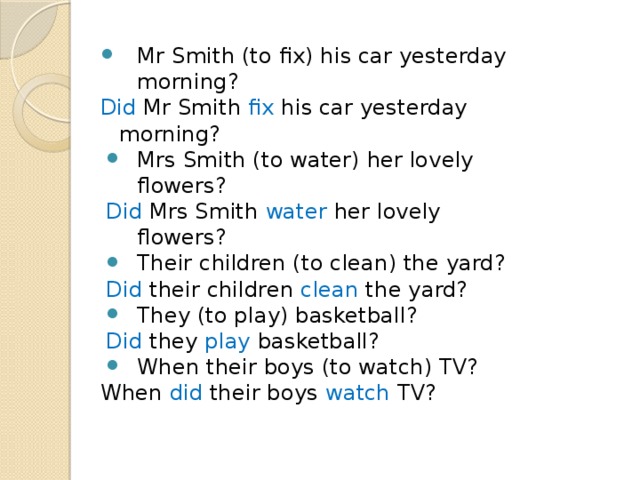
Mr Smith (to fix) his car yesterday morning? Did Mr Smith fix his car yesterday morning? Mrs Smith (to water) her lovely flowers? Did Mrs Smith water her lovely flowers? Their children (to clean) the yard? Did their children clean the yard? They (to play) basketball? Did they play basketball? When their boys (to watch) TV? When did their boys watch TV?
  • Mr Smith (to fix) his car yesterday morning?

Did Mr Smith fix his car yesterday morning?

  • Mrs Smith (to water) her lovely flowers?

Did Mrs Smith water her lovely flowers?

  • Their children (to clean) the yard?

Did their children clean the yard?

  • They (to play) basketball?

Did they play basketball?

  • When their boys (to watch) TV?

When did their boys watch TV?

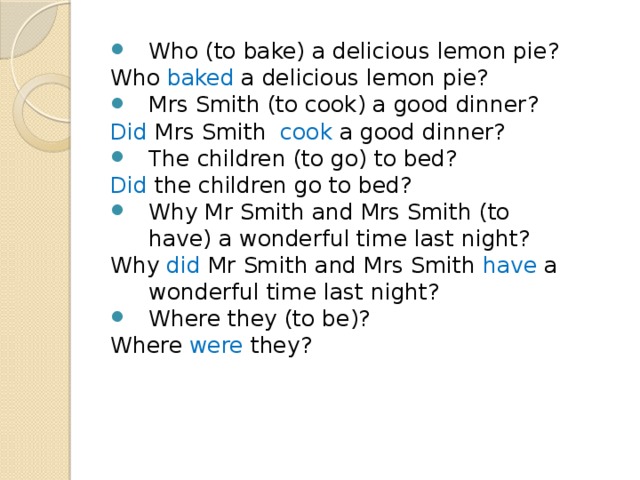
Who (to bake) a delicious lemon pie? Who baked a delicious lemon pie? Mrs Smith (to cook) a good dinner? Did Mrs Smith cook a good dinner? The children (to go) to bed? Did the children go to bed? Why Mr Smith and Mrs Smith (to have) a wonderful time last night? Why did Mr Smith and Mrs Smith have a wonderful time last night? Where they (to be)? Where were they?
  • Who (to bake) a delicious lemon pie?

Who baked a delicious lemon pie?

  • Mrs Smith (to cook) a good dinner?

Did Mrs Smith cook a good dinner?

  • The children (to go) to bed?

Did the children go to bed?

  • Why Mr Smith and Mrs Smith (to have) a wonderful time last night?

Why did Mr Smith and Mrs Smith have a wonderful time last night?

  • Where they (to be)?

Where were they?

Литература Качалова К. Н., Израилевич Е. Е. Практическая грамматика английского языка. : В 2-х т. Т2, К.: Методика, 2003 г. — 304 с. Голицынский Ю. В. Грамматика: Сборник упражнений.— 7-е изд., испр. и доп. —СПб.: КАРО, 2011— 576с.

Литература

Качалова К. Н., Израилевич Е. Е. Практическая грамматика английского языка. : В 2-х т. Т2, К.: Методика, 2003 г. — 304 с.

Голицынский Ю. В. Грамматика: Сборник упражнений.— 7-е изд., испр. и доп. —СПб.: КАРО, 2011— 576с.

-80%
Курсы повышения квалификации

Менеджмент в образовании

Продолжительность 108 часов
Документ: Удостоверение о повышении квалификации
5900 руб.
1180 руб.
Подробнее
Скачать разработку
Сохранить у себя:
Презентация по английскому языку "Past Simple" (0.1 MB)

Комментарии 0

Чтобы добавить комментарий зарегистрируйтесь или на сайт