
 Получите свидетельство
 Вход
Вход


Organization moment. 2 minutes
T: Good afternoon, children!
P: Good afternoon, teacher!
T: I’m glad to see you! How are you today?
P: We are fine, thank you.
T: Who is absent?
P:All are present
T:What date is it today?
P: Today is the 3rd of February.
T:Whatis the day today ?
P:Today is the Wednesday.
T: What is the weather like today?
P: The weather is cold.
Warming up. 5 minutes
T: Now, children, I will read the definition and you must guess what animals is it.
1) It lives on the farm, it flies badly. It eats corn. It lays eggs. It sings songs. What is it? (a hen)
2) It lives on the farm. It runs well. It eats grass. It gives milk. What is it?(a cow)
3) It is brown. It has got 4 legs. It sleeps in winter. What is it? (an elephant)
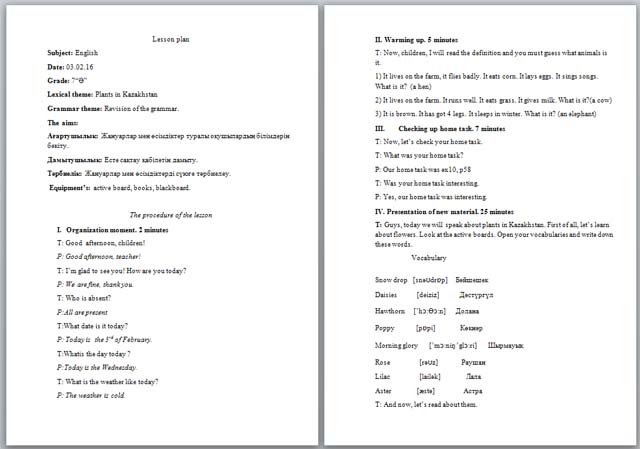
III. Checking up home task. 7 minutes
T: Now, let’s check your home task.
T: What was your home task?
P: Our home task was ex10, p58
T: Was your home task interesting.
P: Yes, our home task was interesting.
IV. Presentation of new material. 25 minutes
T: Guys, today we will speak about plants in Kazakhstan. First of all, let’s learn about flowers. Look at the active boards. Open your vocabularies and write down these words.
Vocabulary
Snow drop [snəʊdrɒp] Бәйшешек
Daisies [deiziz] Дәстүргүл
Hawthorn [’hɔ:Өɔ:n] Долана
Poppy [pɒpi] Көкнәр
Morning glory [’mɔ:niŋ ’glɔ:ri] Шырмауық
Rose [rəʊz] Раушан
Lilac [lailək] Лала
Aster [æstə] Астра
T: And now, let’s read about them.
P1: Snow drop – it is the flower January. It is white as snow. It appears in forests and gardens. This plant a native flower of Europe.
P2: Daisies – It is white and yellow. You can see them everywhere in the fields, gardens and even roadsides.
P3: Hawthorn – is the flower for May. It grows in a small three and it blossoms with pink, white or red flowers.
P4: Poppy – is the flower for August. Poppies are white, red or yellow. They look like cups. They often grow wild in the mountains.
P5: Morning glory – is September’s flower. It is climbing plant with white, blue or purple blossoms. The morning glory has sweet smell and can grow wild.
P6: Rose – is the flower for May. Very popular and beautiful flower. Roses are red, white or pink. Rose has sweet smell.
P7: Tulip – is the flower for Spring. In the sun, this beautiful flower is wide open and at night and in cloudy weather it closes.
P8: Lilac – is the flower for May. It is light varieties of lilies are very strong, specific aromat.
P9: Aster – is the flower for Autumn. It is called as “Queen of the autumn flower garden”. It pleases us with the flowering until the snow.
T: Very good! So, children, let’s answers my questions.
1) Do you like flowers?
P: Yes, I do.
T: 2) Do you plant flowers?
P: Yes, I plant flowers.
T: 3) Do you water them?
P: Yes, I water them.
T: What is your favorite flower?
P1: My favorite flower is rose.
P2: My favorite flower is poppy.
T: Good job! And now, look at the active board.
You must remember!
*Give them water every day
*Give them a clean dry place to sleep
*You must plant trees, water the flowers
T: Guys, let’s read about “Plants in Kazakhstan” Look at the active board. Read by chain.
Plants in Kazakhstan
The flora of highest plants includes a lot of useful medicinal, technical, food, decorative and other species. The vegetative world of Kazakhstan including up to 14-15 thousand of species, considerably differs by zones, natural belts diversity. The resources of the basic medicinal plants (80%) are widespread in the mountains of Zailiski Alatau, Ketmen, Kungey and Terskey Alatau, Jungar Alatau, Altau, Tarbagatai. The Republic can export some species. Among 450 species of aromatic plants, at least 70 are perspective by content and structure of oil. There is no complete information on mosses.
T: Where the resources of the basic medicinal plants?
P1: The resources of the basic medicinal plants are widespread in the mountains.
T: Where the plants includes a lot of useful?
P2: The plants includes a lot of useful medicinal, technical, food, decorative and the other species.
T: How clever of you.
Полную информацию смотрите в файле.


 Plants in Kazakhstan (разработка урока) (18.97 КB)
 0
0 3846
3846 273
273 Нравится
0
Нравится
0


