Меню
Разработки

Interview skills

Презентация на тему "Interview Skills"

29.12.2017

Содержимое разработки

Mushinskaya

The need to effectively communicate one’s personality, abilities, and experiences to others is important from the day you begin playing with other kids and throughout your childhood and adult life. Your skill in the critical process of interviewing determines your friends, your spouse, your job, and career. Fortunately, interviewing is a skill that can be learned and improves with practice, whether your objective is to get that first job or a promotion in management ranks.

As a former senior executive as well as a small business owner, I have interviewed hundreds of candidates seeking entry-level positions to vice president promotions. I’ve also been on the other side of the table and understand the stress, even desperation, that accompanies an uncertain result.

Unfortunately, in today’s business environment, there are often hundreds of applicants for every job opening, and multiple candidates for every promotion. The ability to separate from the competition, to distinguish one’s self from the pool of equally qualified contenders during the job interview process is crucial. Yet, in my experience, less than one in four candidates were adequately prepared to create a winning impression.

Содержимое разработки

Interview Skills Mushinskaya Yuliaya

Interview Skills

Mushinskaya Yuliaya

A job interview is a one-on-one interview consisting of a conversation between a job applicant and a representative of an employer which is conducted to assess whether the applicant should be hired. Interviews are one of the most popularly used devices for employee selection. Interviews vary in the extent to which the questions are structured, from a totally unstructured and free-wheeling conversation, to a structured interview in which an applicant is asked a predetermined list of questions in a specified order; structured interviews are usually more accurate predictors of which applicants will make good employees, according to research studies.
A job interview is a one-on-one interview consisting of a conversation between a job applicant and a representative of an employer which is conducted to assess whether the applicant should be hired. Interviews are one of the most popularly used devices for employee selection. Interviews vary in the extent to which the questions are structured, from a totally unstructured and free-wheeling conversation, to a structured interview in which an applicant is asked a predetermined list of questions in a specified order; structured interviews are usually more accurate predictors of which applicants will make good employees, according to research studies.

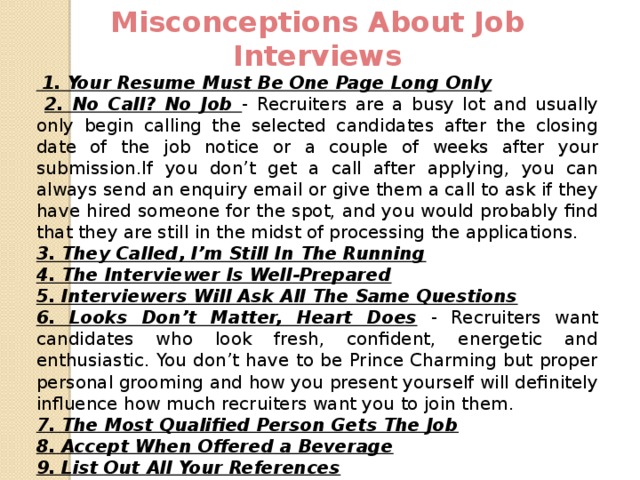
Misconceptions About Job Interviews   1. Your Resume Must Be One Page Long Only  2. No Call? No Job - Recruiters are a busy lot and usually only begin calling the selected candidates after the closing date of the job notice or a couple of weeks after your submission.If you don’t get a call after applying, you can always send an enquiry email or give them a call to ask if they have hired someone for the spot, and you would probably find that they are still in the midst of processing the applications. 3. They Called, I’m Still In The Running 4. The Interviewer Is Well-Prepared 5. Interviewers Will Ask All The Same Questions 6. Looks Don’t Matter, Heart Does - Recruiters want candidates who look fresh, confident, energetic and enthusiastic. You don’t have to be Prince Charming but proper personal grooming and how you present yourself will definitely influence how much recruiters want you to join them. 7. The Most Qualified Person Gets The Job 8. Accept When Offered a Beverage 9. List Out All Your References 10. Keep Your Answers Short  

Misconceptions About Job Interviews

  1. Your Resume Must Be One Page Long Only

2. No Call? No Job - Recruiters are a busy lot and usually only begin calling the selected candidates after the closing date of the job notice or a couple of weeks after your submission.If you don’t get a call after applying, you can always send an enquiry email or give them a call to ask if they have hired someone for the spot, and you would probably find that they are still in the midst of processing the applications.

3. They Called, I’m Still In The Running

4. The Interviewer Is Well-Prepared

5. Interviewers Will Ask All The Same Questions

6. Looks Don’t Matter, Heart Does - Recruiters want candidates who look fresh, confident, energetic and enthusiastic. You don’t have to be Prince Charming but proper personal grooming and how you present yourself will definitely influence how much recruiters want you to join them.

7. The Most Qualified Person Gets The Job

8. Accept When Offered a Beverage

9. List Out All Your References

10. Keep Your Answers Short


How to Prepare for an Interview 1. Analyze the Job - an important part of interview preparation is to take the time to analyze the job posting, or job description, if you have it. As you review the job post, consider what the company is seeking in a candidate. Make a list of the skills, knowledge, and professional and personal qualities that are required by the employer and are critical for success in the job. 2. Make a Match - when you have created a list of the qualifications for the job, make a list of your assets and match them to the job requirements. Create a list of up to 10 assets, including skills, certifications, experiences, professional qualifications and abilities, computer skills, and knowledge bases and have it at the ready to share with the interviewer. Be sure your assets correlate directly with the skills and abilities required by the company. 3. Research the Company - before you go on a job interview, it's important to find out as much as you can about the company. Company research is a critical part of interview preparation. It will help you prepare to both answer interview questions and to ask the interviewer questions. You will also be able to find out whether the company and the company culture are a good fit for you.

How to Prepare for an Interview

1. Analyze the Job - an important part of interview preparation is to take the time to analyze the job posting, or job description, if you have it. As you review the job post, consider what the company is seeking in a candidate. Make a list of the skills, knowledge, and professional and personal qualities that are required by the employer and are critical for success in the job.

2. Make a Match - when you have created a list of the qualifications for the job, make a list of your assets and match them to the job requirements. Create a list of up to 10 assets, including skills, certifications, experiences, professional qualifications and abilities, computer skills, and knowledge bases and have it at the ready to share with the interviewer. Be sure your assets correlate directly with the skills and abilities required by the company.

3. Research the Company - before you go on a job interview, it's important to find out as much as you can about the company. Company research is a critical part of interview preparation. It will help you prepare to both answer interview questions and to ask the interviewer questions. You will also be able to find out whether the company and the company culture are a good fit for you.

4. Practice Interviewing - taking the time to practice answering the interview questions you will probably be asked during a job interview will help give you a framework for your responses and will also help calm your nerves, because you won't be scrambling for an answer while you're in the interview hot seat. Practice interviewing with a friend or family member ahead of time and it will be much easier when you're actually in a job interview. 5. Get Your Interview Clothes Ready - don't wait until the last minute to make sure your interview clothes are ready. Have an interview outfit ready to wear at all times, so you don't have to think about what you're going to wear while you're scrambling to get ready for a job interview. Regardless of the type of job you're interviewing for, that first impression should be a great one. When dressing for an interview for a professional position, dress accordingly in business attire. 6. Decide What to Do With Your Hair - how you style your hair for a job interview is almost as important as the interview clothes you wear. After all, the interviewer is going to notice everything about you—including your interview attire, hairstyle and makeup—and you only have seconds to make a great impression.

4. Practice Interviewing - taking the time to practice answering the interview questions you will probably be asked during a job interview will help give you a framework for your responses and will also help calm your nerves, because you won't be scrambling for an answer while you're in the interview hot seat. Practice interviewing with a friend or family member ahead of time and it will be much easier when you're actually in a job interview.

5. Get Your Interview Clothes Ready - don't wait until the last minute to make sure your interview clothes are ready. Have an interview outfit ready to wear at all times, so you don't have to think about what you're going to wear while you're scrambling to get ready for a job interview. Regardless of the type of job you're interviewing for, that first impression should be a great one. When dressing for an interview for a professional position, dress accordingly in business attire.

6. Decide What to Do With Your Hair - how you style your hair for a job interview is almost as important as the interview clothes you wear. After all, the interviewer is going to notice everything about you—including your interview attire, hairstyle and makeup—and you only have seconds to make a great impression.

7. What to Bring to a Job Interview - it's important to know what to bring to a job interview—a portfolio with extra copies of your resume, a list of references, and a list of questions ask the interviewer. It's also important what not to bring—your cellphone, a cup of coffee, gum, or anything else other than yourself and your credentials . 8. What to Bring to a Job Interview - it's important to know what to bring to a job interview—a portfolio with extra copies of your resume, a list of references, and a list of questions ask the interviewer. It's also important what not to bring—your cellphone, a cup of coffee, gum, or anything else other than yourself and your credentials. 9. Listen and Ask Questions - during a job interview, listening is just as important as answering questions. If you're not paying attention, you're not going to be able to give a good response. It's important to listen to the interviewer, to pay attention, and to take time, if you need it, to compose an appropriate answer. Also, be ready to engage the interviewer. You want there to be a give and take type of conversation, so you're building a relationship with the interviewer rather than just providing rote responses to questions. Have questions of your own ready to ask the interviewer.

7. What to Bring to a Job Interview - it's important to know what to bring to a job interview—a portfolio with extra copies of your resume, a list of references, and a list of questions ask the interviewer. It's also important what not to bring—your cellphone, a cup of coffee, gum, or anything else other than yourself and your credentials .

8. What to Bring to a Job Interview - it's important to know what to bring to a job interview—a portfolio with extra copies of your resume, a list of references, and a list of questions ask the interviewer. It's also important what not to bring—your cellphone, a cup of coffee, gum, or anything else other than yourself and your credentials.

9. Listen and Ask Questions - during a job interview, listening is just as important as answering questions. If you're not paying attention, you're not going to be able to give a good response. It's important to listen to the interviewer, to pay attention, and to take time, if you need it, to compose an appropriate answer. Also, be ready to engage the interviewer. You want there to be a give and take type of conversation, so you're building a relationship with the interviewer rather than just providing rote responses to questions. Have questions of your own ready to ask the interviewer.

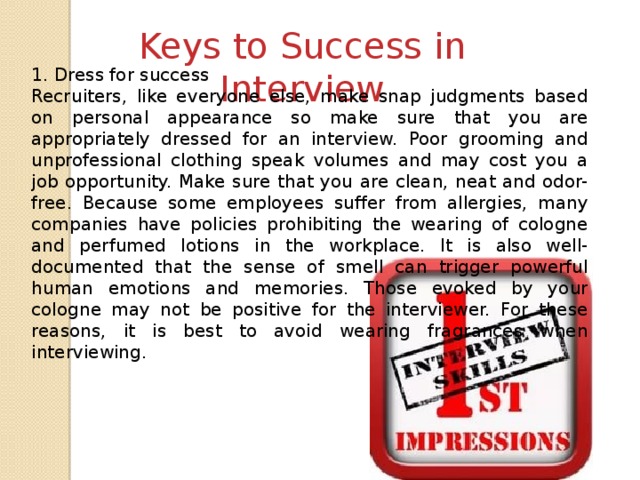
2. Be prepared for the interview Employers are looking for people who can solve problems and save money for their organization. Prepare for the interview by carefully reading the company website and reviewing the job description to gain insight into how your skills and experience will benefit the employer. Then think about ways you can communicate your value during the interview. Bring hard copies of your resume, references, writing samples, and transcripts to the interview. These additional documents may not be needed but having them available makes you look professional and thorough . 3. Be polite and professional Remember that your interview begins the minute you set foot in the employer’s offices. Arrive a few minutes early and give yourself some time to relax before the meeting. How you behave in the interview gives a prospective employer a clue as to how you will interact with co-workers and supervisors if you are hired. Be polite, professional and courteous to everyone you encounter, starting with the receptionist. Since it is best not to eat or drink in an interview, decline offers of food, coffee or other beverages.
2. Be prepared for the interview

Employers are looking for people who can solve problems and save money for their organization. Prepare for the interview by carefully reading the company website and reviewing the job description to gain insight into how your skills and experience will benefit the employer. Then think about ways you can communicate your value during the interview.

Bring hard copies of your resume, references, writing samples, and transcripts to the interview. These additional documents may not be needed but having them available makes you look professional and thorough .

3. Be polite and professional

Remember that your interview begins the minute you set foot in the employer’s offices. Arrive a few minutes early and give yourself some time to relax before the meeting.

How you behave in the interview gives a prospective employer a clue as to how you will interact with co-workers and supervisors if you are hired. Be polite, professional and courteous to everyone you encounter, starting with the receptionist. Since it is best not to eat or drink in an interview, decline offers of food, coffee or other beverages.

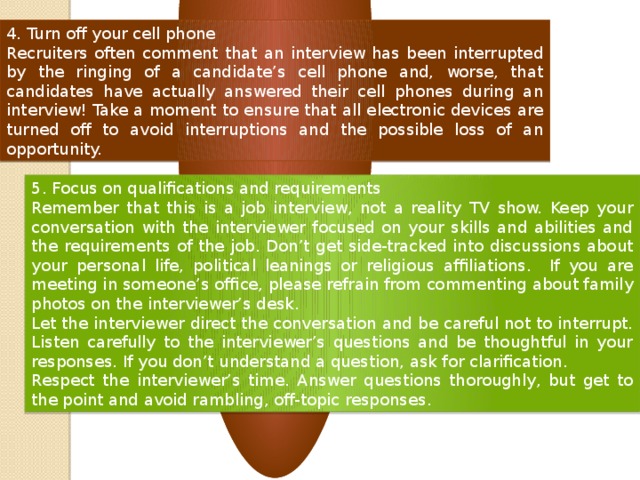
Keys to Success in Interview 1. Dress for success Recruiters, like everyone else, make snap judgments based on personal appearance so make sure that you are appropriately dressed for an interview. Poor grooming and unprofessional clothing speak volumes and may cost you a job opportunity. Make sure that you are clean, neat and odor-free. Because some employees suffer from allergies, many companies have policies prohibiting the wearing of cologne and perfumed lotions in the workplace. It is also well-documented that the sense of smell can trigger powerful human emotions and memories. Those evoked by your cologne may not be positive for the interviewer. For these reasons, it is best to avoid wearing fragrances when interviewing.
Keys to Success in Interview

1. Dress for success

Recruiters, like everyone else, make snap judgments based on personal appearance so make sure that you are appropriately dressed for an interview. Poor grooming and unprofessional clothing speak volumes and may cost you a job opportunity. Make sure that you are clean, neat and odor-free. Because some employees suffer from allergies, many companies have policies prohibiting the wearing of cologne and perfumed lotions in the workplace. It is also well-documented that the sense of smell can trigger powerful human emotions and memories. Those evoked by your cologne may not be positive for the interviewer. For these reasons, it is best to avoid wearing fragrances when interviewing.

4. Turn off your cell phone Recruiters often comment that an interview has been interrupted by the ringing of a candidate’s cell phone and, worse, that candidates have actually answered their cell phones during an interview! Take a moment to ensure that all electronic devices are turned off to avoid interruptions and the possible loss of an opportunity. 5. Focus on qualifications and requirements Remember that this is a job interview, not a reality TV show. Keep your conversation with the interviewer focused on your skills and abilities and the requirements of the job. Don’t get side-tracked into discussions about your personal life, political leanings or religious affiliations. If you are meeting in someone’s office, please refrain from commenting about family photos on the interviewer’s desk. Let the interviewer direct the conversation and be careful not to interrupt. Listen carefully to the interviewer’s questions and be thoughtful in your responses. If you don’t understand a question, ask for clarification. Respect the interviewer’s time. Answer questions thoroughly, but get to the point and avoid rambling, off-topic responses .

4. Turn off your cell phone

Recruiters often comment that an interview has been interrupted by the ringing of a candidate’s cell phone and, worse, that candidates have actually answered their cell phones during an interview! Take a moment to ensure that all electronic devices are turned off to avoid interruptions and the possible loss of an opportunity.

5. Focus on qualifications and requirements

Remember that this is a job interview, not a reality TV show. Keep your conversation with the interviewer focused on your skills and abilities and the requirements of the job. Don’t get side-tracked into discussions about your personal life, political leanings or religious affiliations. If you are meeting in someone’s office, please refrain from commenting about family photos on the interviewer’s desk.

Let the interviewer direct the conversation and be careful not to interrupt. Listen carefully to the interviewer’s questions and be thoughtful in your responses. If you don’t understand a question, ask for clarification.

Respect the interviewer’s time. Answer questions thoroughly, but get to the point and avoid rambling, off-topic responses .

6. Ask questions Even if you have done your homework about the company and have a pretty good understanding of the job requirements, it is important to ask questions. Ideally, you will be weaving questions into the interview as it progresses and those questions should focus on the employer’s expectations and how your success on the job will be measured. It is perfectly acceptable to bring a list of prepared questions to the interview and to reference it before the meeting concludes to make sure that you have all of the information you need. 7. Wrap up If you are truly interested in the job, let the interviewer know that and then ask about the next steps in the process. If you have not been provided with a business card, it is perfectly acceptable to ask for one. You will need that contact information for your follow up correspondence. Thank the interviewer for their time and be sure to thank the receptionist on your way out the door. 8. Follow up This is the electronic age and many candidates prefer to send an email or even a text message to thank the employer for their time. While that is certainly acceptable, there is no substitute for the personal touch that an old-fashioned handwritten note on nice cardstock provides. It might be just the thing that sets you apart from other equally qualified candidates.

6. Ask questions

Even if you have done your homework about the company and have a pretty good understanding of the job requirements, it is important to ask questions. Ideally, you will be weaving questions into the interview as it progresses and those questions should focus on the employer’s expectations and how your success on the job will be measured. It is perfectly acceptable to bring a list of prepared questions to the interview and to reference it before the meeting concludes to make sure that you have all of the information you need.

7. Wrap up

If you are truly interested in the job, let the interviewer know that and then ask about the next steps in the process. If you have not been provided with a business card, it is perfectly acceptable to ask for one. You will need that contact information for your follow up correspondence.

Thank the interviewer for their time and be sure to thank the receptionist on your way out the door.

8. Follow up

This is the electronic age and many candidates prefer to send an email or even a text message to thank the employer for their time. While that is certainly acceptable, there is no substitute for the personal touch that an old-fashioned handwritten note on nice cardstock provides. It might be just the thing that sets you apart from other equally qualified candidates.

Attending an interview Tip #1: Prepare!  Nothing is more important than preparation when it comes to an interview. Preparation includes research. Research the company, the job description, and even the person you are about to meet if possible.  Know as much as you can about what the employer is looking for before you attend the interview. Be prepared to show how your experience can meet and even exceed the company’s needs. Anticipate interview questions and prepare how you will answer them. Prepare good questions about the position and the company.   Tip #2: Organize!  Organization is another part of preparation. Nothing can make you feel more nervous or look more bumbling than a lack of organization. It also tells the employer that you will behave similarly once you have the job. Organize your materials so you can easily access them for application purposes and on the interview itself. Know what time you are to attend the interview and be there early. Organize all your details including clothing, travel route, contact phone numbers, materials, etc. in advance so you don’t feel rushed, flustered, or confused before or during the interview.

Attending an interview

Tip #1: Prepare!

Nothing is more important than preparation when it comes to an interview. Preparation includes research. Research the company, the job description, and even the person you are about to meet if possible.

Know as much as you can about what the employer is looking for before you attend the interview. Be prepared to show how your experience can meet and even exceed the company’s needs. Anticipate interview questions and prepare how you will answer them. Prepare good questions about the position and the company.


Tip #2: Organize!

Organization is another part of preparation. Nothing can make you feel more nervous or look more bumbling than a lack of organization. It also tells the employer that you will behave similarly once you have the job. Organize your materials so you can easily access them for application purposes and on the interview itself. Know what time you are to attend the interview and be there early. Organize all your details including clothing, travel route, contact phone numbers, materials, etc. in advance so you don’t feel rushed, flustered, or confused before or during the interview.

Tip #3: Behave!  You know how your mother told you to “behave?!” Well, there’s no better time to behave than on an interview. It’s a time to be professional and use your best manners. Today there are more opportunities than ever to do the wrong thing on an interview. For example, • Don’t let your cell phone ring when you attend an interview. • Don’t wear a Bluetooth on your ear. • Don’t carry in a cup of coffee. • Even while you are waiting, try to avoid constant texting or listening to music through earbuds or playing games on your phone. Someone may be watching you to see how you spend your time. • Do take the time to review your materials. • Do observe the office. • Do be polite and shake hands, smile and be friendly. • Do take part in conversation but not to the point that you’re rambling about personal details. The interviewer doesn’t need to know about your recent divorce or your honor roll student. • Be yourself but be professional. Engage in conversations the interviewer initiates. • Try your best to use good body language including straight posture. Try not to fidget. Eliminate anything that causes you to do so.  

Tip #3: Behave!

You know how your mother told you to “behave?!” Well, there’s no better time to behave than on an interview. It’s a time to be professional and use your best manners. Today there are more opportunities than ever to do the wrong thing on an interview. For example,

Don’t let your cell phone ring when you attend an interview.

Don’t wear a Bluetooth on your ear.

Don’t carry in a cup of coffee.

Even while you are waiting, try to avoid constant texting or listening to music through earbuds or playing games on your phone. Someone may be watching you to see how you spend your time.

Do take the time to review your materials.

Do observe the office.

Do be polite and shake hands, smile and be friendly.

Do take part in conversation but not to the point that you’re rambling about personal details. The interviewer doesn’t need to know about your recent divorce or your honor roll student.

Be yourself but be professional. Engage in conversations the interviewer initiates.

Try your best to use good body language including straight posture. Try not to fidget. Eliminate anything that causes you to do so.


Tip #4: Thank!  An important part of attending an interview is how you leave an interview. Thank the hiring manager for the opportunity to present your qualifications. You can show your interest by asking questions about when you can expect to hear about their decision and you should express that you are interested in having the job (if you are). Follow up by thanking the employer in writing. Using these tips for attending interviews will help you in any job interview. If you follow through with these tips you will place yourself above many other candidates. Employers often find themselves frustrated by a candidate’s lack of interviewing skills. Often those with great qualifications end up being disappointments to those who had high hopes of hiring them. Don’t be a disappointment – present the candidate they saw in your resume. Exceed their expectations!

Tip #4: Thank!

An important part of attending an interview is how you leave an interview. Thank the hiring manager for the opportunity to present your qualifications. You can show your interest by asking questions about when you can expect to hear about their decision and you should express that you are interested in having the job (if you are). Follow up by thanking the employer in writing.

Using these tips for attending interviews will help you in any job interview. If you follow through with these tips you will place yourself above many other candidates. Employers often find themselves frustrated by a candidate’s lack of interviewing skills. Often those with great qualifications end up being disappointments to those who had high hopes of hiring them. Don’t be a disappointment – present the candidate they saw in your resume. Exceed their expectations!

Closing an interview The way you (and the interviewer) close an interview is always based on the interview flow and the atmosphere created during the conversation.  I would suggest that you don’t put all your energy on creating questions that could sound ‘phony’ questions.  As for closing an interview, try to select questions that are based on your sincere view about the said job. Closing interview questions  For example, here are some questions that show an interest: You may ask questions that are related to the projects/missions in which the company/team is working on now. You can also ask questions on duties and responsibilities for the said job. What are the next interviewing steps – the hiring process? Are they planning to check your references? When will the hiring decision be made? Share the positive things that you know about the company. You can also suggest sending samples of your work, if appropriate.

Closing an interview

The way you (and the interviewer) close an interview is always based on the interview flow and the atmosphere created during the conversation.

I would suggest that you don’t put all your energy on creating questions that could sound ‘phony’ questions.

As for closing an interview, try to select questions that are based on your sincere view about the said job.

Closing interview questions

For example, here are some questions that show an interest:

You may ask questions that are related to the projects/missions in which the company/team is working on now.

You can also ask questions on duties and responsibilities for the said job.

What are the next interviewing steps – the hiring process?

Are they planning to check your references?

When will the hiring decision be made?

Share the positive things that you know about the company.

You can also suggest sending samples of your work, if appropriate.

-80%
Курсы повышения квалификации

Психология межличностных отношений и общения

Продолжительность 144 часа
Документ: Удостоверение о повышении квалификации
6000 руб.
1200 руб.
Подробнее
Скачать разработку
Сохранить у себя:
Interview skills (467.19 KB)

Комментарии 0

Чтобы добавить комментарий зарегистрируйтесь или на сайт

Вы смотрели