
 Получите свидетельство
 Вход
Вход



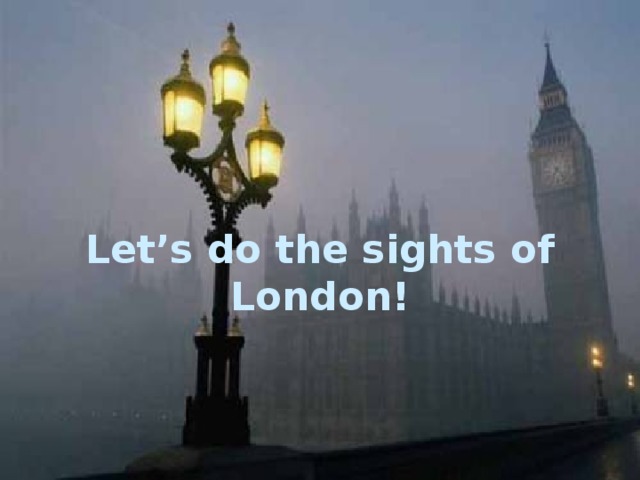
Let’s do the sights of London!
The first place to go if you are in the UK…
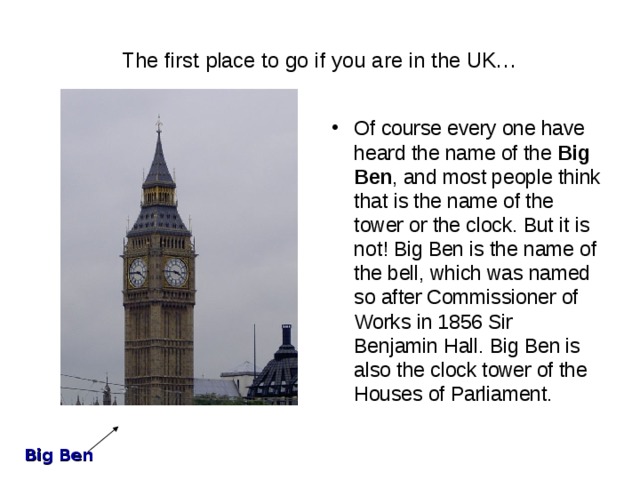
- Of course every one have heard the name of the Big Ben , and most people think that is the name of the tower or the clock. But it is not! Big Ben is the name of the bell, which was named so after Commissioner of Works in 1856 Sir Benjamin Hall. Big Ben is also the clock tower of the Houses of Parliament.
Big Ben
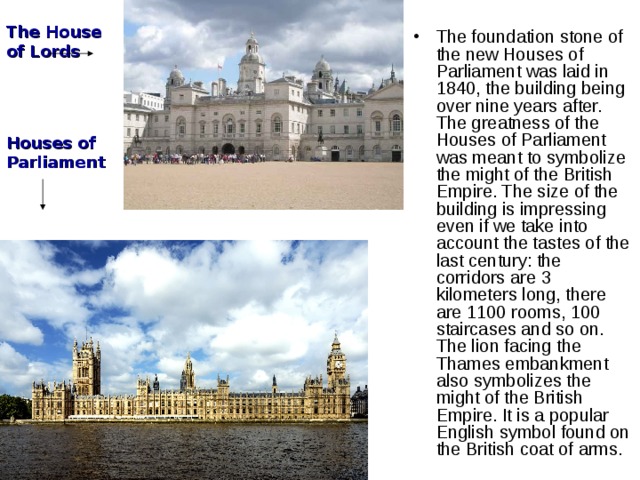
- The foundation stone of the new Houses of Parliament was laid in 1840, the building being over nine years after. The greatness of the Houses of Parliament was meant to symbolize the might of the British Empire. The size of the building is impressing even if we take into account the tastes of the last century: the corridors are 3 kilometers long, there are 1100 rooms, 100 staircases and so on. The lion facing the Thames embankment also symbolizes the might of the British Empire. It is a popular English symbol found on the British coat of arms.
The House of Lords
Houses of Parliament
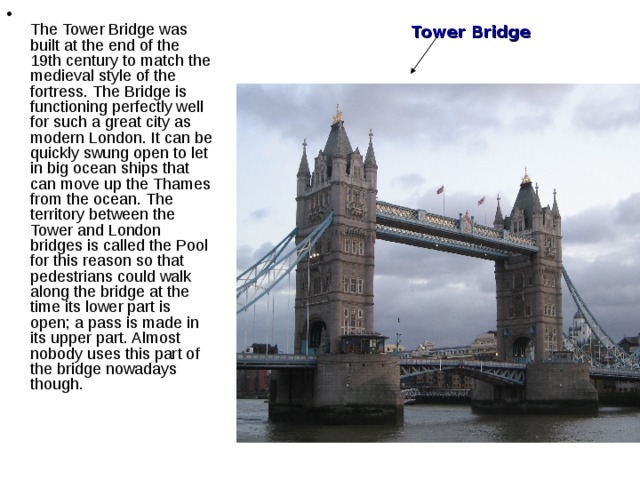
- The Tower Bridge was built at the end of the 19th century to match the medieval style of the fortress. The Bridge is functioning perfectly well for such a great city as modern London. It can be quickly swung open to let in big ocean ships that can move up the Thames from the ocean. The territory between the Tower and London bridges is called the Pool for this reason so that pedestrians could walk along the bridge at the time its lower part is open; a pass is made in its upper part. Almost nobody uses this part of the bridge nowadays though.
Tower Bridge
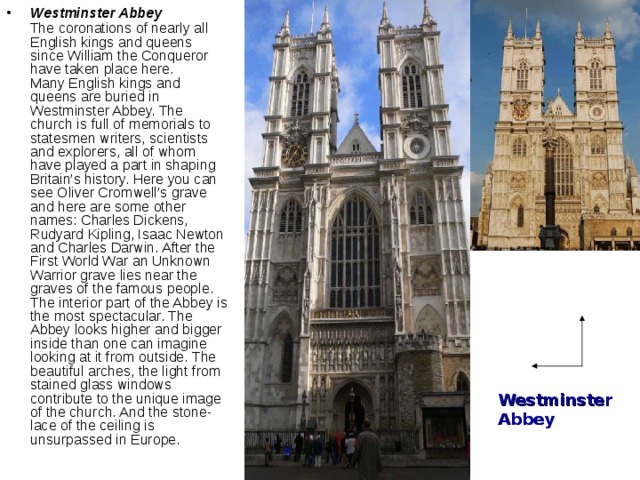
- Westminster Abbey
The coronations of nearly all English kings and queens since William the Conqueror have taken place here. Many English kings and queens are buried in Westminster Abbey. The church is full of memorials to statesmen writers, scientists and explorers, all of whom have played a part in shaping Britain’s history. Here you can see Oliver Cromwell’s grave and here are some other names: Charles Dickens, Rudyard Kipling, Isaac Newton and Charles Darwin. After the First World War an Unknown Warrior grave lies near the graves of the famous people. The interior part of the Abbey is the most spectacular. The Abbey looks higher and bigger inside than one can imagine looking at it from outside. The beautiful arches, the light from stained glass windows contribute to the unique image of the church. And the stone-lace of the ceiling is unsurpassed in Europe.
Westminster Abbey
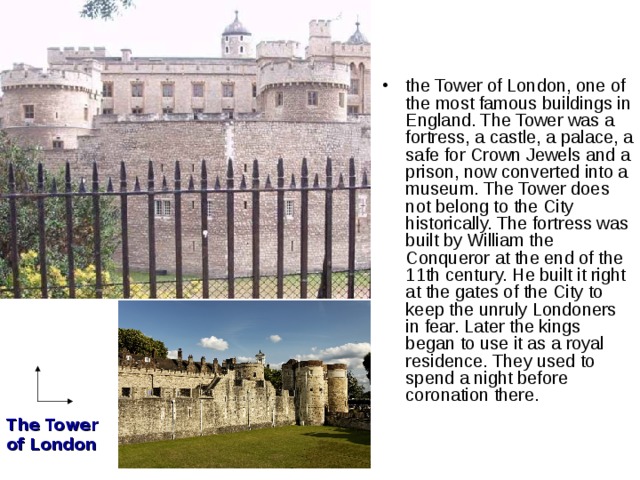
- the Tower of London, one of the most famous buildings in England. The Tower was a fortress, a castle, a palace, a safe for Crown Jewels and a prison, now converted into a museum. The Tower does not belong to the City historically. The fortress was built by William the Conqueror at the end of the 11th century. He built it right at the gates of the City to keep the unruly Londoners in fear. Later the kings began to use it as a royal residence. They used to spend a night before coronation there.
The Tower of London
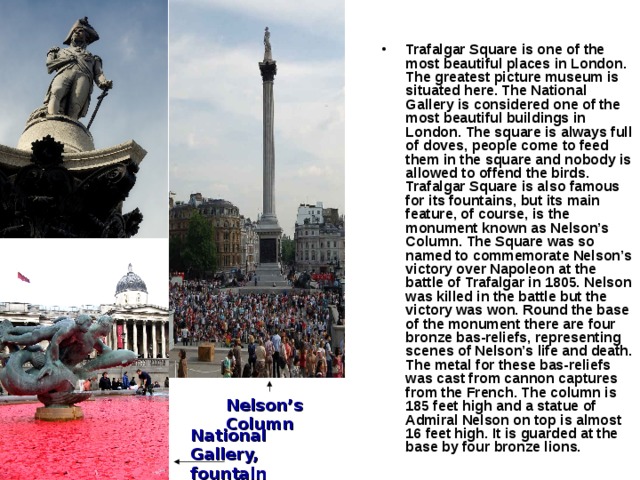
- Trafalgar Square is one of the most beautiful places in London. The greatest picture museum is situated here. The National Gallery is considered one of the most beautiful buildings in London. The square is always full of doves, people come to feed them in the square and nobody is allowed to offend the birds. Trafalgar Square is also famous for its fountains, but its main feature, of course, is the monument known as Nelson’s Column. The Square was so named to commemorate Nelson’s victory over Napoleon at the battle of Trafalgar in 1805. Nelson was killed in the battle but the victory was won. Round the base of the monument there are four bronze bas-reliefs, representing scenes of Nelson’s life and death. The metal for these bas-reliefs was cast from cannon captures from the French. The column is 185 feet high and a statue of Admiral Nelson on top is almost 16 feet high. It is guarded at the base by four bronze lions.
Nelson’s Column
National Gallery, fountain
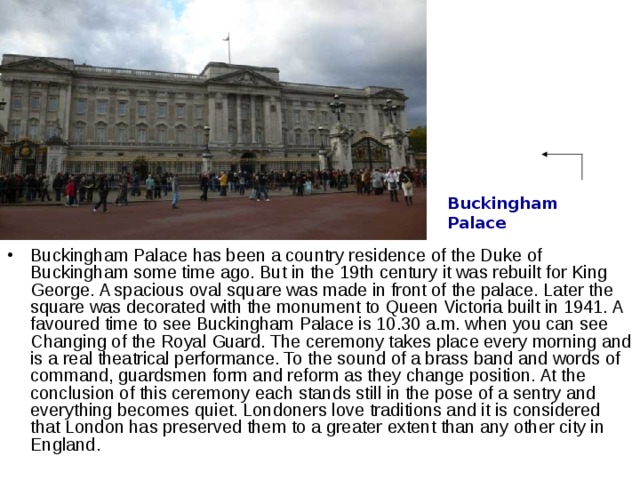
Buckingham Palace
- Buckingham Palace has been a country residence of the Duke of Buckingham some time ago. But in the 19th century it was rebuilt for King George. A spacious oval square was made in front of the palace. Later the square was decorated with the monument to Queen Victoria built in 1941. A favoured time to see Buckingham Palace is 10.30 a.m. when you can see Changing of the Royal Guard. The ceremony takes place every morning and is a real theatrical performance. To the sound of a brass band and words of command, guardsmen form and reform as they change position. At the conclusion of this ceremony each stands still in the pose of a sentry and everything becomes quiet. Londoners love traditions and it is considered that London has preserved them to a greater extent than any other city in England.
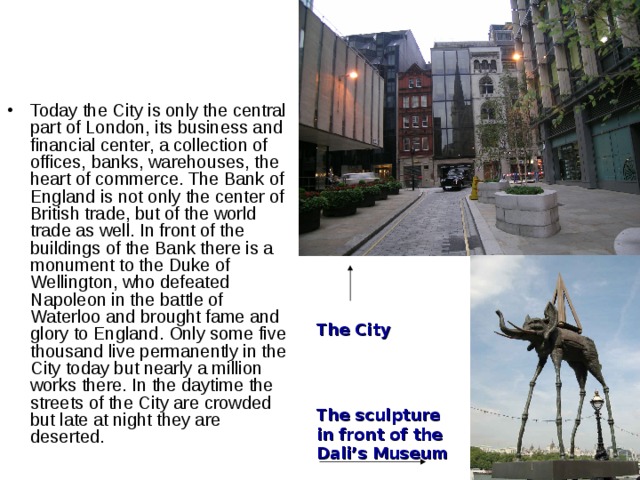
- Today the City is only the central part of London, its business and financial center, a collection of offices, banks, warehouses, the heart of commerce. The Bank of England is not only the center of British trade, but of the world trade as well. In front of the buildings of the Bank there is a monument to the Duke of Wellington, who defeated Napoleon in the battle of Waterloo and brought fame and glory to England. Only some five thousand live permanently in the City today but nearly a million works there. In the daytime the streets of the City are crowded but late at night they are deserted.
The City
The sculpture in front of the Dali’s Museum
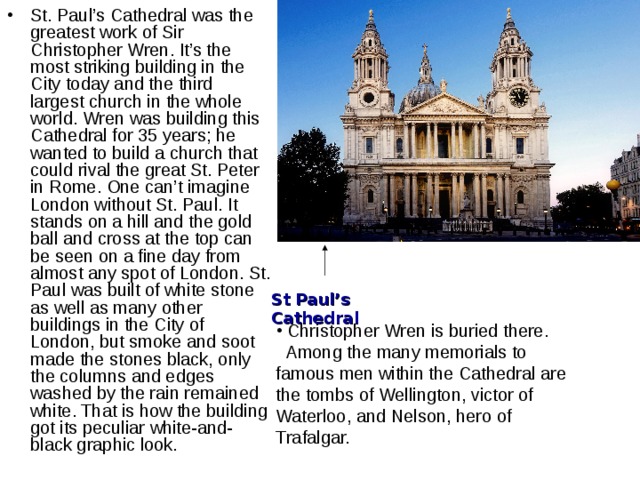
- St. Paul’s Cathedral was the greatest work of Sir Christopher Wren. It’s the most striking building in the City today and the third largest church in the whole world. Wren was building this Cathedral for 35 years; he wanted to build a church that could rival the great St. Peter in Rome. One can’t imagine London without St. Paul. It stands on a hill and the gold ball and cross at the top can be seen on a fine day from almost any spot of London. St. Paul was built of white stone as well as many other buildings in the City of London, but smoke and soot made the stones black, only the columns and edges washed by the rain remained white. That is how the building got its peculiar white-and-black graphic look.
St Paul’s Cathedral
- Christopher Wren is buried there. Among the many memorials to famous men within the Cathedral are the tombs of Wellington, victor of Waterloo, and Nelson, hero of Trafalgar.
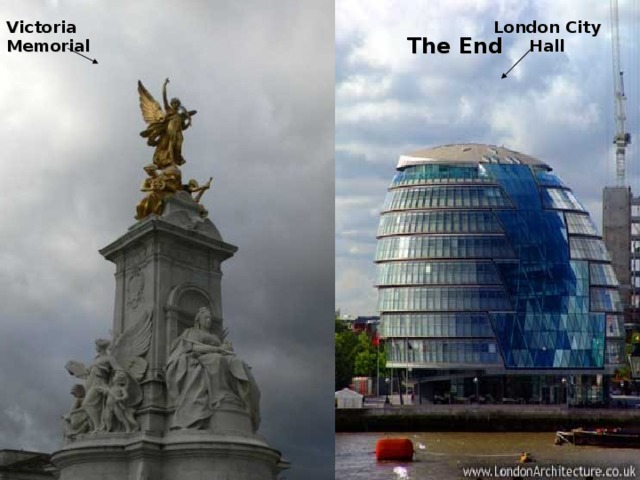
V ictoria M emoria l
London C ity H all
The End









 Достопримечательности Лондона (21.08 MB)
 0
0 425
425 9
9 Нравится
0
Нравится
0


