
 Получите свидетельство
 Вход
Вход




« Eco-helpers »

Match English and Russian equivalents .
- plant flowers
- recycle cans
- collect rubbish
- build nesting boxes
- teach the cycle of life
- clean out a pond
- read a book about ecology
- строить домики для птиц
- читать книгу по экологии
- сажать цветы
- чистить пруд
- собирать мусор
- подвергать вторичному использованию банки
- преподавать цикл жизни
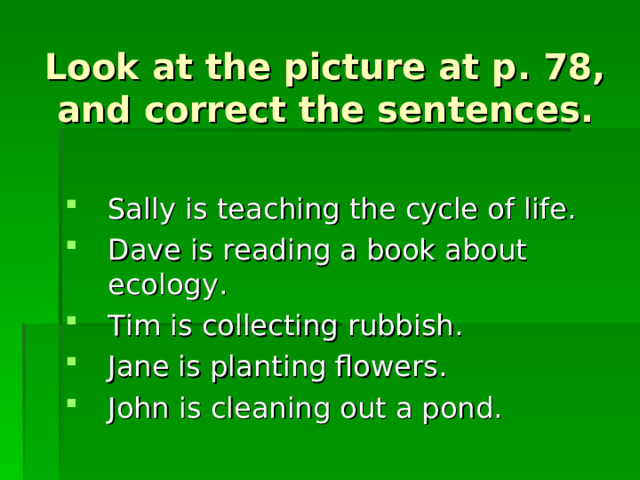
Look at the picture at p. 78, and correct the sentences.
- Sally is teaching the cycle of life.
- Dave is reading a book about ecology.
- Tim is collecting rubbish.
- Jane is planting flowers.
- John is cleaning out a pond.

Read the sentences and transform them into the present perfect continuous tense.
- Jane is teaching the cycle of life.
- _________________________________________
- Rose is cleaning out a pond.
- _________________________________________
- Dave is planting flowers.
- _________________________________________
Tim is building nesting boxes
- _________________________________________

Label the pictures.
- a ladder
- a hammer and nails
- a spade
- a watering can
- a rake
- a net
- gardening gloves
- a plastic bag

Read the dialogue and complete the sentences.
- Sally ___________________ for a month.
- Dave’s been _____________________ .
- The birds will leave the city if _________ .
- Tim wants to ______ on Monday morning .
![Fill in with live, life, leave and live [laiv]. It is my dream to _______ in New York. We are _______ for London on April 5. ___________ is not all cakes and ale. I like watching _______ commentaries.](https://static.multiurok.ru/videouroki/html/2025/03/27/v_67e4caf125ab3/img6.jpg)
Fill in with live, life, leave and live [laiv].
- It is my dream to _______ in New York.
- We are _______ for London on April 5.
- ___________ is not all cakes and ale.
- I like watching _______ commentaries.

QUESTION TAGS
Разделительные вопросы

не так ли?
Question at the end of the statement
***
Вопрос в конце высказывания

1
You haven't got a car , have you?
It was a good film, wasn't it?
We use auxiliary verbs (in the correct tense) and personal pronoun to ask questions tags.
В вопросительных тэгах используются вспомогательные глаголы и личные местоимения.
They came by car, didn't they?

В предложении с отрицанием ( negative sentence ) обычно используется утвердительный ( positive ) вопросительный тэг:
:
POSITIVE QUESTION TAG
NEGATIVE STATEMENT
are they?
My parents aren´t very rich,
He isn´t tall,
is he?
В утвердительном предложении ( positive sentence ) используется вопросительный тэг с отрицанием
NEGATIVE QUESTION TAG
POSITIVE STATEMENT
He is tall,
isn´t he?
My parents are very rich,
aren´t they ?

После Let’s… вопросительным тэгом служит shall we?:
Let's go out for a walk, shall we?
После повелительного наклонения (do/ don't do something) тэгом является will you?:
Open the door, will you?
Don't be late, will you ?
Заметьте, что говорят aren't I?(=am I not ):
I'm late, aren't I?

Если в предложении есть наречие Never вопросительный тэг будет утвердительным:
You never do you homework, do you ?

Complete the sentences
i sn ’ t he
1.He is at school, ______________ ?
2.Your mum works in a bank, ________?
does’nt she
3.They helped you a lot, _ ________ ____?
didn´t they
4.He was crying, _____ ________ ____?
wasn´t he
has she
5.Mary has not visited London, _________ ?
6.You are working abroad,__________?
aren´t you
7.He will go there, ________________?
won´t he
8.They are not going to the cinema now,
__________?
are they

Finish the sentenses
It wo n‘t be snowy tomorrow,
I was in London,
You were n‘t busy,
She can dance well,
will it?
was n‘t I?
were you?
can ‘t she?

He is a student,
They are n‘t at home,
We shall go to the Zoo,
You can use a dictionary,
is n‘t he?
are they?
sha n‘t we?
ca n’t you?

My friends are students ,
aren‘t they ?
Tom can speak English,
The girl was in Britain,
The dog has a nice house ,
can‘t he ?
wasn‘t she ?
hasn‘t it ?

You like detective stories,
Your sister plays the piano,
They went to the park,
do n‘t you?
does n‘t she?
did not they?

Complete the question tags.
- Rose is cleaning out the pond, _________________?
- Andy has been reading a book for 15 minutes, __________________?
- Sally is collecting rubbish, ______________?
- They study at a secondary school, _____________?
- You can speak three languages, _______________?
- He has passed the exam, _______________?

Read the study box. Find examples of (absence of) necessity in the dialogue.
- I have to take the dog for a walk before I leave. (it is necessary )
- It is Saturday – I don’t have to go to school today. (it is not necessary )

What does/doesn’t Roger have to do?
- Order more trees done!
- Call the recycling centre
- Tidy the eco-library Sally & Andy
- Clean out the clubhouse
- Buy more wood and nails next week
- Give out membership cards

What do/don’t you have to do today?





 Spotlight 7 Module 8b (856.5 KB)
 0
0 1059
1059 152
152 Нравится
0
Нравится
0


