Present Simple
Данная презентация разработана для УМК М.З.Биболетовой «Enjoy English». Представляет грамматический материал по теме « Present Simple ». Также может использоваться как дидактический материал при работе с другими УМК.
Яровая Оксана Станиславовна учитель английского языка МБОУ «СОШ №120» г. Казань, Республика Татарстан
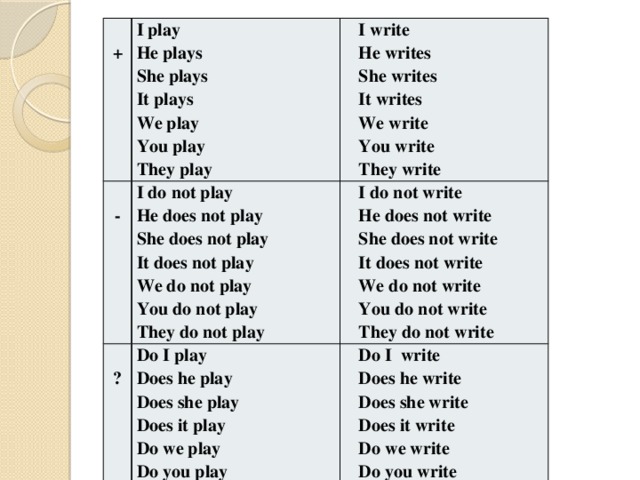
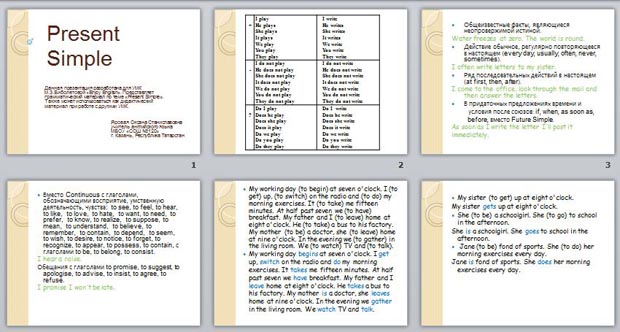
I play
+
He plays
I do not play
-
I write
Do I play
?
He does not play
I do not write
He writes
She plays
Does he play
He does not write
Do I write
She does not play
It plays
She writes
Does she play
It does not play
We play
Does he write
She does not write
It writes
We do not play
You play
Does it play
We write
It does not write
Does she write
You do not play
They play
Do we play
We do not write
Does it write
You write
They do not play
Do you play
You do not write
They write
Do we write
Do they play
They do not write
Do you write
Do they write
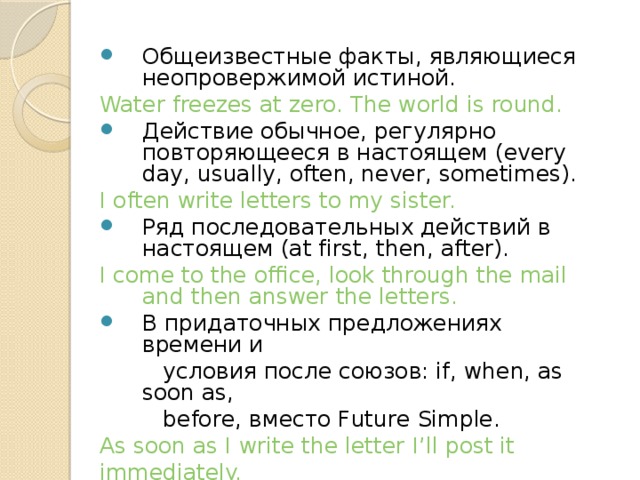
- Общеизвестные факты, являющиеся неопровержимой истиной.
Water freezes at zero. The world is round.
- Действие обычное, регулярно повторяющееся в настоящем (every day, usually, often, never, sometimes).
I often write letters to my sister.
- Ряд последовательных действий в настоящем (at first, then, after).
I come to the office, look through the mail and then answer the letters.
- В придаточных предложениях времени и
условия после союзов: if, when, as soon as,
before, вместо Future Simple.
As soon as I write the letter I’ll post it
immediately.
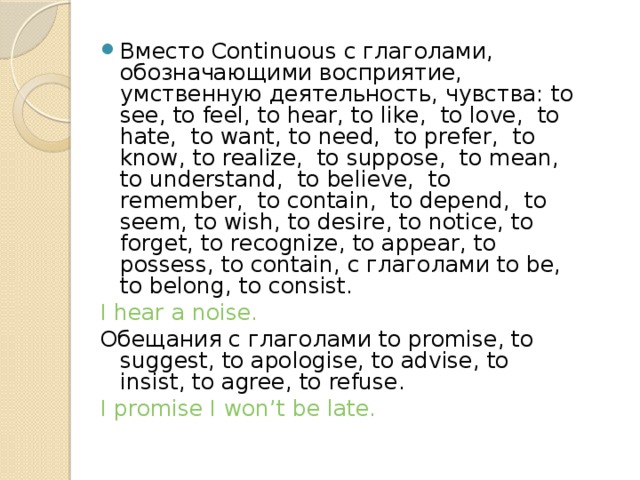
- Вместо Continuous с глаголами, обозначающими восприятие, умственную деятельность, чувства: to see, to feel, to hear, to like, to love, to hate, to want, to need, to prefer, to know, to realize, to suppose, to mean, to understand, to believe, to remember, to contain, to depend, to seem, to wish, to desire, to notice, to forget, to recognize, to appear, to possess, to contain, с глаголами to be, to belong, to consist.
I hear a noise.
Обещания с глаголами to promise, to suggest, to apologise, to advise, to insist, to agree, to refuse.
I promise I won’t be late.
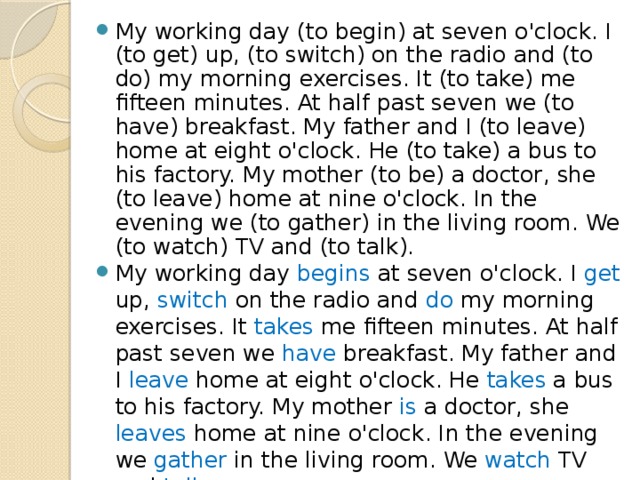
- My working day (to begin) at seven o'clock. I (to get) up, (to switch) on the radio and (to do) my morning exercises. It (to take) me fifteen minutes. At half past seven we (to have) breakfast. My father and I (to leave) home at eight o'clock. He (to take) a bus to his factory. My mother (to be) a doctor, she (to leave) home at nine o'clock. In the evening we (to gather) in the living room. We (to watch) TV and (to talk).
- My working day begins at seven o'clock. I get up, switch on the radio and do my morning exercises. It takes me fifteen minutes. At half past seven we have breakfast. My father and I leave home at eight o'clock. He takes a bus to his factory. My mother is a doctor, she leaves home at nine o'clock. In the evening we gather in the living room. We watch TV and talk .
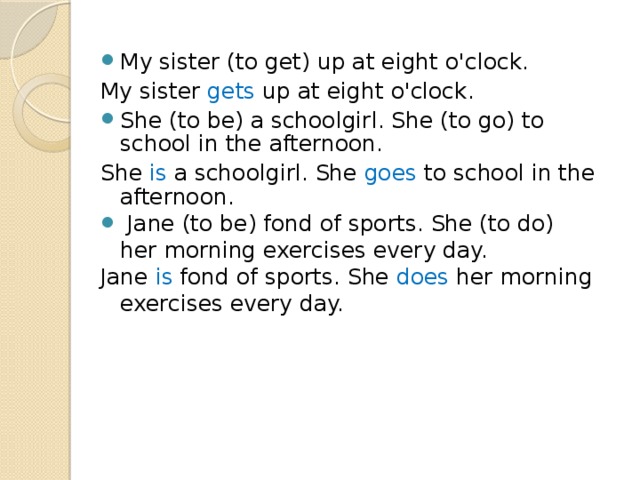
- My sister (to get) up at eight o'clock.
My sister gets up at eight o'clock.
- She (to be) a schoolgirl. She (to go) to school in the afternoon.
She is a schoolgirl. She goes to school in the afternoon.
- Jane (to be) fond of sports. She (to do) her morning exercises every day.
Jane is fond of sports. She does her morning exercises every day.
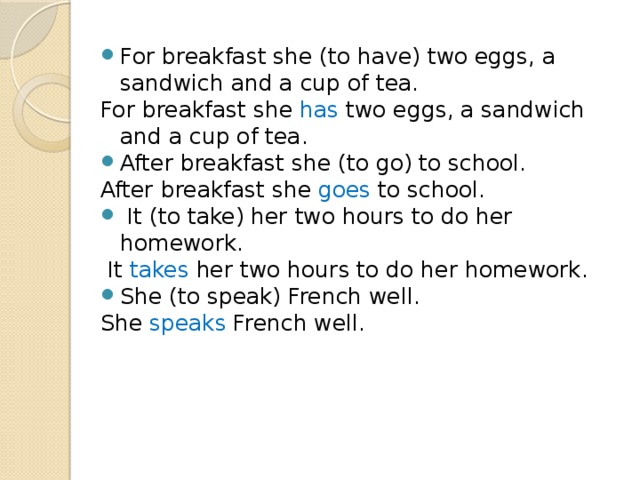
- For breakfast she (to have) two eggs, a sandwich and a cup of tea.
For breakfast she has two eggs, a sandwich and a cup of tea.
- After breakfast she (to go) to school.
After breakfast she goes to school.
- It (to take) her two hours to do her homework.
It takes her two hours to do her homework.
- She (to speak) French well.
She speaks French well.
Литература
Качалова К. Н., Израилевич Е. Е. Практическая грамматика английского языка. : В 2-х т. Т2, К.: Методика, 2003 г. — 304 с.
Голицынский Ю. В. Грамматика: Сборник упражнений.— 7-е изд., испр. и доп. —СПб.: КАРО, 2011— 576с.

 Получите свидетельство
 Вход
Вход





 Презентация по английскому языку "Present Simple" (90.78 КB)
 0
0 773
773 24
24 Нравится
0
Нравится
0


