Меню
Разработки
Разработки  /  Английский язык  /  Презентации  /  7 класс  /  «Модальные глаголы как способ общения

«Модальные глаголы как способ общения

Инновационный урок английского языка в 7 классе с применением ИКТ на тему «Модальные глаголы как способ общения»
30.09.2019

Содержимое разработки

Инновационный урок английского языка в 7 классе с применением ИКТ на тему «Модальные глаголы как способ общения» Шмелева  Анастасия Сергеевна, учитель английского языка
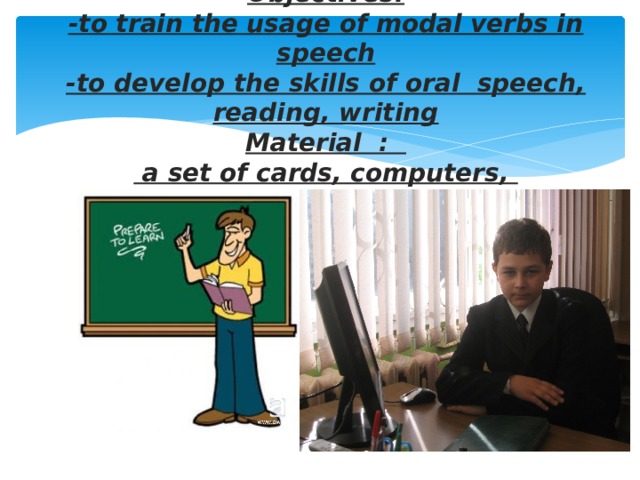
Инновационный урок английского языка в 7 классе с применением ИКТ на тему «Модальные глаголы как способ общения»

Шмелева

Анастасия Сергеевна, учитель английского языка

Objectives:  -to train the usage of modal verbs in speech  -to develop the skills of oral  speech, reading, writing  Material  :    a set of cards, computers, presentations
Objectives: -to train the usage of modal verbs in speech -to develop the skills of oral  speech, reading, writing Material  :   a set of cards, computers, presentations

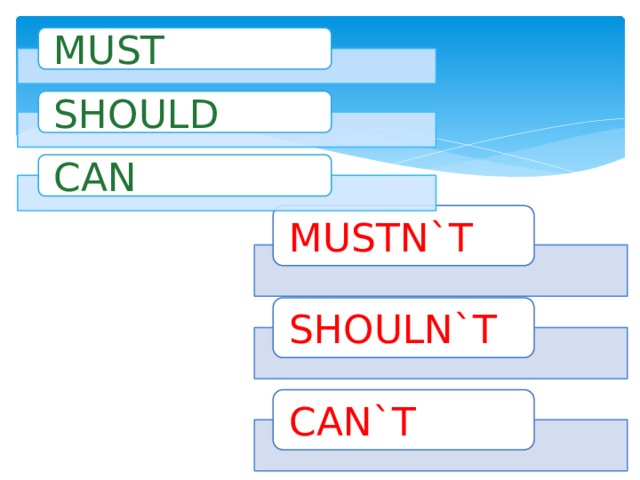
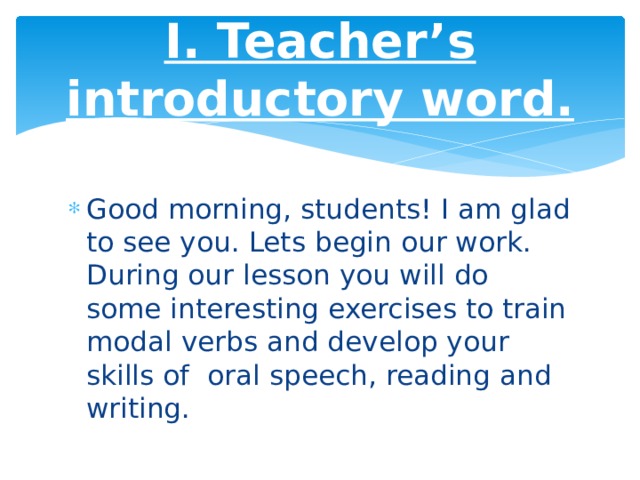
MUST SHOULD CAN MUSTN`T SHOULN`T CAN`T
MUST

SHOULD

CAN

MUSTN`T

SHOULN`T

CAN`T

I. Teacher’s introductory word. Good morning, students! I am glad to see you. Lets begin our work. During our lesson you will do some interesting exercises to train modal verbs and develop your skills of  oral speech, reading and writing.
I. Teacher’s introductory word.

  • Good morning, students! I am glad to see you. Lets begin our work. During our lesson you will do some interesting exercises to train modal verbs and develop your skills of  oral speech, reading and writing.
II. While-activity.  1) Think of some sentences with modal verbs to the  phrase: My brother is a first-former now. 1)He must get up  early now. 2)He  should… 3)He can…
II. While-activity.

1) Think of some sentences with modal verbs to the  phrase: My brother is a first-former now.

1)He must get up  early now.

2)He  should…

3)He can…

2)-I hope you like your school. Going to school is your work, isn’t it? What do you have to do at school? - answer teacher’s questions, make reports, do tests, wear a uniform, tidy up classrooms      etc.
2)-I hope you like your school.

Going to school is your work, isn’t it?

What do you have to do at school?

- answer teacher’s questions,

make reports,

do tests,

wear a uniform,

tidy up classrooms      etc.

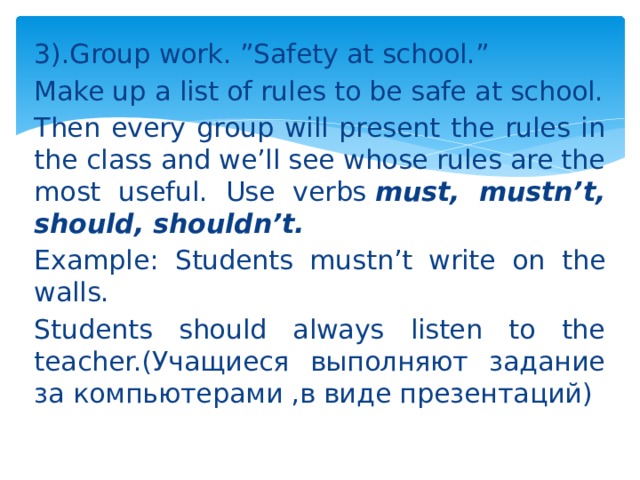
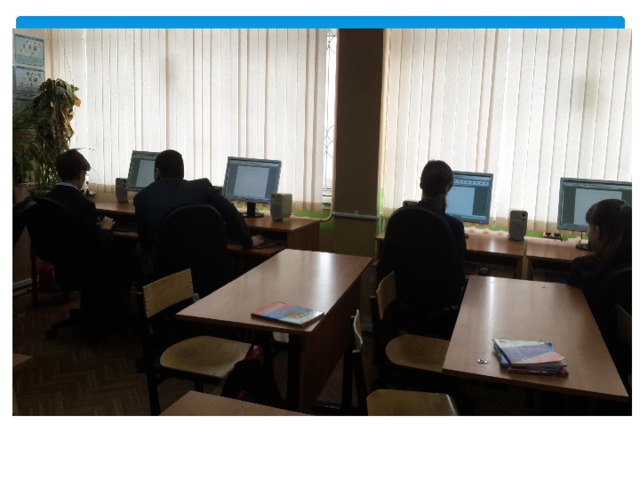
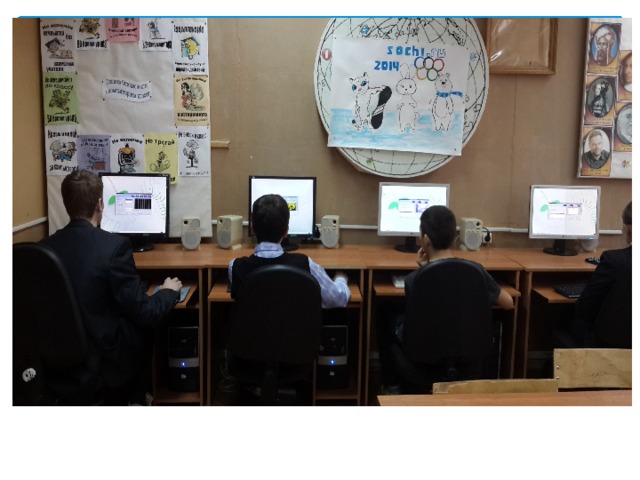
3).Group work. ”Safety at school.” Make up a list of rules to be safe at school. Then every group will present the rules in the class and we’ll see whose rules are the most useful. Use verbs  must, mustn’t, should, shouldn’t. Example: Students mustn’t write on the walls. Students should always listen to the teacher.(Учащиеся выполняют задание за компьютерами ,в виде презентаций)
3).Group work. ”Safety at school.”

Make up a list of rules to be safe at school.

Then every group will present the rules in the class and we’ll see whose rules are the most useful. Use verbs  must, mustn’t, should, shouldn’t.

Example: Students mustn’t write on the walls.

Students should always listen to the teacher.(Учащиеся выполняют задание за компьютерами ,в виде презентаций)
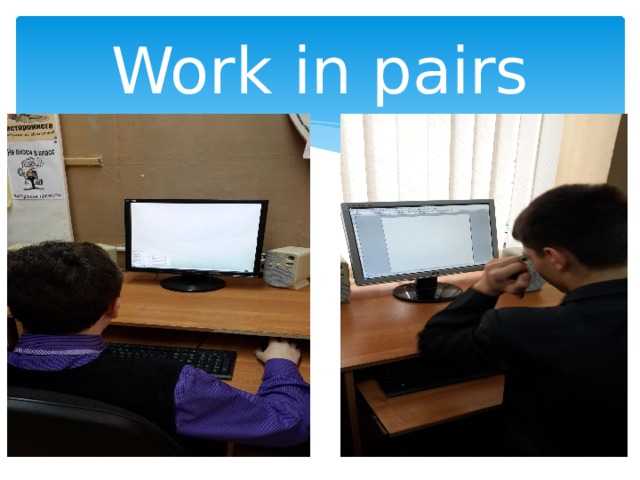
Work in pairs
Work in pairs

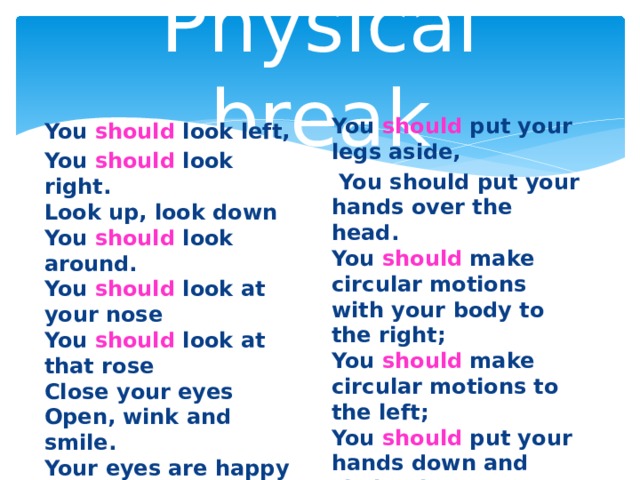
Physical break You should put your legs aside,  You should put your hands over the head.  You should make circular motions with your body to the right;  You should make circular motions to the left;  You should put your hands down and shake them.  Repeat 4–6 times. The pace is medium. You should look left, You should look right.  Look up, look down  You should look around.  You should look at your nose  You should look at that rose  Close your eyes  Open, wink and smile.  Your eyes are happy again.

Physical break

You should put your legs aside,

You should put your hands over the head. You should make circular motions with your body to the right; You should make circular motions to the left; You should put your hands down and shake them. Repeat 4–6 times. The pace is medium.

You should look left,

You should look right. Look up, look down You should look around. You should look at your nose You should look at that rose Close your eyes Open, wink and smile. Your eyes are happy again.
III. Modal verbs games
III. Modal verbs games

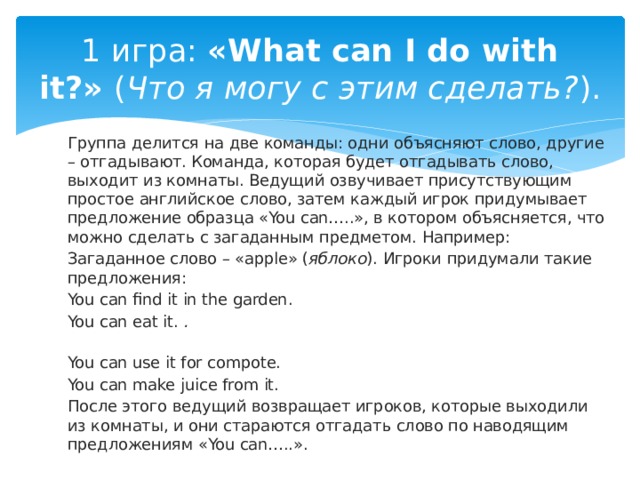
1 игра:  «What can I do with it?»  ( Что я могу с этим сделать? ). Группа делится на две команды: одни объясняют слово, другие – отгадывают. Команда, которая будет отгадывать слово, выходит из комнаты. Ведущий озвучивает присутствующим простое английское слово, затем каждый игрок придумывает предложение образца «You can…..», в котором объясняется, что можно сделать с загаданным предметом. Например: Загаданное слово – «apple» ( яблоко ). Игроки придумали такие предложения: You can find it in the garden.  You can eat it.  .   You can use it for compote.  You can make juice from it.  После этого ведущий возвращает игроков, которые выходили из комнаты, и они стараются отгадать слово по наводящим предложениям «You can…..».
1 игра:  «What can I do with it?»  ( Что я могу с этим сделать? ).

Группа делится на две команды: одни объясняют слово, другие – отгадывают. Команда, которая будет отгадывать слово, выходит из комнаты. Ведущий озвучивает присутствующим простое английское слово, затем каждый игрок придумывает предложение образца «You can…..», в котором объясняется, что можно сделать с загаданным предметом. Например:

Загаданное слово – «apple» ( яблоко ). Игроки придумали такие предложения:

You can find it in the garden. 

You can eat it.  .

You can use it for compote. 

You can make juice from it. 

После этого ведущий возвращает игроков, которые выходили из комнаты, и они стараются отгадать слово по наводящим предложениям «You can…..».

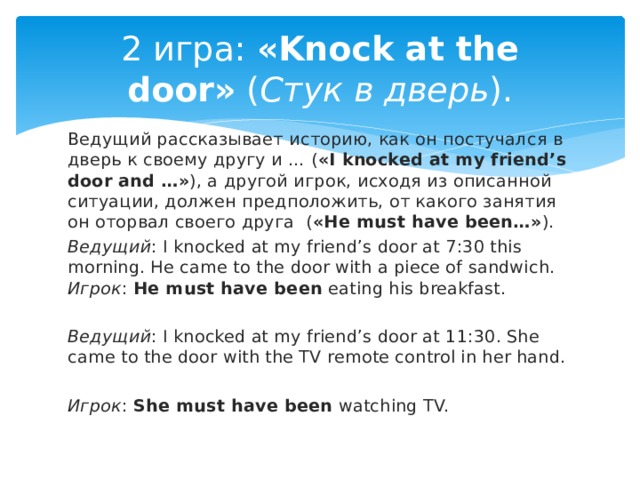
2 игра:  «Knock at the door»  ( Стук в дверь ). Ведущий рассказывает историю, как он постучался в дверь к своему другу и … ( «I knocked at my friend’s door and …» ), а другой игрок, исходя из описанной ситуации, должен предположить, от какого занятия он оторвал своего друга  ( «He must have been…» ). Ведущий : I knocked at my friend’s door at 7:30 this morning. He came to the door with a piece of sandwich.   Игрок :  He must have been  eating his breakfast.  Ведущий : I knocked at my friend’s door at 11:30. She came to the door with the TV remote control in her hand.  Игрок :  She must have been  watching TV. 
2 игра:  «Knock at the door»  ( Стук в дверь ).

Ведущий рассказывает историю, как он постучался в дверь к своему другу и … ( «I knocked at my friend’s door and …» ), а другой игрок, исходя из описанной ситуации, должен предположить, от какого занятия он оторвал своего друга  ( «He must have been…» ).

Ведущий : I knocked at my friend’s door at 7:30 this morning. He came to the door with a piece of sandwich.  ИгрокHe must have been  eating his breakfast. 

Ведущий : I knocked at my friend’s door at 11:30. She came to the door with the TV remote control in her hand. 

ИгрокShe must have been  watching TV. 

Stop me, please!»  ( Остановите меня, пожалуйста! ) . Эта игра на использование негативных модальных глаголов. Для нее нужно подготовить маленькие бутылочки/колбы (или обычные карточки): на одних написать «Poison»(« Яд ») на других «Drug»(« Лекарство ») и смешать их. Ведущий рассказывает, что он заболел и ему нужно принять лекарство, но он потерял очки и не различает, где лекарство, а где яд. Затем берет бутылочку, демонстрирует игрокам, и делает вид, что собирается выпить со словами «This  must  be the right bottle!», а игроки должны предостерегать его фразами: You  don’t have to  drink it! You  must not  take it! You  don’t need to  . . . You  should not  . . . Ведущий может обращаться к игрокам с вопросами: «Is this the right bottle?», «Can anyone help me? I can’t read the label!», «Do you think this is the right one?».
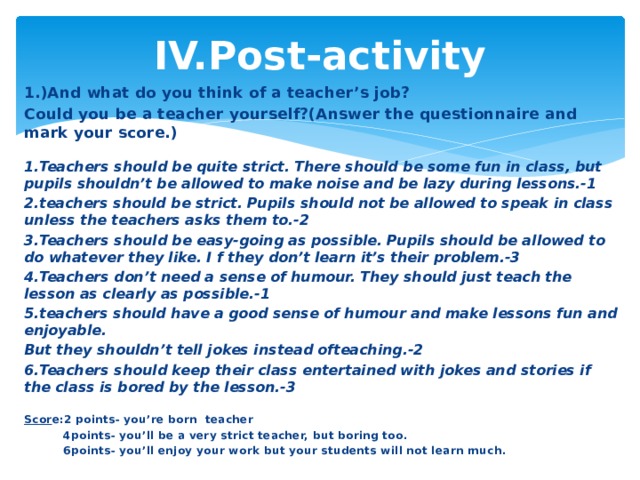
Stop me, please!»  ( Остановите меня, пожалуйста! ) .

Эта игра на использование негативных модальных глаголов. Для нее нужно подготовить маленькие бутылочки/колбы (или обычные карточки): на одних написать «Poison»(« Яд ») на других «Drug»(« Лекарство ») и смешать их. Ведущий рассказывает, что он заболел и ему нужно принять лекарство, но он потерял очки и не различает, где лекарство, а где яд. Затем берет бутылочку, демонстрирует игрокам, и делает вид, что собирается выпить со словами «This  must  be the right bottle!», а игроки должны предостерегать его фразами:

You  don’t have to  drink it!

You  must not  take it!

You  don’t need to  . . .

You  should not  . . .

Ведущий может обращаться к игрокам с вопросами: «Is this the right bottle?», «Can anyone help me? I can’t read the label!», «Do you think this is the right one?».

IV.Рost-activity 1.)And what do you think of a teacher’s job? Could you be a teacher yourself?(Answer the questionnaire and mark your score.) 1.Teachers should be quite strict. There should be some fun in class, but pupils shouldn’t be allowed to make noise and be lazy during lessons.-1 2.teachers should be strict. Pupils should not be allowed to speak in class unless the teachers asks them to.-2 3.Teachers should be easy-going as possible. Pupils should be allowed to do whatever they like. I f they don’t learn it’s their problem.-3 4.Teachers don’t need a sense of humour. They should just teach the lesson as clearly as possible.-1 5.teachers should have a good sense of humour and make lessons fun and enjoyable. But they shouldn’t tell jokes instead ofteaching.-2 6.Teachers should keep their class entertained with jokes and stories if the class is bored by the lesson.-3 Scor e:2 points- you’re born  teacher           4points- you’ll be a very strict teacher, but boring too.           6points- you’ll enjoy your work but your students will not learn much.
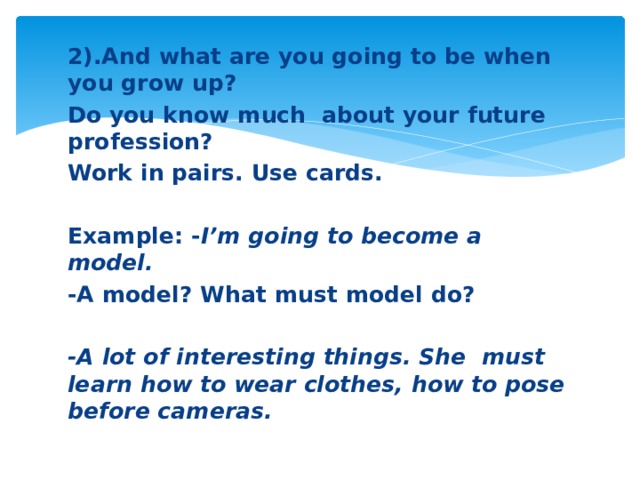
IV.Рost-activity

1.)And what do you think of a teacher’s job?

Could you be a teacher yourself?(Answer the questionnaire and mark your score.)

1.Teachers should be quite strict. There should be some fun in class, but pupils shouldn’t be allowed to make noise and be lazy during lessons.-1

2.teachers should be strict. Pupils should not be allowed to speak in class unless the teachers asks them to.-2

3.Teachers should be easy-going as possible. Pupils should be allowed to do whatever they like. I f they don’t learn it’s their problem.-3

4.Teachers don’t need a sense of humour. They should just teach the lesson as clearly as possible.-1

5.teachers should have a good sense of humour and make lessons fun and enjoyable.

But they shouldn’t tell jokes instead ofteaching.-2

6.Teachers should keep their class entertained with jokes and stories if the class is bored by the lesson.-3

Scor e:2 points- you’re born  teacher

          4points- you’ll be a very strict teacher, but boring too.

          6points- you’ll enjoy your work but your students will not learn much.

2).And what are you going to be when you grow up? Do you know much  about your future profession? Work in pairs. Use cards.  Example: - I’m going to become a model. -A model? What must model do?  -A lot of interesting things. She  must learn how to wear clothes, how to pose before cameras.
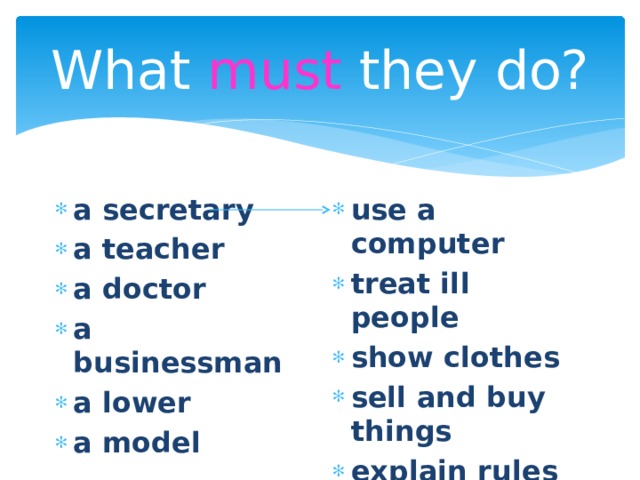
2).And what are you going to be when you grow up?

Do you know much  about your future profession?

Work in pairs. Use cards.

Example: - I’m going to become a model.

-A model? What must model do?

-A lot of interesting things. She  must learn how to wear clothes, how to pose before cameras.

What must they do? a secretary a teacher a doctor a businessman a lower a model  use a computer treat ill people show clothes sell and buy things explain rules communicate with people

What must they do?

  • a secretary
  • a teacher
  • a doctor
  • a businessman
  • a lower
  • a model 
  • use a computer
  • treat ill people
  • show clothes
  • sell and buy things
  • explain rules
  • communicate with people
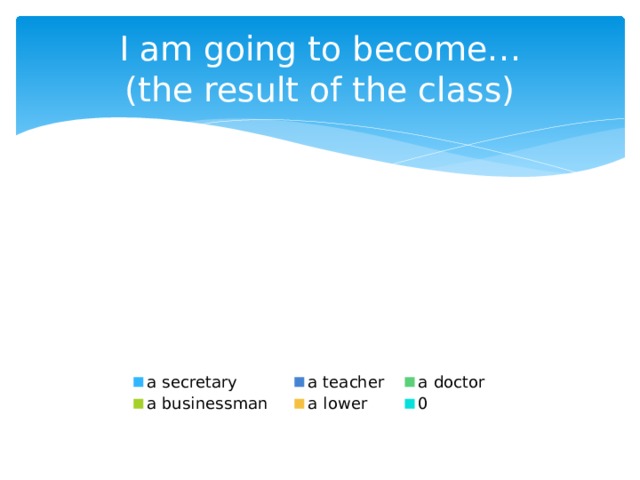
I am going to become…  (the result of the class)
I am going to become… (the result of the class)

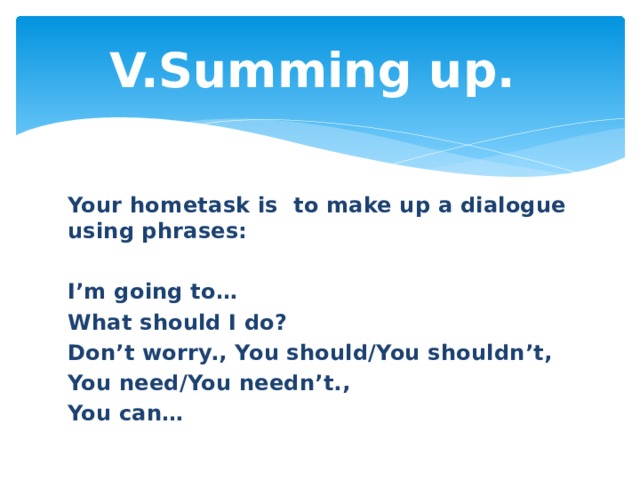
V.Summing up.   Your hometask is  to make up a dialogue using phrases:  I’m going to… What should I do? Don’t worry., You should/You shouldn’t, You need/You needn’t., You can…

V.Summing up.  

Your hometask is  to make up a dialogue using phrases:

I’m going to…

What should I do?

Don’t worry., You should/You shouldn’t,

You need/You needn’t.,

You can…
-80%
Курсы дополнительного образования

Кухни мира

Продолжительность 72 часа
Документ: Cвидетельство о прохождении курса
4000 руб.
800 руб.
Подробнее
Скачать разработку
Сохранить у себя:
«Модальные глаголы как способ общения (2.01 MB)

Комментарии 0

Чтобы добавить комментарий зарегистрируйтесь или на сайт