
 Получите свидетельство
 Вход
Вход



Глагол to be — быть, находится, являться
Составитель : учитель английского языка МОБУ СОШ №9 г.Сочи Рыбкина О.К.

Только что мы изучили очень важную тему в английском языке - личные местоимения. Знайте их и не путайте.
Теперь они будут встречаться постоянно, но они будут встречаться не сами по
себе, а обязательно с глаголами.

Чтобы сказать, к примеру: Я умный, ты красивая, мы друзья - нам обязательно нужно использовать глагол to be (быть) .
I am - я есть
You are - ты есть
He is - он есть
She is - она есть
It is - это есть
We are - мы есть
They are - они есть

Т аблица с изменением глагола to be по лицам (спряжение глагола) в настоящем, прошлом и будущем времени.
Настоящее время
I
am — я есть
Прошедшее время
You
He, she, it
Будущее время
was
are — он есть
is — он, она, оно есть
shall / will
We
were
will
was
are — ты, вы есть
You
will
are — мы есть
They
were
are — они есть
shall / will
were
will
were
will

Сейчас попробуем связать предложения: Я умный - I am intelligent Ты красивая - You are beautiful Мы друзья - We are friends Он американец - He is American Она высокая - She is tall Они радостные - They are happy

Формы глагола to be можно использовать не только с местоимениями, но и с полноценными существительными
The boys are intelligent - Мальчики умные
Mr. Brown is old - Мистер Браун старый
Rebecca is tall - Ребекка высокая
The houses are white - Дома белые

Также в предложениях употребляются сокращенные формы глагола to be :
I am = I'm
He is = He's
They are = They're
He is not = He isn't
We are not = We aren't

Составьте предложения по образцу:
Tie
This is a tie. That is a tie. It is a tie. It’a tie.
Desk, hat, pencil, lamp, pie, apple
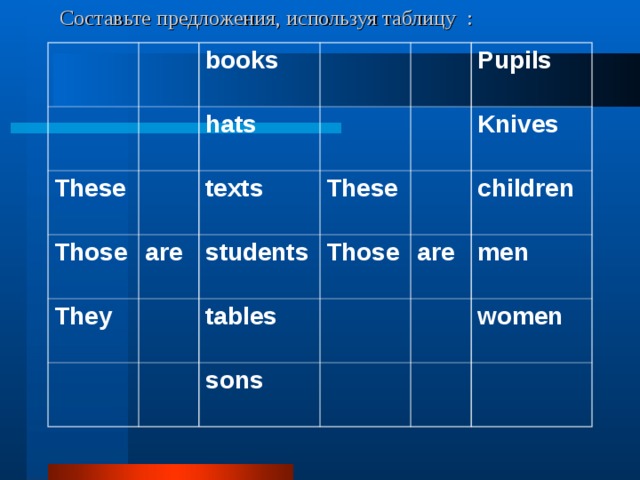
Составьте предложения, используя таблицу :
books
These
hats
Those
They
texts
are
These
students
Pupils
Those
tables
Knives
sons
are
children
men
women

Измените предложения по следующему образцу:
This is a brown jacket.
These are brown jackets. They’re brown.
1. This is a dark blue sweater. 2. That’s a grey hat. 3. This is a good dialog. 4. That’s a thin notebook. 5. this is a nice child. 6. That’s a good knife. 7. This is an easy text. 8. That’s a good man.

Для отрицания в русском языке используется частица "не", а в английском частица "not" , которая ставится после вспомогательного глагола be .
He is not at home — Он не дома .
They are not enemies — Они не враги

Выразите своё несогласие:
This apple is bad. (good).
This apple isn’t bad. It’s good.
1. That coat is green (yellow). 2. The pencil is red ( black). 3. His hat is white (black). 4. The textbook is thick (thin). 5. His notebook is thin (thick). 6. The classroom is bad (good). 7. His cat is black ( white). 8. His tie is yellow (green).

Выразите своё несогласие:
These are notebooks.
Oh, no. These aren’t notebooks. They’re books.
1. These are rooms (classrooms). 2. Those are caps (hats). 3. These are pens (pencils). 4. Those are jackets (sweaters). 5. These are trousers (jeans). 6. Those are knives (pencils).

Чтобы задать вопрос необходимо поменять местами подлежащее и глагол to be .
He is a writer. — Он писатель .
Is he a writer? — Он писатель ?
Am I a pupil? Yes, I am . / No, I am not.
Is she 15? Yes, she is . / No, she isn’t
Are they at home? Yes, they are . / No, they aren’t

Напишите краткий ответ
Are you all friends? Yes, we are .
- Are they Americans? No, ________.
- Is Tom at home? Yes, __________ .
- Are Lucy and Mary at home? No, _________.
- Are you students? Yes, __________.
- Is the house big? Yes, ___________.

Задать общий вопрос.
The lamp is on the desk.
The book is under the crayons.
The pencils are jn the desk.
The toy car is in front of the wardrobe.
The bag is between the shelves and the bookcase.
The ball is in front of the bag.

 Глаголы to be, to have (426 KB)
 0
0 596
596 9
9 Нравится
0
Нравится
0


