Получите свидетельство
 Вход
Вход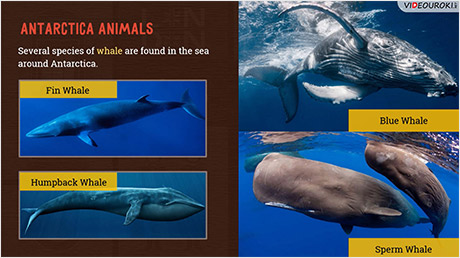



Hello guys! It’s chilly in here, isn’t it?
In today’s lesson, we’ll be exploring the vast frozen continent of Antarctica.
We’ll find out interesting facts about its location, its climate, its animals and plants, and how it was discovered.
What Is Antarctica?
Antarctica is an ice-covered continent that covers the southernmost part of the world. The South Pole is located in Antarctica. Antarctica is surrounded by the Southern Ocean.
How Big Is Antarctica?
Antarctica covers an area of 14 million square kilometres.

It is the 5th largest continent after Asia, Africa, North America, and South America. (The two continents that are smaller that Antarctica are Europe and Australia.)
Antarctica is almost twice the size of Australia, about 1.3 times the size of Europe, and just less than one and a half times the size of the USA.
Antarctica’s coastline is 17,968 km (11,158 miles) long.
Where Is Antarctica?
If you were to sail due south from either Chile, South Africa, Australia or New Zealand, you’d get to Antarctica! In fact, because the South Pole is in Antarctica, by flying south from anywhere in the world you’d eventually reach the continent.
Antarctica is at the ‘bottom’ of most globes.
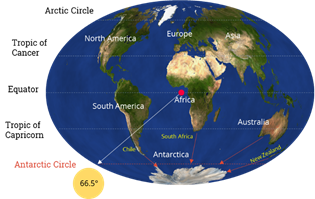
Most – but not all – of Antarctica is located within the Antarctic Circle – an imaginary line that circles the southern part of the world.
The latitude of the Antarctic Circle is approximately 66.5° South. Its exact latitude changes over time.
Latitude is the angle from the Equator, measured from the centre of the earth.
Antarctica Geography
Antarctica is divided into three main parts. East Antarctica is the biggest part. It is separated from West Antarctica by a mountain range called the Transantarctic Mountains.
Projecting from West Antarctica is the Antarctic Peninsula, the northernmost part of Antarctica. From the tip of the Antarctic Peninsula, South America is around 621 miles (1,000 km) away.
The South Pole is in East Antarctica.
Day Lengths On Antarctica
During the winter months at the South Pole, the sun doesn’t rise above the horizon. In summer, the sun doesn’t set for several months!
Within the Antarctic Circle, there are periods of the year during which the sun doesn’t rise for at least 24 hours, and during which the sun doesn’t set for at least 24 hours.
As you approach the South Pole, the periods during the winter in which the sun doesn’t rise – and in the summer in which the sun doesn’t set – get increasingly longer.
At the South Pole itself, the sun only rises once a year, and only sets once a year!
Antarctica Vs Antarctic
The word “Antarctica” refers to the continent of Antarctica. The word “Antarctic” is used to describe the polar region that includes the continent of Antarctica, and also the seas and islands of the Southern Ocean that surround the continent.
Is There Land Under Antarctica?
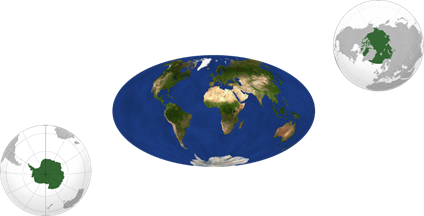
Unlike the North Pole, which is located on the frozen ice of the Arctic Ocean, the South Pole is on land.
Although it’s buried by thick ice, there is land under Antarctica. There is therefore land under the South Pole.
Antarctica Ice Sheet
98% of Antarctica is covered by a thick sheet of ice. The ice is, on average, around 1.9 km thick. In places, the ice can be 4.5 km thick.
The ice sheet is continually moving, forming glaciers and huge ice shelves that float on the sea.
If the Antarctic ice sheet were to melt, then the world’s sea level would be raised by 60 m.
Antarctica is a very good place to study meteorites. They are easy to find against the white snow and ice. The ice also keeps them well preserved.
Antarctica Climate
Antarctica is the coldest, driest, and windiest continent on Earth.
The average temperature in the interior of Antarctica is between -55 and -60 °C.
The average temperature for the coldest part of the year is −63 °C.
The lowest temperature ever recorded −89.6 °C, occurred in Antarctica.
There is very little precipitation on Antarctica. In the interior, it falls as snow, and averages 50 mm per year.
More rain falls on the Sahara Desert than snow on the Antarctic interior.
Is Antarctica a country?
Antarctica is not a country, and doesn’t have a government. Various countries have claimed parts of Antarctica, but these claims aren’t always recognised by other countries.
In 1959, 12 countries signed the ‘Antarctic Treaty’ that prevented countries from claiming parts of Antarctica. Forty-one country have since signed the treaty.
The treaty also ensured that Antarctica could only be used for scientific purposes. No military activity is allowed on Antarctica, and mining, nuclear explosions and nuclear waste disposal are also banned.
Since 1994, no non-native species (other than humans!) are allowed on Antarctica.
Do People Live On Antarctica?
Most of the people who live on Antarctica are scientists and support staff. In the summer, only 5,000 people live on the continent. Only around 1,000 people remain during the winter.
Antarctica has no indigenous peoples.
Who Discovered Antarctica?
British naval captain James Cook and his crew were the first people to enter the Antarctic circle. However, although they sailed within 150 miles of Antarctica, they were still too far away to actually see the continent.
The first time anyone laid eyes on Antarctica was in 1820, when several expeditions set out to the continent. One was led by Russian explorers Fabian Gottlieb von Bellingshausen and Mikhail Lazarev, and another by English naval officer Edward Bransfield.
Antarctica Animals
Antarctica’s inhospitable climate means that it has low biodiversity, i.e. not many different species live here. Life can only exist in milder coastal areas and on the Antarctic Peninsula.
There are no terrestrial |təˈrɛstrɪəl| mammals on Antarctica. Several species of seal, including the Elephant Seal and Antarctic Fur Seal, are found on the Antarctic coast.
Several species of whale are found in the sea around Antarctica.
Whales also inhabit the Southern Ocean. Species known to pass close to Antarctica include the Blue whale, Fin whale, Humpback whale and Sperm whale.
There are no reptiles or amphibians on Antarctica.
Several small invertebrates |ɪnˈvəːtɪbrət| (animals without backbones) live on Antarctica.
Antarctica’s most famous inhabitants are its penguins.
In spring, there are around 100 million birds in Antarctica.
Antarctica Plants
Most of Antarctica’s plants are mosses and lichens. Most plants are found on the Antarctica Peninsula – a narrow arm of land that stretches out towards South America.
Some mosses and lichens are found further inland. The only two flowering plants found on Antarctica are the Antarctic Hairgrass and the Antarctic Pearlwort.
That’s all for today. We hope that you have enjoyed the facts about one of the world’s most amazing places.

 1199
1199