Получите свидетельство
 Вход
Вход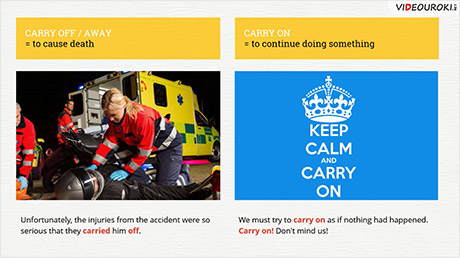



Hello, guys!
In today’s lesson we’re going to look at phrasal verb CARRY and some confusing words.
Phrasal verbs are very common in spoken and written English. So we need them to understand and speak natural English.
Phrasal verb is a verb followed by a preposition or an adverb; the combination creates a meaning different from the original verb.
In its primary meaning the phrasal verb “carry” is translated as «нести; относить; переносить».
But if it is used with the prepositions AWAY, OFF, ON, OUT, OVER, FORWARD, it has a completely different meaning and some of them have more than one. So let’s consider some of them.
CARRY AWAY
to become so excited about something that you do not control what you say or do:
There's far too much food – I'm afraid I got a bit carried away.
CARRY OFF
to transport away
Example: I need a truck to carry off all this furniture.
CARRY OFF
to succeed in doing or achieving something difficult:
Example: The actress carried off a difficult performance.
CARRY OFF/AWAY
to cause death
Example: Unfortunately, the injuries from the accident were so serious that they carried him off.
CARRY ON
to continue doing something:
Example: We must try to carry on as if nothing had happened.

Carry on! Don't mind us!
CARRY OUT
to fulfill
Example: She finally carried out her lifelong ambition to become an actress.
I will carry out the promise.
CARRY OVER / FORWARD
to transfer (something) to a later point in time
Example: The rent was carried over to December.
The English language has a few words that appear so similar that it's hard to tell the difference.
In this part of our lesson, we will cover some confusing words.
injure / harm
Injure: to hurt or cause physical harm to a person or animal: травмировать, повредить
I fell down the stairs and injured my leg.
Harm: to hurt someone or damage something: нанести вред
Thankfully no one was harmed in the accident.
The article has harmed his reputation.
gain / win
Gain: to get something that is useful, that gives you an advantage, or that is in some way positive, especially over a period of time – приобретать, извлекать пользу.
You can't gain access to the computer system without entering your password.
After you've gained some experience teaching abroad, you can come home and get a job.
Win: to achieve first position and/or get a prize in a competition, election, fight, etc.- выиграть, заслужить.
Which year was it that Italy won the World Cup?
He would do anything to win her love.
suitably / properly
Suitably: in a way that is acceptable and right for something or someone – соответствующим образом.
There are rules about dressing suitably.
She was afraid she might not have behaved suitably.
Properly: in a way that is considered to be correct; correctly – правильно.
To learn to speak a language properly, you have to live in the country where that language is spoken.
lose / miss
Lose: to no longer have something because you do not know where it is – потерять.
He's always losing his car keys.
I'm trying to lose weight.
Miss: to fail to do or experience something, often something planned or expected, or to avoid doing or experiencing something – пропустить.
I missed the start of the class because my bus was late.
My office is first on the right with a bright red door. You can't miss it
recover / rescue
Recover: to become completely well or normal again after an illness or having problems – поправляться, восстанавливать.
It took her a long time to recover from/after her heart operation.
Rescue: to help someone or something out of a dangerous, harmful, or unpleasant situation – спасать, освобождать
They shouted for help, but nobody came to rescue them.
avoid / prevent
Avoid: to stay away from someone or something – избегать, уклоняться.
I try to avoid supermarkets on Saturdays - they're always so busy.
If you want to lose weight, avoid eating between meals.
Prevent: to stop something from happening or someone from doing something – предотвращать, препятствовать.
Label your suitcases to prevent confusion.
Nothing will prevent us from reaching our aim!
instead of / besides
Instead of: in place of someone or something – вместо, взамен.
You can go instead of me, if you want.
You waste a lot of water by having a bath instead of a shower.
Besides: in addition to; also – кроме того, помимо, также.
Do you play any other sports besides golf?
She wants to learn other languages besides English and French.
inspire / promise
Inspire: to fill someone with confidence and desire to do something –
вдохновлять, внушать.
He inspired many young people to take up the sport.
Promise: to tell someone that you will certainly do something – обещать.
"But listen, you must promise never to tell anyone!”
disability / inability
Disability: an illness, injury, or condition that makes it difficult for someone to do the things that other people do – инвалидность, нетрудоспособность.
Most public places are simply not geared to the needs of people with disabilities.
Inability: lack of ability to do something – неумение.
Inability to use a computer is a serious disadvantage when you are applying for jobs.
That`s all for today.
Join us at our grammar lessons at videouroki.net.

 1854
1854