Меню
Разработки
Разработки  /  Английский язык  /  Презентации  /  9 класс  /  Презентация "Страдательный залог"

Презентация "Страдательный залог"

Правило образования страдательного залога в настоящем, прошедшем и будущем времени и упражнения на закрепление. Можно использовать как обобщение по данной теме.

04.09.2016

Содержимое разработки

   The Passive Voice (страдательный залог)  подлежащее не само выполняет действие  to be + Vз (V ₁ + ed )     Present:  am, is, are + V₃ Past:  was, were + V₃ Future:  shall/will be + V₃   ‗‗‗‗‗‗‗‗ ______ ‗‗‗‗‗   ? ‗‗‗‗‗‗‗‗ ______ ‗‗‗‗‗ _ _ _ _ _ ? not V₃ _ всп.гл. V₃ всп.гл. подл.
The Passive Voice (страдательный залог) подлежащее не само выполняет действие to be + Vз (V ₁ + ed )

Present: am, is, are + V₃

Past: was, were + V₃

Future: shall/will be + V₃

‗‗‗‗‗‗‗‗ ______ ‗‗‗‗‗

? ‗‗‗‗‗‗‗‗ ______ ‗‗‗‗‗ _ _ _ _ _ ?

not

V₃

_

всп.гл.

V₃

всп.гл.

подл.

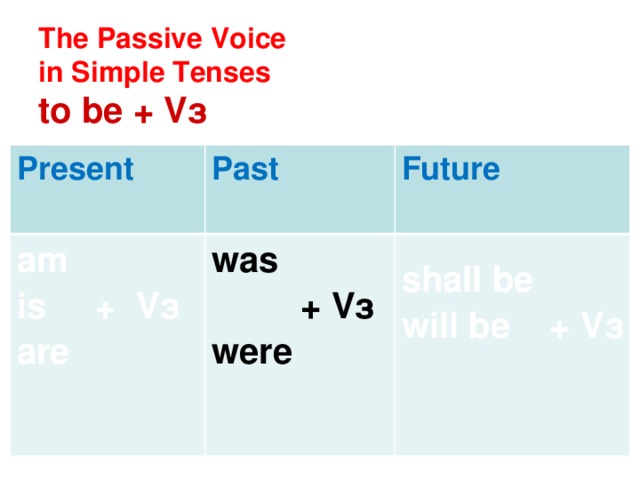
   The Passive Voice  in Simple Tenses  to be + Vз     Present  Past am  Future is + Vз was  + Vз  are were shall be will be + Vз

The Passive Voice in Simple Tenses to be + Vз

Present

Past

am

Future

is + Vз

was

+ Vз

are

were

shall be

will be + Vз

Present Simple Passive I  This boy   Many factories    New schools am  is  are   A big stadium invited to a party.  visited by tourists.  asked to recite a poem.  sent to Moscow.  built in our city.  taught to play the piano.  seen there every day.  much spoken of.  The pupils

Present Simple Passive

I

This boy

Many factories

New schools

am is are

A big stadium

invited to a party. visited by tourists. asked to recite a poem. sent to Moscow. built in our city. taught to play the piano. seen there every day. much spoken of.

The pupils

Past Simple Passive Our school  Those houses   This book    These stories was  were   I asked to go home.  visited by a delegation.  printed in London.  built two years ago.  written by him.  met by Nick.  seen by her.  read with interest.  They

Past Simple Passive

Our school

Those houses

This book

These stories

was were

I

asked to go home. visited by a delegation. printed in London. built two years ago. written by him. met by Nick. seen by her. read with interest.

They

Future Simple Passive  The theatre    Two schools  I published next year.  examined by the teacher.   A new film shall be  will be  This book  asked to tell the story.  We  built in our town.  shown there tomorrow.  given the task.  sent to the book-shop.  met by Oleg.

Future Simple Passive

The theatre

Two schools I

published next year.

examined by the teacher.

A new film

shall be will be

This book

asked to tell the story.

We

built in our town.

shown there tomorrow.

given the task.

sent to the book-shop.

met by Oleg.

 Exercise 1. Fill in the verb is or are.   1. Grammar rules ... always learnt by heart. 2. Rare animals ... protected in many countries. 3. This scarf ... made by my granny. 4. Animals in the reserve ... fed two times a day. 5. The same shirts ... worn by the members of our team. 6. New Russian books ... shown in our library 7. Many Russian towns ... described in this book. 8. Dinner ... always cooked by my mother. 9. This place ... crowded on Sunday. 10. Our village ... surrounded with a forest.

Exercise 1. Fill in the verb is or are.

1. Grammar rules ... always learnt by heart.

2. Rare animals ... protected in many countries.

3. This scarf ... made by my granny.

4. Animals in the reserve ... fed two times a day.

5. The same shirts ... worn by the members of our team.

6. New Russian books ... shown in our library

7. Many Russian towns ... described in this book.

8. Dinner ... always cooked by my mother.

9. This place ... crowded on Sunday.

10. Our village ... surrounded with a forest.

Exercise 2. Поставьте предложения в вопросительную и отрицательную формы.  1. Marmalade is made of oranges.  2. This town was built a century ago.  3. They were invited to a birthday party.  4. The fax was sent yesterday.  5. America was discovered long ago.  6. The book is published.  7. My friend’s car was stolen last night.  8. His winter boots were made in Germany.  9. The building was ruined by the earthquake.  10. Italian is spoken in Italy and on Malta.

Exercise 2. Поставьте предложения в вопросительную и отрицательную формы.

1. Marmalade is made of oranges. 2. This town was built a century ago. 3. They were invited to a birthday party. 4. The fax was sent yesterday. 5. America was discovered long ago. 6. The book is published. 7. My friend’s car was stolen last night. 8. His winter boots were made in Germany. 9. The building was ruined by the earthquake. 10. Italian is spoken in Italy and on Malta.

Exercise 3. Translate the verbs into English  1. A lot of houses (построено) in London and other towns. 2.When (было написано) this letter? 3. The letter (было написано) 2 days ago. 4. Whom (будет переведена) this article into English by? 5. The article (переведена) yesterday. 6. This question (задают) every day. 7. The students (пригласят) to the concert. 8. The work (закончена) by him quickly. 9. A new stadium in N.N (был построен) last year. 10. The little boy (смотрели) with interest by the people.

Exercise 3. Translate the verbs into English

1. A lot of houses (построено) in London and other towns.

2.When (было написано) this letter?

3. The letter (было написано) 2 days ago.

4. Whom (будет переведена) this article into English by?

5. The article (переведена) yesterday.

6. This question (задают) every day.

7. The students (пригласят) to the concert.

8. The work (закончена) by him quickly.

9. A new stadium in N.N (был построен) last year.

10. The little boy (смотрели) with interest by the people.

  Exercise 4. Write true sentences in Passive Voice.    1)  BMW cars 2) CDs grown in India.  3) Tea 4) Modems sent via satellite.  is   are 5) Cricket 6) TV pictures played in England.  sold in music shops.  made in Germany.  used to access the Internet.

Exercise 4. Write true sentences in Passive Voice.

1) BMW cars

2) CDs

grown in India.

3) Tea

4) Modems

sent via satellite.

is

are

5) Cricket

6) TV pictures

played in England.

sold in music shops.

made in Germany.

used to access the Internet.

Exercise 5. Write true sentences in Passive Voice.   The house The children invited to the concert    We  brought in the morning The letter The newspapers   cooked by my mother  Dinner The picture  am   is painted by my friend The classroom   are I cleaned every day Potatoes   given text-books at School  built of stone  written in English  not allowed to ride a motor-bike.  grown in many countries.

Exercise 5. Write true sentences in Passive Voice.

The house

The children

invited to the concert

We

brought in the morning

The letter

The newspapers

cooked by my mother

Dinner

The picture

am

is

painted by my friend

The classroom

are

I

cleaned every day

Potatoes

given text-books at School

built of stone

written in English

not allowed to ride a motor-bike.

grown in many countries.

   Exercise 6. Choose the correct form of the verb  to complete the sentences.   I ... (like / am liked) this place. What books by Charles Dickens ... (translated / are translated) into Russian? Who ... (protects / is protected) animals? This city ... (is visited / visited) by many people. Who ... (gives / is given) bad marks in your class? Our house ... (made /is made) of wood. Our holiday ... (is begun / begins) next week. Pupils ... (are given / give) books by the teacher. The holiday...(celebrated/is celebrated) this year.

Exercise 6. Choose the correct form of the verb to complete the sentences.

  • I ... (like / am liked) this place.
  • What books by Charles Dickens ... (translated / are translated) into Russian?
  • Who ... (protects / is protected) animals?
  • This city ... (is visited / visited) by many people.
  • Who ... (gives / is given) bad marks in your class?
  • Our house ... (made /is made) of wood.
  • Our holiday ... (is begun / begins) next week.
  • Pupils ... (are given / give) books by the teacher.
  • The holiday...(celebrated/is celebrated) this year.
Exercise 7. Fill in the gaps using the Present Simple Passive Voice  Mushroom and Ham Salad  First, 5 mushrooms … (1 – cut) into small pieces and …(2 — mix) with two cut spring onions. Then, 100 g cooked ham …(3— cut) into fine cubes. Now, mushrooms, onions and ham … (4 — mix) in a bowl. Finally, 2 tablespoons of lemon juice … (5 — mix) with 1 tablespoon of soy sauce and the mixture… (6 — add) to the salad mixture. Enjoy your salad!

Exercise 7. Fill in the gaps using the Present Simple Passive Voice

Mushroom and Ham Salad

First, 5 mushrooms … (1 – cut) into small pieces and …(2 — mix) with two cut spring onions. Then, 100 g cooked ham …(3— cut) into fine cubes. Now, mushrooms, onions and ham … (4 — mix) in a bowl. Finally, 2 tablespoons of lemon juice … (5 — mix) with 1 tablespoon of soy sauce and the mixture… (6 — add) to the salad mixture. Enjoy your salad!

Exercise 8. Fill in the gaps using the Present Simple Passive Voice  The news reporter and a camera operator _______ (1 – send) to investigate a news story. People_____ (2 – interview) by a reporter and the interviews ______ (3 – film) by a camera operator. The film ____ (4 – take) back to the TV studio, and the best parts of the film _______ (5 – choose) by the news editor. Finally, the news report ______ (6 – send) to televisions in people's homes and the news _____ (7 – watch) by people all over the country.

Exercise 8. Fill in the gaps using the Present Simple Passive Voice

The news reporter and a camera operator _______ (1 – send) to investigate a news story. People_____ (2 – interview) by a reporter and the interviews ______ (3 – film) by a camera operator. The film ____ (4 – take) back to the TV studio, and the best parts of the film _______ (5 – choose) by the news editor. Finally, the news report ______ (6 – send) to televisions in people's homes and the news _____ (7 – watch) by people all over the country.

Exercise 9. Fill in the gaps using the Present Simple Passive Voice  My motherland is the Republic of Belarus.  My country (1 – situate) in the centre of Europe.  It (2 – make up) of six regions: Brest, Vitebsk, Gomel, Grodno, Minsk and Mogilev.  Belarus (3 – not wash) by any seas or oceans,  so it (4 – not separate) from other countries by seas and oceans.  Belarus (5 – border) by five countries.  Belarus is mostly flat (плоская). Some uplands can (6 – find) near Minsk and in some districts of Mogilev and Grodno regions. Most of Belarus (7 – cover) by forests. It is a beautiful country with a lot of lakes.

Exercise 9. Fill in the gaps using the Present Simple Passive Voice

My motherland is the Republic of Belarus.

My country (1 – situate) in the centre of Europe.

It (2 – make up) of six regions: Brest, Vitebsk, Gomel, Grodno, Minsk and Mogilev.

Belarus (3 – not wash) by any seas or oceans,

so it (4 – not separate) from other countries by seas and oceans.

Belarus (5 – border) by five countries.

Belarus is mostly flat (плоская). Some uplands can (6 – find) near Minsk and in some districts of Mogilev and Grodno regions. Most of Belarus (7 – cover) by forests. It is a beautiful country with a lot of lakes.

Exercise 10.  Respond to the situations with a negative sentence Cars are made at this factory, (bicycles)   But bicycles are not made at this factory. 1. Bread is sold in this shop, (milk) 2. Our house is built of wood, (their house) 3. My books are kept on the shelf, (exercise-books ) 4. My younger sister is usually given fruit and milk for supper, (my elder brother) 5. Apples are grown in Belarus, (oranges) 6. Glass is made of sand, (paper) 7. My dresses are made by my mother, (jackets) 8. Films are watched by many people, (sports programmes) 9. This apple-tree is planted by me, (that cherry-tree) 10. All the words are always learnt by the pupils, (rules)

Exercise 10.  Respond to the situations with a negative sentence

Cars are made at this factory, (bicycles)

But bicycles are not made at this factory.

1. Bread is sold in this shop, (milk)

2. Our house is built of wood, (their house)

3. My books are kept on the shelf, (exercise-books )

4. My younger sister is usually given fruit and milk for supper, (my elder brother)

5. Apples are grown in Belarus, (oranges)

6. Glass is made of sand, (paper)

7. My dresses are made by my mother, (jackets)

8. Films are watched by many people, (sports programmes)

9. This apple-tree is planted by me, (that cherry-tree)

10. All the words are always learnt by the pupils, (rules)

 Exercise 11. Answer the questions in Simple Present Passive.     Is football played in the yard? — Yes, it is. It’s sometimes played in the yard. — No, it isn’t. It’s usually played in the field. Is it played by boys or by girls? — It’s played by boys as a rule. 1 . Are you always given good marks? 2. Is your friend also given good marks? 3. Is your homework always done in time? 4. Are you often given money by your parents? 5. Is chess played by two or three people? 6. Are you often punished at home? 7. Are trees planted in summer or in autumn? 8. Are you shown videos at your English lessons? 9. Are your copy-books collected at the beginning  or at the end of the lesson?

Exercise 11. Answer the questions in Simple Present Passive.

  Is football played in the yard?

Yes, it is. It’s sometimes played in the yard.

No, it isn’t. It’s usually played in the field.

Is it played by boys or by girls?

It’s played by boys as a rule.

1 . Are you always given good marks?

2. Is your friend also given good marks?

3. Is your homework always done in time?

4. Are you often given money by your parents?

5. Is chess played by two or three people?

6. Are you often punished at home?

7. Are trees planted in summer or in autumn?

8. Are you shown videos at your English lessons?

9. Are your copy-books collected at the beginning

or at the end of the lesson?

Exercise 12. Ask for more information about the sentences   The children are left after the lessons.(why,how often) — Why are the children left after the lessons? — How often are the children left after the lessons?  The game is won by our school team, (what game) The map is brought from England, (when) My books are not kept on the shelf, (why) School meetings are held every month, (where) The glass is filled with something, (what) Hockey is usually played by boys, (when) Oranges are not grown in Russia, (why) The dinner is not yet served, (why) New rules are explained at the lesson, (by whom)
Exercise 12. Ask for more information about the sentences

  The children are left after the lessons.(why,how often)

Why are the children left after the lessons?

How often are the children left after the lessons?

  • The game is won by our school team, (what game)
  • The map is brought from England, (when)
  • My books are not kept on the shelf, (why)
  • School meetings are held every month, (where)
  • The glass is filled with something, (what)
  • Hockey is usually played by boys, (when)
  • Oranges are not grown in Russia, (why)
  • The dinner is not yet served, (why)
  • New rules are explained at the lesson, (by whom)
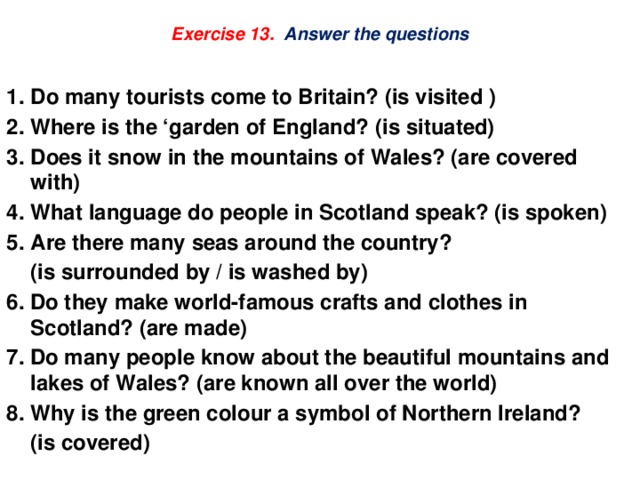
Exercise 13. Answer the questions  Do many tourists come to Britain? (is visited ) Where is the ‘garden of England? (is situated) Does it snow in the mountains of Wales? (are covered with) What language do people in Scotland speak? (is spoken) Are there many seas around the country?  (is surrounded by / is washed by) 6. Do they make world-famous crafts and clothes in Scotland? (are made) 7. Do many people know about the beautiful mountains and lakes of Wales? (are known all over the world) 8. Why is the green colour a symbol of Northern Ireland?  (is covered)

Exercise 13. Answer the questions

  • Do many tourists come to Britain? (is visited )
  • Where is the ‘garden of England? (is situated)
  • Does it snow in the mountains of Wales? (are covered with)
  • What language do people in Scotland speak? (is spoken)
  • Are there many seas around the country?

(is surrounded by / is washed by)

6. Do they make world-famous crafts and clothes in Scotland? (are made)

7. Do many people know about the beautiful mountains and lakes of Wales? (are known all over the world)

8. Why is the green colour a symbol of Northern Ireland?

(is covered)

Exercise 14. Make up questions in Simple Present Passive.   What    When   the windows  Where this box to check up? to make of? tea  to protect? envelopes Why  your homework to grow? rare animals By whom to wash? these houses  to keep? milk How to sell? dinner to build? to serve?

Exercise 14. Make up questions in Simple Present Passive.

What

When

the windows

Where

this box

to check up?

to make of?

tea

to protect?

envelopes

Why

your homework

to grow?

rare animals

By whom

to wash?

these houses

to keep?

milk

How

to sell?

dinner

to build?

to serve?

Exercise 15. Write questions to the sentences   1. The park is situated in the centre of the city.  (what, where) 2. The statue is made by a famous sculptor. (disjunctive) 3. Demonstrations are held in this square.  (what, where) 4. The square is planned round the monument. (general) 5. The obelisk is decorated with figures. (how) 6. The tent is put up on a rock. (alternative)

Exercise 15. Write questions to the sentences

1. The park is situated in the centre of the city.

(what, where)

2. The statue is made by a famous sculptor. (disjunctive)

3. Demonstrations are held in this square.

(what, where)

4. The square is planned round the monument. (general)

5. The obelisk is decorated with figures. (how)

6. The tent is put up on a rock. (alternative)

Exercise 16.  Change the sentences from Active into Passive.    Do they sell shoes in this shop? Do they bring tea from India? Do they teach English at your school? Do they make bicycles at this factory? Do they pay him a lot of money? Where do they sell bananas?

Exercise 16. Change the sentences from Active into Passive.

  • Do they sell shoes in this shop?
  • Do they bring tea from India?
  • Do they teach English at your school?
  • Do they make bicycles at this factory?
  • Do they pay him a lot of money?
  • Where do they sell bananas?
 Exercise 17. Translate into English.    Слова написаны на доске. Эта книга продается во всех магазинах. Ему часто отправляют письма? Когда приносят газеты? Этот парк всегда показывают туристам. Завтрак не дают в нашей школе. Эти тексты не учат наизусть.

Exercise 17. Translate into English.

  • Слова написаны на доске.
  • Эта книга продается во всех магазинах.
  • Ему часто отправляют письма?
  • Когда приносят газеты?
  • Этот парк всегда показывают туристам.
  • Завтрак не дают в нашей школе.
  • Эти тексты не учат наизусть.
-80%
Курсы повышения квалификации

Система управления охраной труда в учреждении образования

Продолжительность 72 часа
Документ: Удостоверение о повышении квалификации
4000 руб.
800 руб.
Подробнее
Скачать разработку
Сохранить у себя:
Презентация "Страдательный залог" (100.58 KB)

Комментарии 0

Чтобы добавить комментарий зарегистрируйтесь или на сайт