
 Получите свидетельство
 Вход
Вход





Discrimination at school: myth or uncomfortable truth?
Supervisor: Olga Peshcherskaya

Our aim:
Encourage and call students to tolerance and opposition against any kinds of discrimination for establishment of tolerant ,equal and confidential relations inside any social group on the way to globalization

Our side tasks :
- Find and select out all necessary information on this theme
- To define and describe the principal kinds of discrimination and at school
- To list several methods how to struggle against it in order to be tolerant, patient and broad-minded person
- To make a poll among the students of 8-11 th forms and our teachers to reveal their attitude to this social phenomenon
- To summarize the results and construct a set of graphs
- To make out several sound advice how to protect yourself from discrimination
- To come to the conclusion

Our hypothesis
To prove that there are certain distinctive forms of discrimination at school as we live in a huge urban center Moscow with a real kaleidoscope of various nationalities, religions and traditions.
If we educate tolerance, respect and acceptance of different cultures, nationalities and religions from school days , there won’t be discrimination at school and we will be on the way to globalization and blurring of distinction among cultures and nationalities based on universal values.

Novelty and topicality
Moscow is a multinational city, where coexist various layers of culture influencing each other. I am from Ukraine and faced the problem of discrimination at school and managed to cope with it. I would like to share my methods and introduce to your some more ideas how to deal with discrimination.
My project includes such fundamentals as : Social Studies, ethics, psychology and legal studies.

The guide to my project
1 .Introduction
2.Methodological characteristics
3.Theoretical background
- What is discrimination and tolerance in general?
- Description of different kinds of discrimination
- What are the typical types of discrimination at school?
- Definite ways of struggle against this age-old problem
4.Practical part
- Special questionnaire for students and teachers
- Diagrams with the results
- Special elective course for teachers to cultivate tolerance consciously
5. Conclusions
6.Applications +Glossary
7.Bibliograhpy

What is discrimination?
- Discrimination is a negative attitude , bias, violence and deprivation of certain rights of people
- Discrimination can be defined as an act where a person or a group of people is subjected to exclusion, rejection and mistreatment because of various reasons.
- Discrimination is treatment or consideration of, or making a distinction in favor of or against, a person based on the group, class, or category to which the person is perceived to belong rather than on individual attributes.

Types of discrimination
- Racism (Racism is the bad attitude of one race over another.)
- Discrimination of Religions (Religious discrimination treating a person or group differently because of what they believe in)
- Ageism (Ageism is stereotyping and discriminating against individuals or groups on the basis of their age.)
- Sexism (Sexism— biased against men or discrimination against people on the basis of sex or gender)
- Special types of discrimination at school: bullying and harassment

Racial discrimination ( Ethnic penalty)
Racism is the belief in the superiority of one race over another, which often results in discrimination and prejudice towards people based on their race or ethnicity.
It is connected with the idea that humans can be subdivided into distinct groups that are different due to their social behavior and their innate capacities as well as the idea that they can be ranked as inferior or superior
It can take many forms and is prevalent all over the world. This form of discrimination is a reality in today's world and is something no one can help noticing.

Discrimination against the Kurds in Syria
Racial discrimination of the Maoris in New Zealand
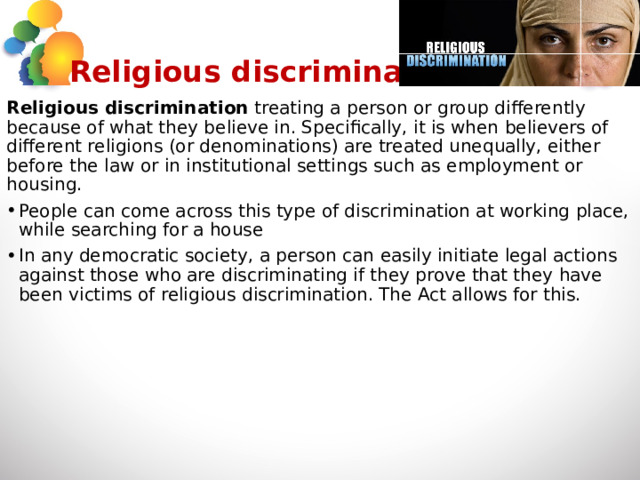
Religious discrimination
Religious discrimination treating a person or group differently because of what they believe in. Specifically, it is when believers of different religions (or denominations) are treated unequally, either before the law or in institutional settings such as employment or housing.
- People can come across this type of discrimination at working place, while searching for a house
- In any democratic society, a person can easily initiate legal actions against those who are discriminating if they prove that they have been victims of religious discrimination. The Act allows for this.


Ageism
- Ageism (also spelled " agism ") is stereotyping and discriminating against individuals or groups on the basis of their age. This may be casual or systematic
It is a combination of three connected elements:
- prejudicial attitudes towards older people, old age, and the aging process
- discriminatory practices against older people
- institutional practices and policies that perpetuate stereotypes about elderly people
The objects of ageism are teens and elderly people. It can also be passive and covert .


Sexism
Sexism biased against men or discrimination against people on the basis of sex or gender; it is also an ideology and system of social practices that support Patriarchy, or the oppression of women.
Types of sexism:
- Hostile sexism (sexist manifestations are expressed in aggressive behavior, statements or conduct in relation to the other sex)
- Benevolent sexism (involves the idealization of women and their glorification with a certain purpose, which is to create women are frail and helpless image, requiring constant care from men. )


Kinds of discrimination at school:
There are five main types of discrimination that students can come across at schools:
- direct discrimination
- indirect discrimination
- harassment and bullying
- victimization
- Disability-related discrimination

Direct discrimination
Direct discrimination is when a child is treated less favourably on the grounds of gender, disability, race, sexual orientation, economic condition, religious belief or age. For example, assuming a child may not be able to reach a certain level of work because they are disabled. In these cases the act itself is unlawful, not whether or not someone meant it. It includes sexism, racism , ageism, religious discrimination .

Indirect discrimination
Indirect discrimination is when policies or practices affect a certain group of children more than others for no good reason. The groups protected by the legislation include groups defined by their gender, race, sexual orientation, religion or belief, or age.
Indirect discrimination is where an organization unjustifiably operates a rule or policy that looks the same for everyone but in effect disadvantages people from a particular protected group.

Victimization
Victimization is where a pupil has made a complaint of discrimination, in good faith or helped someone else with a complaint under the discrimination laws, and suffered as a result. Protection from victimization is intended to ensure that people are not put off from complaining about discrimination out of fear of further adverse treatment.

Disability-related discrimination
Disability-related discrimination is essentially a form of direct discrimination. It is very closely linked with the duty to make reasonable adjustments. Disability-related discrimination is much less likely to occur when the reasonable adjustment duty has been complied with. So, the focus and priority for you should be on complying with the reasonable adjustment duty.
What is the reasonable adjustment duty for disabled people?
The duty arises where:
a provision, criterion or practice is applied by or on behalf of a school/college; or
any physical feature of premises occupied by a school/college;
places disabled students at a substantial disadvantage in comparison with students who are not disabled.

Harassment and bullying
- Harassment and bullying are terms used to explain certain types of unacceptable behaviour that pupils may sometimes be subjected to.
Forms of bullying
- Telling mean and hurtful things or making fun of them or calling them mean and hurtful names
- completely ignoring or leaving them out from their group of friends or leaving them out of things on purpose
- Physical bullying: hitting, kicking, pushing, shoving around, or locking them inside a room
- Telling lies or spreading false rumours about them or send mean notes and try to make other pupils dislike them

Subdivisions of bullying
- Weight discrimination
- Attractiveness or ugliness
- Name discrimation
- Linguicism
- Heightism
- Behavioral and thinking peculiarities , unlikeness from the rest of the group –syndrome of “black sheep”


Methods of struggle with discrimination
- Give a rebuff. If someone commits racist statements, indicate that belonging to any race does not mean what kind of person will become, and how successful and promising his future will be.
- Don’t suffer in silence ! Share your problems with your teacher, school principal, supervisor or school physiologist or call a helpline for good and qualified advice how to stop it. A problem share is a problem halved!
- Get other people involved! You can even start an anti-discrimination committee or party to protect students who suffer from any form of discrimination or and prevent from all types of discrimination.
- Do not show your weakness. Try to overcome emotions, control yourself and don’t let people humiliate your dignity or intimidate you.
- Find your followers, friends who support you in any time and lend a helping hand .REMEMBER tolerant and global people are much more than narrow-minded and one-idead bullies and fools.
- Know your rights! Discrimination is illegal .school, police have a responsibility to protect you!
- Never give up and give place to discrimination. If you are being bulling because of your race, religion, drawbacks , keep on fighting as you are equal with everybody!

Practical part
- Questionnaires for the students and teachers
- Results of these polls in special pie –diagrams and graphics
- Useful tips how to prevent discrimination at school
- Special course for teachers with a system of form periods and holidays in order to educate tolerance at our school

My questions for the upper-form students
- Have you ever faced these forms of discrimination at school?
- Race discrimination
- Religious discrimination
- ageism
- Sexism
- Harassment/bullying
2. What were the demonstrations of this form of discrimination? What was your reaction?
3.How did you manage to solve the problem? Who helped you ?
4. Do you consider yourself as a tolerant and broad-minded person?
5.Should a special subject, related to teaching how to be tolerant and respectful to others ,be included into school timetable?
6.Would you like to join a special anti-discrimination party at school, if it arranged?

Have you ever faced any forms of discrimination at school?
Из 61 человека столкнулось 66% , соответственно 34% не столкнулось

The most widespread types of discrimination

Would you like to be a member of a special committee at school?

Pie-diagrams/column chart with the results : students
35%
65 %

My questions for teachers
- The problem of discrimination on which of these aspects
- national
- religious
- sexual
- social humiliation and neglect of children by their appearance, mental ability, anti-social behaviour of the child and difference from others) is most acute in our school?
2) How do you assess the level of discrimination in school? (high/medium/low/no at all)
3) Do you think that the school pays enough attention to the problem of discrimination and ways to prevent it ?
4) Do you think the school should carry out activities to prevent discrimination and educate tolerance ? What are they?
5) How often have you experienced different forms of discrimination at school against your students and what have been your actions in a particular situation?
6) Do you consider yourself a tolerant and broad-minded person?

The results of this questionnaire among the teachers

The results of this questionnaire among the teachers
24%
59 %
6%
12%

The results of this questionnaire among the teachers

The results of this questionnaire among the teachers

My comments on these results
- The majority of students in some way suffered from discrimination.
- There are some forms of discrimination at school and this fact was witnessed by both teachers and students
- The most widespread forms of it are racial discrimination and bullying, students rarely face ageism itself.
- Some students were rather honest and self-critical to name themselves as non-tolerant people
- Our teachers estimated the level of discrimination as medium and this result corresponded to the students’ answers
- Forms of discrimination pointed out by the students fitted with those that the teachers listed
- All the teachers are solidary with the idea of strengthening some measures on tolerance at school and consider themselves as tolerant people
- All in all, our polls proved the fact that this topic is contradictory and is worth discussion

Tips how to become more tolerant
These are three important traits of tolerant people:
- Respect: Being respectful to others should be among your key principles, as it can help you to get far in life. If you want to receive respect, you should first be respectful to others. Respect is the key to open the door of tolerance.
- Peacefulness: Intolerance causes conflicts and in many cases, it even triggered wars. Peace is a good breeding ground to nurture tolerance. A tolerant individual never starts a conflict unnecessarily.
- Courage: You need to have courage to become tolerant. It takes a good deal of courage to say no to things that can cause intolerance.
- Keeping calm : Having your own piece of mind does not mean forcing it through verbal abuse of the other. Staying calm and remaining peaceful at all times without getting angry is the next step towards being more tolerant. This is something you will have to learn so you progressively learn to control your temper .

Programme for a special course “Tolerance is the crucial ideology of the civil world”
The aim of the course:
The program of the interdisciplinary elective course is aimed at deepening and expanding knowledge and skills in the subjects of history and social science which open up significant opportunities for the disclosure of the essence of tolerance and its place in the development of human civilization and create a practical field for the formation of tolerant consciousness of schoolchildren. The course is designed for 12 hours of theoretical training and 12 hours of practical training

Tasks of this elective course
- educating students in the spirit of openness and understanding of other peoples, diversity of cultures and history, in the spirit of the principles of interdependence of people living near the school, village, city, country, planet;
- education of pupils in the spirit of Culture of the world, i.e. understanding of that level of development of mankind, its material and spiritual culture it also is culture of the world which allows to build relations between people, without resorting to methods of violence;
- contribute to strengthening the principles of cooperation;
- training on non-violent conflict resolution;
- training in the use of peaceful means to resolve differences;
- clarification that the Russian state was formed and developed as a result of interaction of the people living in it;

Contents
Content of education
Topic 1 . Declaration of principles of tolerance
Number of hours
2 hours
Topic 2 . Variety of modern world
Forms of the lessons
Topic 1.
Topic 3.Religious identity and consciousness and tolerance
1 hour
1)Lesson-lecture with presentation.
Topic 4. National identity and consciousness
2) Practical work with the materials from Declaration on Principles of Tolerance Drawing a comparative chat.
Topic 5 . Ageism and its peculiarities
4 hours
Topic 2. Lesson-argument with group work and mini-defense of projects
Topic 6. All drawbacks of sexism
Topic 3.
2 hours
Topic 7. Different forms of discrimination at school
1)What do we know about Christianity?
Topic 8. Sense of justice and tolerant behaviour
Topic 9. Tolerance as a way of coping with social and interpersonal conflicts
1 hour
2) Muslim people and their beliefs: traditions of Islam
1 hour
3) Judaism and its canons
Topic 10 Our planet without wars and violence
4) Hinduism and its origin
3 hours
Topic 11. General revision on the course “ Tolerance”
Topic 4.
Topic 12. Call-in show with American students to exchange our ideas about tolerance and discrimination
2 hours
1)Definition of racial discrimination and its types
2) Modern cases of discrimination all over the world with analysis
Topic 5.
2 hours
How to survive when you are on pension or going to retire.
Topic 6. Sexism and its demonstrations
2 hours
4 hours
1 hour

Contents
Content of education
Number of hours
Topic 1 . Declaration of principles of tolerance
Forms of the lessons
Topic 2 . Variety of modern world
2 hours
Topic 7.
Topic 3.Religious identity and consciousness and tolerance
- Bullying at modern schools
- Harassment :what is it?
- How do recognize discrimination?
- 4) How to struggle against at school?
Topic 4. National identity and consciousness
1 hour
Topic 5 . Ageism and its peculiarities
Topic 8.
4 hours
Topic 6. All drawbacks of sexism
1)Practical work with documents (Declaration of human and citizen rights, the Constitution of the Russian Federation, Group work..
2 hours
2)Essays on "The rules surrounding man in everyday life", "Can people live without rules?", "Habit is the second nature”
Topic 7. Different forms of discrimination at school
Topic 9.
Topic 8. Sense of justice and tolerant behaviour
1 hour
1)Questionnaire (identifying the level of tolerance, the level of conflict) and drawing diagramms.
Topic 9. Tolerance as a way of coping with social and interpersonal conflicts
1 hour
Topic 10 Our planet without wars and violence
2)Role-playing game-dispute. Psychological exercises and games with the goal of preventing conflict behavior.
3 hours
Topic 11. General revision on the course “ Tolerance”
Topic 12. Call-in show with American students to exchange our ideas about tolerance and discrimination
2 hours
2 hours
2 hours
4 hours
1 hour

Сontents
Content of education
Number of hours
Topic 1 . Declaration of principles of tolerance
Forms of the lessons
Topic 2 . Variety of modern world
2 hours
Topic 3.Religious identity and consciousness and tolerance
Topic 10.
1)The lesson – practical work. Work with documents. Preparation of reference tables.
Topic 4. National identity and consciousness
1 hour
4 hours
2)Student reports on the effects of armed conflict. Development of rules of war.
Topic 5 . Ageism and its peculiarities
Topic 11.
Topic 6. All drawbacks of sexism
1-3)Preparation for Round table “How tolerant are you?”
2 hours
Topic 7. Different forms of discrimination at school
4) Business game “I am a real globalist and tolerant person, aren’t you?”
Topic 8. Sense of justice and tolerant behaviour
Topic 12 special call-in show on the theme “Tolerance against discrimination. Join us!”
1 hour
Topic 9. Tolerance as a way of coping with social and interpersonal conflicts
1 hour
Topic 10 Our planet without wars and violence
3 hours
Topic 11. General revision on the course “ Tolerance”
Topic 12. Call-in show with American students to exchange our ideas about tolerance and discrimination
2 hours
2 hours
2 hours
4 hours
1 hour

My conclusions
- I have proved that discrimination still exists at school in different forms and has a bad and detrimental impact on the development, personal progress and building relationships among schoolchildren.
- There should be introduced a special course “Ethics and Religious Culture” to teach students how to be tolerant, respectful and patient to each other certain differences and explore the themes of justice, tolerance and the accommodation of differences.
- Teachers should be specially trained and taught to help those students who become victims of any type of discrimination
- At every school can be start an anti-discrimination group where the members of it can provide a counselling service or invite guest speaking along with a set of trainings.

Thank you for your attention !

Литература:
1. Асмолов А.Г. Слово о толерантности//Век толерантности. 2001 г., №1
2. Дик Н.Ф. Ученическое самоуправление в общеобразовательном учреждении. Ростов-на-Дону, «Феникс», 2006 г.
3.Иконникова С. Н. Молодѐжь. Социологический и социально-психологический анализ. Л.: Издательство Ленинградского университета, 1974.
4.Иконникова С. Н., Кон И. С. Молодѐжь как социальная категория. М., 1970.
5. Орлов А.Б., Шапира А.З. Психология толерантности: проблемы и перспективы. Вопросы психологии. 2006 г.
6. Словарь иностранных слов М.: Русский язык, 1986 г.
7.Солдатова Г.У., Шайгерова Л.А., Шарова О.Д. Жить в мире с собой и другими. Тренинг толерантности для подростков. Москва, «Генезис», 2000 г.
8. Тишков В.А. Этническое и религиозное многообразие – основа стабильности и развития российского общества: статьи и интервью. Москва: Московское бюро

Список литры+глоссарий
- https://ru.m.wikihow.com/%D0%B1%D0%BE%D1%80%D0%BE%D1%82%D1%8C%D1%81%D1%8F-%D1%81-%D1%80%D0%B0%D1%81%D0%B8%D0%B7%D0%BC%D0%BE%D0%BC?amp=1
- https://ru.wikipedia.org/wiki/%D0%A0%D0%B0%D1%81%D0%B8%D0%B7%D0%BC
- https://dic.academic.ru/dic.nsf/dic_fwords/1307/%D0%AD%D0%99%D0%94%D0%96%D0%98%D0%97%D0%9C
- https://ru.wikipedia.org/wiki /%D0%A2%D0%BE%D0%BB%D0%B5%D1%80%D0%B0%D0%BD%D1%82%D0%BD%D0%BE%D1%81%D1%82%D1%8C









 Презентация к проекту на АЯ "Discrimination at school: myth or uncomfortable truth?" (2.6 MB)
 0
0 400
400 6
6 Нравится
0
Нравится
0


