Меню
Разработки
Разработки  /  Английский язык  /  Презентации  /  8 класс  /  Present Perfect Tense, Present Perfect Continuous Tense.

Present Perfect Tense, Present Perfect Continuous Tense.

Сравнительная характеристика времен английского глагола PRESENT PERFECT и PRESENT PERFECT CONTINUOUS.

Грамматические задания для учащихся.

14.10.2017

Содержимое разработки

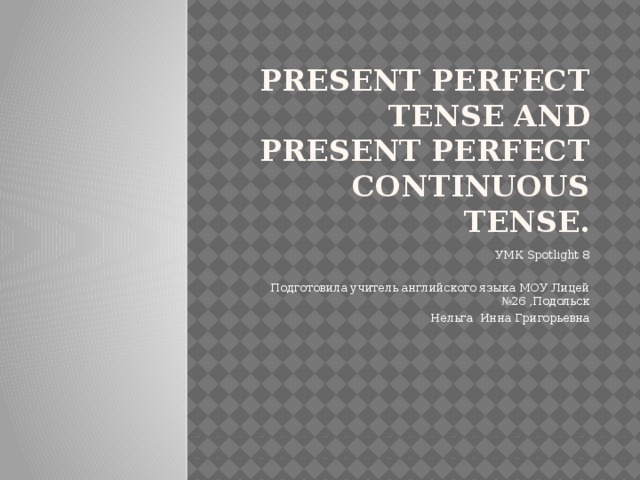
Present Perfect Tense and Present Perfect Continuous TenSe. УМК Spotlight 8 Подготовила учитель английского языка МОУ Лицей №26 ,Подольск Нельга Инна Григорьевна

Present Perfect Tense and Present Perfect Continuous TenSe.

УМК Spotlight 8

Подготовила учитель английского языка МОУ Лицей №26 ,Подольск

Нельга Инна Григорьевна

The present perfect continuous  or the present perfect simple? REMEMBER! The present perfect continuous makes the action important, and says how long it’s been continuing.   The present perfect simple makes the result important, and says how many times something has happened.

The present perfect continuous or the present perfect simple?

REMEMBER!

The present perfect continuous makes the action important, and says how long it’s been continuing.

The present perfect simple makes the result important, and says how many times something has happened.

Present Perfect Tense. It is usually used to express a completed action connected with the present. I have seen’’ HAMLET’’ I have already eaten my breakfast. I haven’t seen you for ages. I haven’t been to Moscow sinse 2010 year.

Present Perfect Tense.

  • It is usually used to express a completed action connected with the present.
  • I have seen’’ HAMLET’’
  • I have already eaten my breakfast.
  • I haven’t seen you for ages.
  • I haven’t been to Moscow sinse 2010 year.
Present Perfect Tense.   It is usually used with these words to express a completed action connected with the present. Already Ever Never Yet Just lately

Present Perfect Tense.

  • It is usually used with these words to express a completed action connected with the present.
  • Already
  • Ever
  • Never
  • Yet
  • Just
  • lately
Preset Perfect Tense.   It is often used with Since For I haven’t ridden a bycycle since my childhood. I haven’t seen her for ages.

Preset Perfect Tense.

  • It is often used with
  • Since
  • For
  • I haven’t ridden a bycycle since my childhood.
  • I haven’t seen her for ages.
Present Perfect Tense.   Present Perfect is not used with question WHEN. The Past Simple is used.

Present Perfect Tense.

  • Present Perfect is not used with question
  • WHEN.
  • The Past Simple is used.
Present Perfect Continuous. It is used to express an action which began in the past. Present Perfect Continuous has been continuing for same time. Present Perfect Continuous is still in progress at the present moment or recently finished. I have been riding a bicycle for two hours. He has been doing his homework since morning.

Present Perfect Continuous.

  • It is used to express an action which began in the past.
  • Present Perfect Continuous has been continuing for same time.
  • Present Perfect Continuous is still in progress at the present moment or recently finished.
  • I have been riding a bicycle for two hours.
  • He has been doing his homework since morning.
Present Perfect, Present Perfect continuous . I have already picked a whole basket of black berries. I have been picking blackberries since early morning and can’t finished. Compare these pairs of sentences.  Is the action or the result important
  • Present Perfect, Present Perfect continuous .
  • I have already picked a whole basket of black berries.
  • I have been picking blackberries since early morning and can’t finished.

Compare these pairs of sentences. Is the action or the result important

There are 3 uses of the present perfect continuous: To talk about an action which has happened over a period of time. To talk about an action which has recently finished and has a result in the present. To talk about an action which is still happening, or has recently finished.
There are 3 uses of the present perfect continuous:

  • To talk about an action which has happened over a period of time.
  • To talk about an action which has recently finished and has a result in the present.
  • To talk about an action which is still happening, or has recently finished.
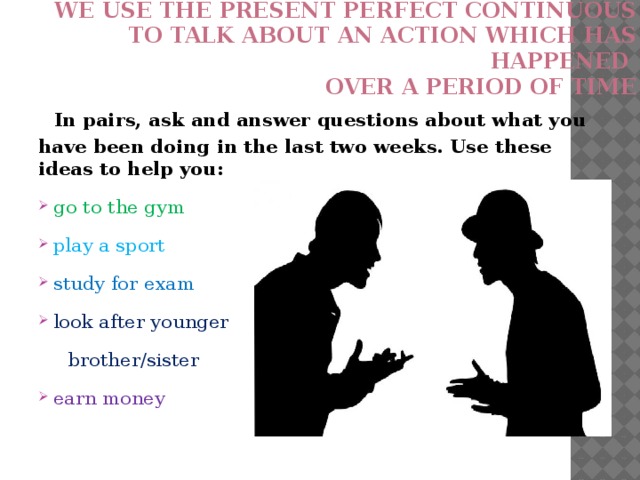
We use the present perfect continuous  to talk about an action which has happened  over a period of time    In pairs, ask and answer questions about what you have been doing in the last two weeks. Use these ideas to help you:  go to the gym  play a sport  study for exam  look after younger  brother/sister  earn money

We use the present perfect continuous to talk about an action which has happened over a period of time

In pairs, ask and answer questions about what you

have been doing in the last two weeks. Use these ideas to help you:

  • go to the gym
  • play a sport
  • study for exam
  • look after younger

brother/sister

  • earn money
We use the present perfect continuous  to talk about an action  which is still happening,or has recently finished  We use for and since to talk about the length of the action. Complete using for and since : We use (1)____to say when an action started and (2)____to say how long the action took.

We use the present perfect continuous to talk about an action which is still happening,or has recently finished

We use for and since to talk about the length of the action.

Complete using for and since :

We use (1)____to say when an action started

and (2)____to say how long the action took.

Write sentences using for and since and  the verb in the present perfect continuous form. I / study / first aid ( for / since ) last year. One student / not feel / well ( for / since ) a few days. I / try / to ring my parents ( for / since ) ages. What / you / do / in the library ( for / since ) so long. We / learn / how to climb ( for / since ) 1 st August. I / wonder / what job to do ( for / since ) a long time.

Write sentences using for and since and the verb in the present perfect continuous form.

  • I / study / first aid ( for / since ) last year.
  • One student / not feel / well ( for / since ) a few days.
  • I / try / to ring my parents ( for / since ) ages.
  • What / you / do / in the library ( for / since ) so long.
  • We / learn / how to climb ( for / since ) 1 st August.
  • I / wonder / what job to do ( for / since ) a long time.
Ppesent Perfect. Present Perfect Continuous. I. Put the verbs in brackets into Present Perfect Simple or Present Perfect Continuous Don't walk in here. I …...........................( just/clean ) the floor. Jane is hungry. She …............( not /eat ) anything for six hours. She is tired. She …......( study) for four hours. I don't want to see that film again. I …....................... (see) it twice already. Sandy …...................( teach ) English for 10 years. Chris …..................( not/do) the washing up yet. He …...................... (walk) all the morning. They....................................... (play) in the garden for two hours.  

Ppesent Perfect. Present Perfect Continuous.

  • I. Put the verbs in brackets into Present Perfect Simple or Present Perfect Continuous
  • Don't walk in here. I …...........................( just/clean ) the floor.
  • Jane is hungry. She …............( not /eat ) anything for six hours.
  • She is tired. She …......( study) for four hours.
  • I don't want to see that film again. I …....................... (see) it twice already.
  • Sandy …...................( teach ) English for 10 years.
  • Chris …..................( not/do) the washing up yet.
  • He …...................... (walk) all the morning.
  • They....................................... (play) in the garden for two hours.
  •  
Choose the correct form of the verbs to complete these sentences Steven Spielberg has directed/has been directing  over twenty films. 2. He  has worked/has been working on a new since February. 3. Oxford University Press has published/ has been publishing  thousands of books. 4. They  have published/ have been  publishing for hundreds of years. 5. Madonna has recorded/ has been recording  albums for more than two decades. 6. She has recorded/ has been recording at least ten hit records.

Choose the correct form of the verbs to complete these sentences

  • Steven Spielberg has directed/has been directing over twenty films.

2. He has worked/has been working on a new since February.

3. Oxford University Press has published/ has been publishing thousands of books.

4. They have published/ have been publishing for hundreds of years.

5. Madonna has recorded/ has been recording albums for more than two decades.

6. She has recorded/ has been recording at least ten hit records.

II. Put the verbs in brackets into Present Perfect Simple or Present Perfect Continuous   1. A: Where's Peter?  B: He ….................................................. (just/leave) for work. 2. A: Why are you tired?  B: I........................................................... (play) football. 3 .A: Is Paul studying in his room?  B: Yes, he …............................................ (study) since 4:00. 4 .A: How is Jim?  B:I don't know. I …........................................... (not/speak) to him since Monday. 5 .A: Let's go out to eat tonight.  B: How about tomorrow night? I................................... (already/cook) dinner.

II. Put the verbs in brackets into Present Perfect Simple or Present Perfect Continuous

  • 1. A: Where's Peter?
  • B: He ….................................................. (just/leave) for work.
  • 2. A: Why are you tired?
  • B: I........................................................... (play) football.
  • 3 .A: Is Paul studying in his room?
  • B: Yes, he …............................................ (study) since 4:00.
  • 4 .A: How is Jim?
  • B:I don't know. I …........................................... (not/speak) to him since Monday.
  • 5 .A: Let's go out to eat tonight.
  • B: How about tomorrow night? I................................... (already/cook) dinner.
II. Put the verbs in brackets into Present Perfect Simple or Present Perfect Continuous   6. A: I am going to the cinema.  B: Again!You …............................................... (see) three films this week. 7. A: Have you finished the book that I lent you?  B: No, I …....................................................... (finish) it yet. 8. A: Has Diana lost weight?  B: Yes,she …..................................................... (exercise) for six months. 9. A: Does Tom work at MLT Limited?  B: Yes, he …..................................................... (work) at that company for ten years. 10. A: Do John and Andy live in Spain?  B: Yes, they................................................... (live )in Spain since 1997.

II. Put the verbs in brackets into Present Perfect Simple or Present Perfect Continuous

  • 6. A: I am going to the cinema.
  • B: Again!You …............................................... (see) three films this week.
  • 7. A: Have you finished the book that I lent you?
  • B: No, I …....................................................... (finish) it yet.
  • 8. A: Has Diana lost weight?
  • B: Yes,she …..................................................... (exercise) for six months.
  • 9. A: Does Tom work at MLT Limited?
  • B: Yes, he …..................................................... (work) at that company for ten years.
  • 10. A: Do John and Andy live in Spain?
  • B: Yes, they................................................... (live )in Spain since 1997.
III. Complete the dialogue by putting the verbs into Present Perfect or Present Perfect Continuous   Tom: Hello, Peter. I 1) (not/see)____________ you for ages. What 2) (do) ________ (you)__________?  Peter: I 3) (work)________________for a film company. It”s very interesting.  Tom:  4) (make)_________ you _________any films?   Peter: Yes, 5) ( make) ______________ two films about south-east Asia for the last two months. I 6)( work)________________ on a film about the islands in the Pacific   Tom: 7) (go)__________you ______________to the islands?  Peter: Of course. And the film will be about underwater life around the islands. So I 8) (have)__________driving lessons. I 9) (enjoy)________ that.  Tom: You 10) (find)____________a really interesting job.

III. Complete the dialogue by putting the verbs into Present Perfect or Present Perfect Continuous

  • Tom: Hello, Peter. I 1) (not/see)____________ you for ages. What 2) (do) ________ (you)__________?
  • Peter: I 3) (work)________________for a film company. It”s very interesting.
  • Tom: 4) (make)_________ you _________any films?
  • Peter: Yes, 5) ( make) ______________ two films about south-east Asia for the last two months. I 6)( work)________________ on a film about the islands in the Pacific
  • Tom: 7) (go)__________you ______________to the islands?
  • Peter: Of course. And the film will be about underwater life around the islands. So I 8) (have)__________driving lessons. I 9) (enjoy)________ that.
  • Tom: You 10) (find)____________a really interesting job.

I wish you success!

I wish you success!

-80%
Курсы повышения квалификации

Педагог дополнительного профессионального образования

Продолжительность 72 часа
Документ: Удостоверение о повышении квалификации
4000 руб.
800 руб.
Подробнее
Скачать разработку
Сохранить у себя:
Present Perfect Tense, Present Perfect Continuous Tense. (376.84 KB)

Комментарии 0

Чтобы добавить комментарий зарегистрируйтесь или на сайт