
 Получите свидетельство
 Вход
Вход



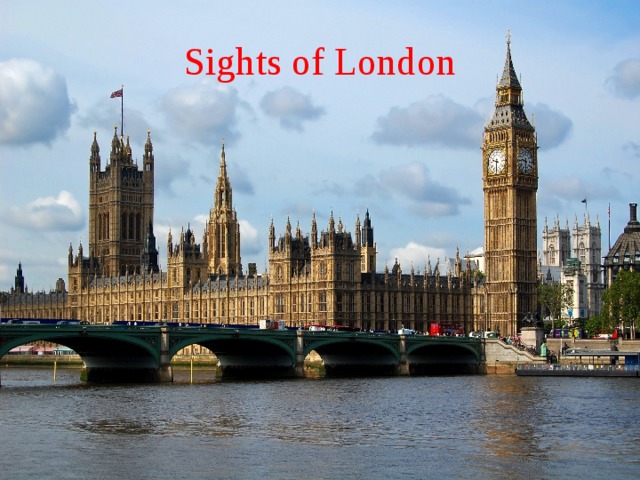
Sights of London
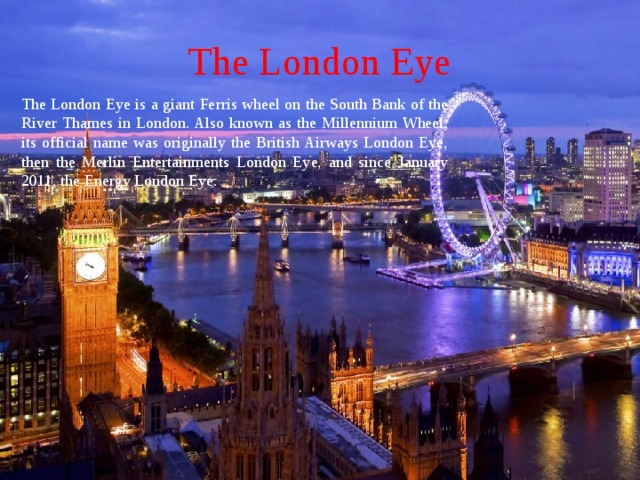
The London Eye
The London Eye is a giant Ferris wheel on the South Bank of the River Thames in London. Also known as the Millennium Wheel, its official name was originally the British Airways London Eye, then the Merlin Entertainments London Eye, and since January 2011, the Energy London Eye.
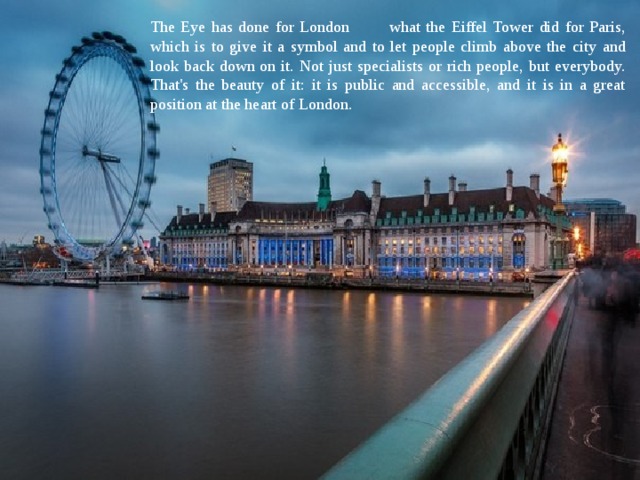
The Eye has done for London what the Eiffel Tower did for Paris, which is to give it a symbol and to let people climb above the city and look back down on it. Not just specialists or rich people, but everybody. That's the beauty of it: it is public and accessible, and it is in a great position at the heart of London.
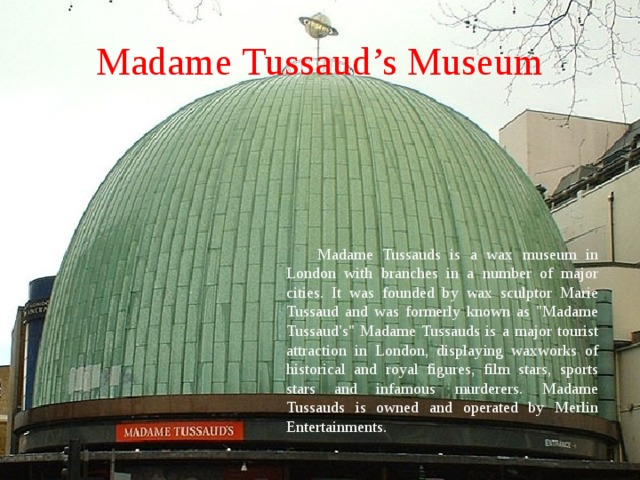
Madame Tussaud’s Museum
Madame Tussauds is a wax museum in London with branches in a number of major cities. It was founded by wax sculptor Marie Tussaud and was formerly known as "Madame Tussaud's" Madame Tussauds is a major tourist attraction in London, displaying waxworks of historical and royal figures, film stars, sports stars and infamous murderers. Madame Tussauds is owned and operated by Merlin Entertainments.
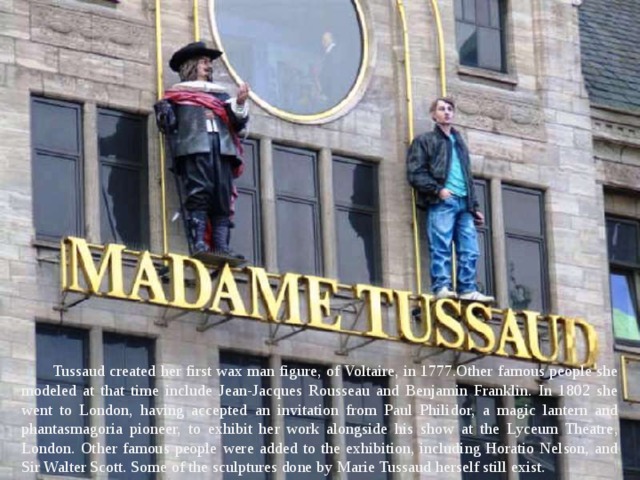
Tussaud created her first wax man figure, of Voltaire, in 1777.Other famous people she modeled at that time include Jean-Jacques Rousseau and Benjamin Franklin. In 1802 she went to London, having accepted an invitation from Paul Philidor, a magic lantern and phantasmagoria pioneer, to exhibit her work alongside his show at the Lyceum Theatre, London. Other famous people were added to the exhibition, including Horatio Nelson, and Sir Walter Scott. Some of the sculptures done by Marie Tussaud herself still exist.
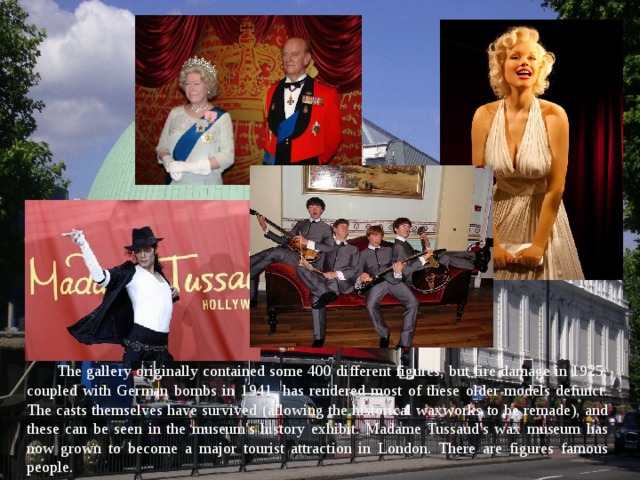
The gallery originally contained some 400 different figures, but fire damage in 1925, coupled with German bombs in 1941, has rendered most of these older models defunct. The casts themselves have survived (allowing the historical waxworks to be remade), and these can be seen in the museum's history exhibit. Madame Tussaud's wax museum has now grown to become a major tourist attraction in London. There are figures famous people.
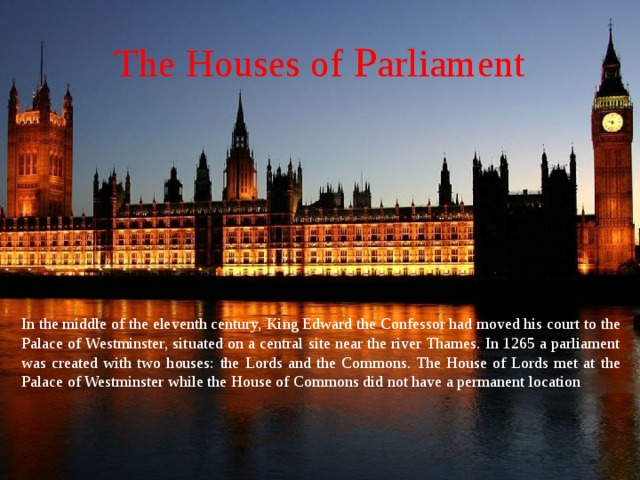
The Houses of P arliament
In the middle of the eleventh century, King Edward the Confessor had moved his court to the Palace of Westminster, situated on a central site near the river Thames. In 1265 a parliament was created with two houses: the Lords and the Commons. The House of Lords met at the Palace of Westminster while the House of Commons did not have a permanent location
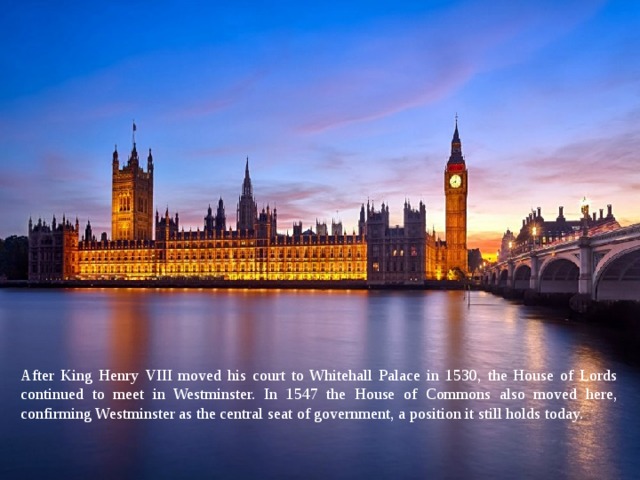
After King Henry VIII moved his court to Whitehall Palace in 1530, the House of Lords continued to meet in Westminster. In 1547 the House of Commons also moved here, confirming Westminster as the central seat of government, a position it still holds today.
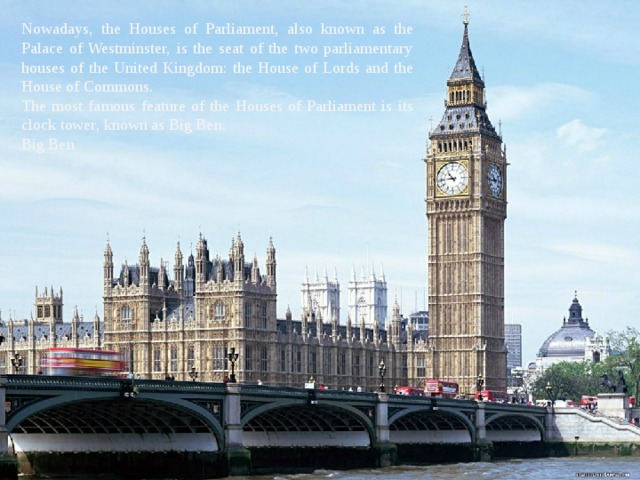
Nowadays, the Houses of Parliament, also known as the Palace of Westminster, is the seat of the two parliamentary houses of the United Kingdom: the House of Lords and the House of Commons.
The most famous feature of the Houses of Parliament is its clock tower, known as Big Ben.
Big Ben
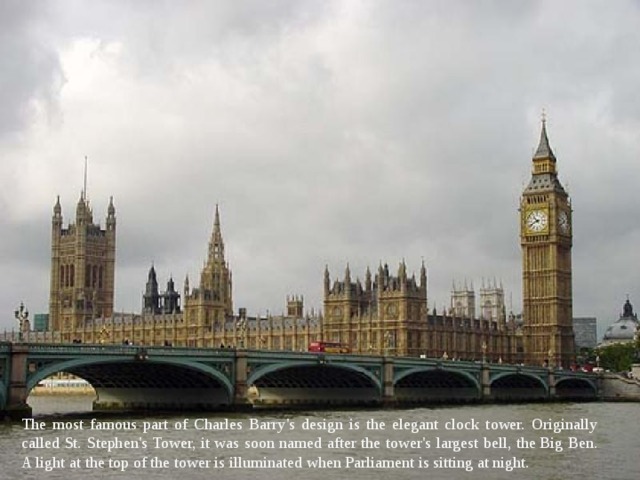
The most famous part of Charles Barry's design is the elegant clock tower. Originally called St. Stephen's Tower, it was soon named after the tower's largest bell, the Big Ben. A light at the top of the tower is illuminated when Parliament is sitting at night.
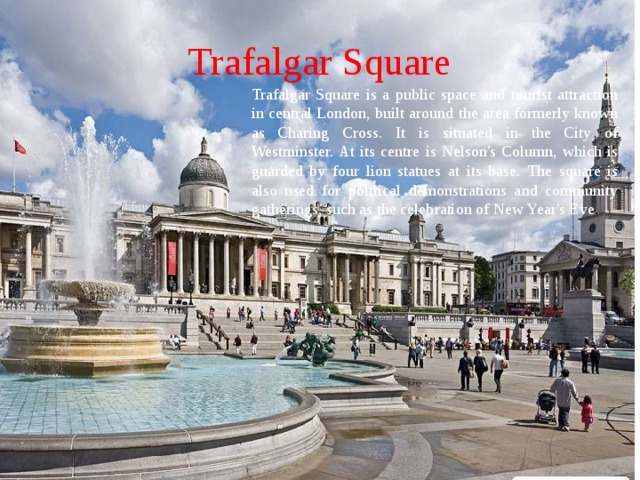
Trafalgar Square
Trafalgar Square is a public space and tourist attraction in central London, built around the area formerly known as Charing Cross. It is situated in the City of Westminster. At its centre is Nelson's Column, which is guarded by four lion statues at its base. The square is also used for political demonstrations and community gatherings, such as the celebration of New Year's Eve .
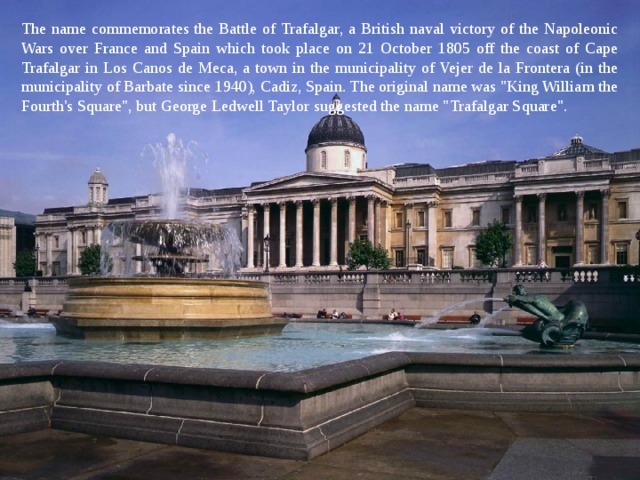
The name commemorates the Battle of Trafalgar, a British naval victory of the Napoleonic Wars over France and Spain which took place on 21 October 1805 off the coast of Cape Trafalgar in Los Canos de Meca, a town in the municipality of Vejer de la Frontera (in the municipality of Barbate since 1940), Cadiz, Spain. The original name was "King William the Fourth's Square", but George Ledwell Taylor suggested the name "Trafalgar Square".
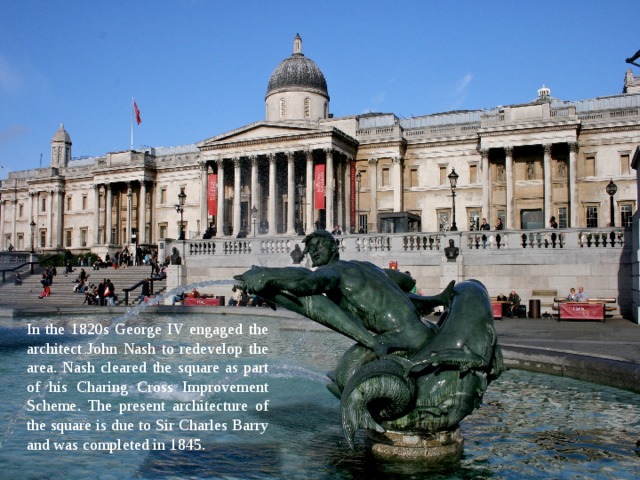
In the 1820s George IV engaged the architect John Nash to redevelop the area. Nash cleared the square as part of his Charing Cross Improvement Scheme. The present architecture of the square is due to Sir Charles Barry and was completed in 1845.
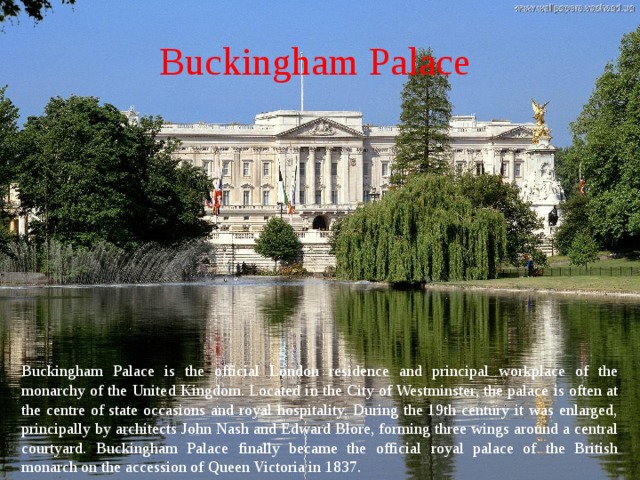
Buckingham Palace
Buckingham Palace is the official London residence and principal workplace of the monarchy of the United Kingdom. Located in the City of Westminster, the palace is often at the centre of state occasions and royal hospitality. During the 19th century it was enlarged, principally by architects John Nash and Edward Blore, forming three wings around a central courtyard. Buckingham Palace finally became the official royal palace of the British monarch on the accession of Queen Victoria in 1837.
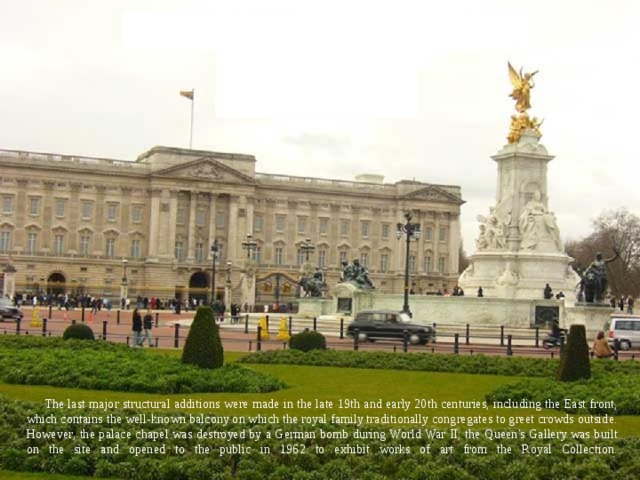
The last major structural additions were made in the late 19th and early 20th centuries, including the East front, which contains the well-known balcony on which the royal family traditionally congregates to greet crowds outside. However, the palace chapel was destroyed by a German bomb during World War II; the Queen's Gallery was built on the site and opened to the public in 1962 to exhibit works of art from the Royal Collection.
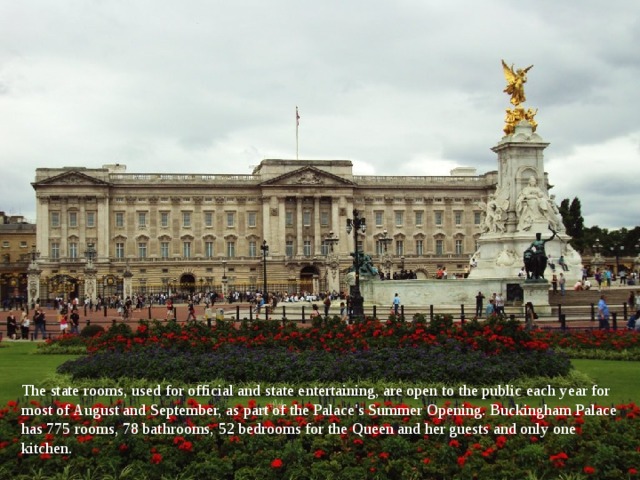
The state rooms, used for official and state entertaining, are open to the public each year for most of August and September, as part of the Palace's Summer Opening. Buckingham Palace has 775 rooms, 78 bathrooms, 52 bedrooms for the Queen and her guests and only one kitchen.
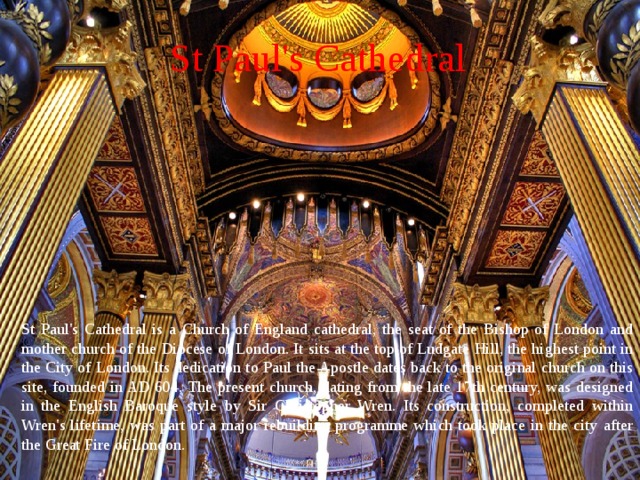
St Paul's Cathedral
St Paul's Cathedral is a Church of England cathedral, the seat of the Bishop of London and mother church of the Diocese of London. It sits at the top of Ludgate Hill, the highest point in the City of London. Its dedication to Paul the Apostle dates back to the original church on this site, founded in AD 604. The present church, dating from the late 17th century, was designed in the English Baroque style by Sir Christopher Wren. Its construction, completed within Wren's lifetime, was part of a major rebuilding programme which took place in the city after the Great Fire of London.
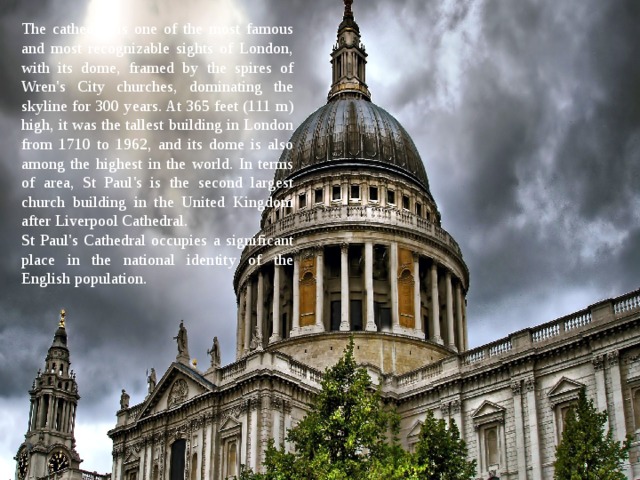
The cathedral is one of the most famous and most recognizable sights of London, with its dome, framed by the spires of Wren's City churches, dominating the skyline for 300 years. At 365 feet (111 m) high, it was the tallest building in London from 1710 to 1962, and its dome is also among the highest in the world. In terms of area, St Paul's is the second largest church building in the United Kingdom after Liverpool Cathedral.
St Paul's Cathedral occupies a significant place in the national identity of the English population.
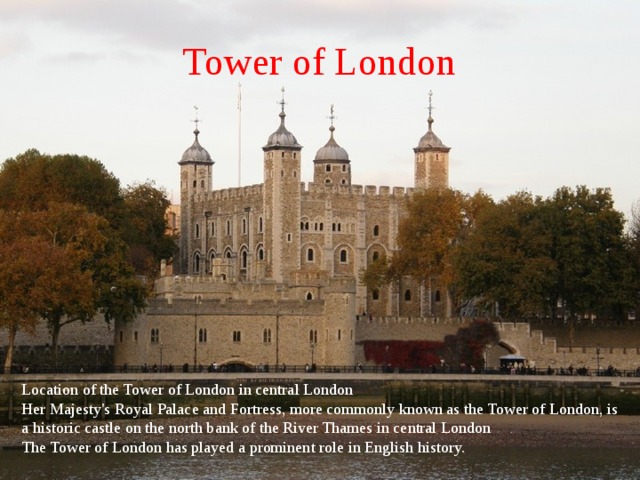
Tower of London
Location of the Tower of London in central London
Her Majesty's Royal Palace and Fortress, more commonly known as the Tower of London, is a historic castle on the north bank of the River Thames in central London
The Tower of London has played a prominent role in English history.
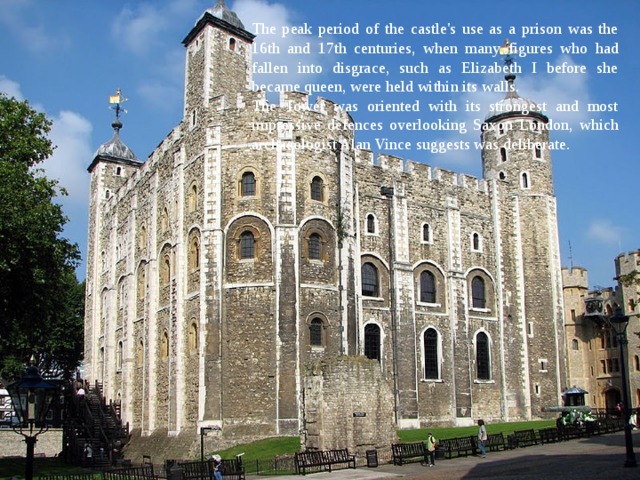
The peak period of the castle's use as a prison was the 16th and 17th centuries, when many figures who had fallen into disgrace, such as Elizabeth I before she became queen, were held within its walls.
The Tower was oriented with its strongest and most impressive defences overlooking Saxon London, which archaeologist Alan Vince suggests was deliberate.
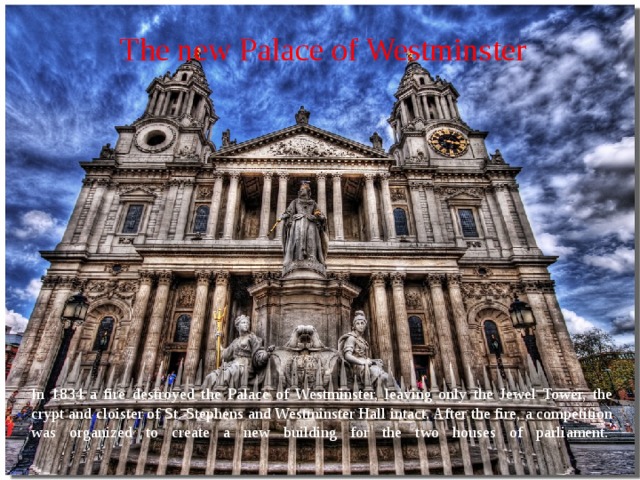
The new Palace of Westminster
In 1834 a fire destroyed the Palace of Westminster, leaving only the Jewel Tower, the crypt and cloister of St. Stephens and Westminster Hall intact. After the fire, a competition was organized to create a new building for the two houses of parliament.
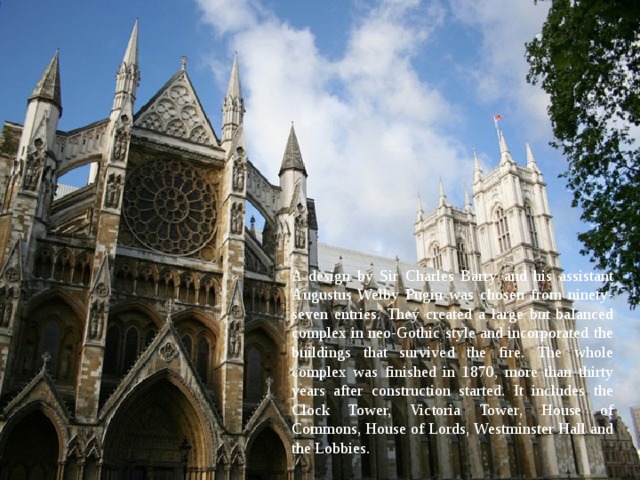
A design by Sir Charles Barry and his assistant Augustus Welby Pugin was chosen from ninety-seven entries. They created a large but balanced complex in neo-Gothic style and incorporated the buildings that survived the fire. The whole complex was finished in 1870, more than thirty years after construction started. It includes the Clock Tower, Victoria Tower, House of Commons, House of Lords, Westminster Hall and the Lobbies.
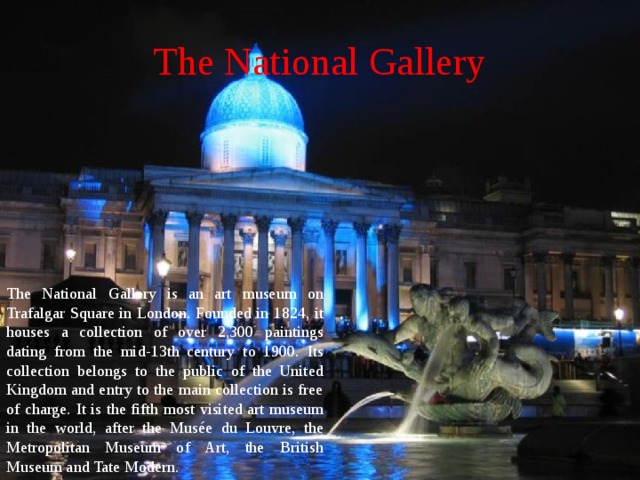
The National Gallery
The National Gallery is an art museum on Trafalgar Square in London. Founded in 1824, it houses a collection of over 2,300 paintings dating from the mid-13th century to 1900. Its collection belongs to the public of the United Kingdom and entry to the main collection is free of charge. It is the fifth most visited art museum in the world, after the Musée du Louvre, the Metropolitan Museum of Art, the British Museum and Tate Modern.
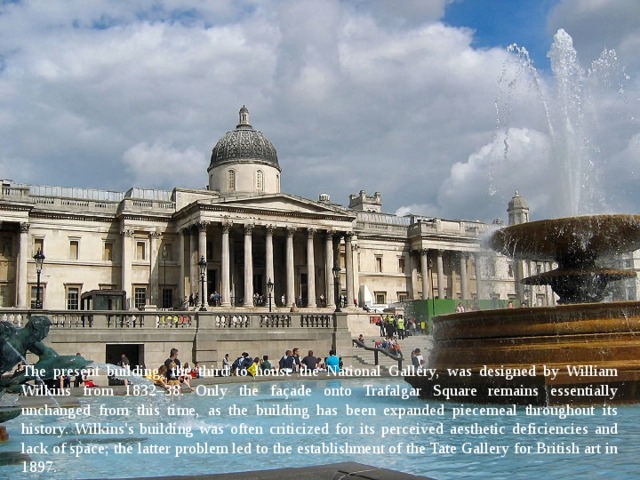
The present building, the third to house the National Gallery, was designed by William Wilkins from 1832–38. Only the façade onto Trafalgar Square remains essentially unchanged from this time, as the building has been expanded piecemeal throughout its history. Wilkins's building was often criticized for its perceived aesthetic deficiencies and lack of space; the latter problem led to the establishment of the Tate Gallery for British art in 1897.
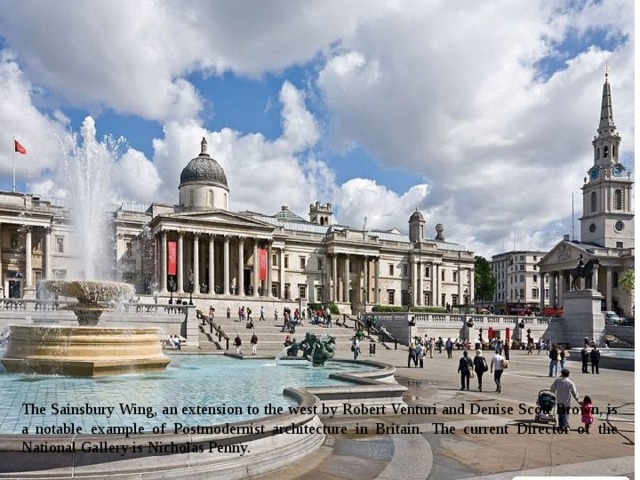
The Sainsbury Wing, an extension to the west by Robert Venturi and Denise Scott Brown, is a notable example of Postmodernist architecture in Britain. The current Director of the National Gallery is Nicholas Penny.









 Достопримечательности Лондона (9.37 MB)
 0
0 462
462 18
18 Нравится
0
Нравится
0


