
 Получите свидетельство
 Вход
Вход


Short term lesson plan
| Unit of a long term plan: Unit 3 Our Countryside.
| School: №22 | ||||||
| Date: 20.11.18 | Teacher's name: Karabalieva A.K
| ||||||
| CLASS: 6 B | Number present: | absent: | |||||
| Lesson title | A description of a wildlife photo. | ||||||
| Learning objectives(s) | 6.S7 use appropriate subject-specific vocabulary and syntax to talk about a range of general topics, and some curricular topics 6.W6 link independently, sentences into coherent paragraphs using a variety of basic connectors on a range of familiar general topics and some curricular topics 6.W1 plan, write, edit and proofread work at text level with little support on a range of general and curricular topics | ||||||
| Lesson objectives | All learners will be able to:
Most learners will be able to:
Some learners will be able to:
| ||||||
| Level of thinking | Higher order thinking skills (according to the revised Bloom's taxonomy). | ||||||
| Assessment criteria |
| ||||||
| Target language | Orcas, squid, calf, extinct, fishing net, habitat, | ||||||
| Values links | Appreciating the love to animals and the ability to write articles about animals. | ||||||
| Cross-curricular links | Kazakh language, Russian language, Social Science, Biology | ||||||
| Previous learning | Vocabulary related to people's activities | ||||||
| Plan | |||||||
| Planned timings | Planned activities (replace the notes below with your planned activities) | Resources | |||||
| Start 5 min | The lesson greeting. Warm-up
Teacher informs that they are going to write an article about animals. | Slide (objectives) https://www.youtube.com/watch?v=MCjhynvMunE Slide (useful phrases) | |||||
| Main part
| Speaking about animals. Game «What is it?»
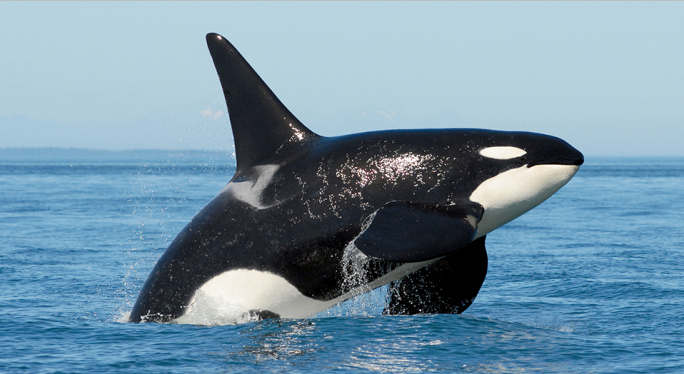
Speaking about Red list animals: The orca ( Kосатка) The killer whale or orca (Orcinus orca) is a toothed whale belonging to the oceanic dolphin family, of which it is the largest member.
The article is usually consists of 3 parts: 1. Introduction: the animal(s) in this photo is.... 2. The way of living: habitat, behaviour, babies. 3. They are in the ' red list' because..... Read the article about the orcas and do Ex.1 - 2 p.39. Optional activity: Language Focus. Linking words: because, and, also, but, or. Put a right linking word: 1.These animals are orcas___ "killer whales". 2.An orca is not a whale,______ a type of dolphin. 3.They are aggressive___ they eat fish. 4.They are in danger___ there is a pollution in the sea. 5.They ____ die in fishing nets. Answers: 1. or 2.but 3.and 4. because 5. also WTITING GUIDE Look at the photo and write an article about polar bears. Ex.4 p.39. Use a plan and notes. |
Whiteboard A presentation " Wild Animals".
A picture Writing Worksheets
Student's Book p.39 Writing Worksheets Student's Book p.39
| |||||
| End
| Home task. WB p.29 An article about an animal. Students express their attitude to the lesson and give self-assessment using the method: “Six thinking hats”:
| Slide (Homework) Slide "Six thinking hats"
| |||||
| Additional information | |||||||
| Differentiation – how do you plan to give more support? How do you plan to challenge the more able learners? | Assessment – how are you planning to check learners’ learning? | Health and safety check | |||||
| Differentiation can be achieved through content (Based on the theory of Multiple Intelligences different tasks are used with the same text). By support: Less able learners will be supported through step-be-step instructions, glossaries, thinking time. By task: For more able learners additional leveled tasks are offered.
| Assessment criteria:
Descriptors: A learner
Teacher's observation Self-assessment.
| Health saving technologies.
| |||||









 A discription a wild life photo (2.23 MB)
 0
0 1104
1104 63
63 Нравится
0
Нравится
0


