Получите свидетельство
 Вход
Вход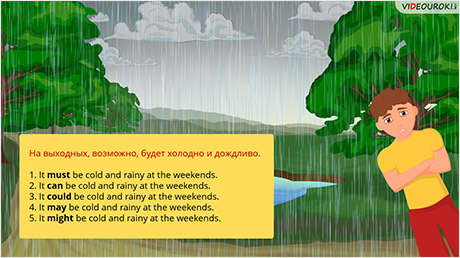



— Hello, our dear friends! My name is James Wilson.
— And my name is Martin Green.
— We also invited Martin’s neighbor Michael to the lesson.
— Hello, guys! And welcome to our grammar lesson!
— Today we would like to start the lesson with five short stories.
— Listen to these stories, please.
— This will help you to guess the topic of the lesson today.
One.
— Hey, Robert. Did you see Anna? I would like to invite her to dinner tonight.
— Yes, I did. But I’m not sure that she will go with you.
— Why do you think so?
— Anna said that she might go to the concert with her sister tonight. Well… she wasn’t sure about that.
— Oh, I see. In this case I think I should invite her.
Two.
— Cody, do you know where my car keys are?
— No, dad, I don’t. Oh, wait…
— What?
— I think they may be in the car, because sometimes Julia leaves them there.
— Oh, I need to talk to your sister about this bad habit. Thieves can steal our car any moment.
Three.
— Harry, where was your brother last night?
— Tyler, why are you asking?
— Your brother had promised to come to our meeting yesterday, but he didn’t show up!
— Well… I think he could had taken the wrong bus, as usual.
Four.
— Bradley, look! There is a light in Megan’s window!
— So what, Jordan?
— She went to Egypt with her family two days ago. It can’t be Megan or her family members.
— Oh my God! It can be thieves. We need to call the police!
Five.
— Dylan, your phone is ringing!
— Oh, thank you, Felix. It must be my mom.
— Dylan, how do you know that?
— Well… she calls me every day at this time.
Now let’s look through the stories once again. Pay attention to the underlined words.
In the 1st story we used the word “might”.
In the 2nd – we used the word “may”.
In the 3rd story we used “could”.
In the 4th – the word “can”.
And in the last story we used “must”.
— As you can see, in all these stories we used different modal verbs.
— These modal verbs helped us to show different degree of possibility in each sentence.
Now I think you understand that today in the lesson we will:
· revise the definition of the term “modal verb”;
And
· talk about the modal verbs “must”, “can”, “could”, “may” and “might” to express probability.
— Let’s start our lesson.
— First of all, we will remind you the definition of the term “modal verb”.
— After that we will talk about the modal verbs “must”, “can”, “could”, “may” and “might” to express different degrees of possibility.
Modal verbs are verbs which we use to express ability, necessity, obligation, duty, request, permission, advice, desire, probability, possibility, etc.
They need to be accompanied by another main verbs.
Pay attention! Modal verbs always take base form of a verb with them.
For example:
Tyler and Mike hate their new school, because they have to wear a uniform.
Or
Wendy, you can eat my ice-cream, because I have a sore throat.
(In these two sentences we used the modal verbs “have to” and “can”. They are accompanied by the main verbs “wear” and “eat”).
Modal verbs are unlike other verbs. Sometimes they are called defective verbs, because they don’t have all the functions of main verbs. Modal verbs cannot be used without a main verb. They cannot form gerunds or participles. And they don’t have any endings to show person, number or tense.
Modal verbs form questions without the help of the other auxiliary verbs.
For instance:
Liam, I’m so tired! Can we go now?
Daddy, may I take this book, please?
Or
Bobby, it’s your first day at school! Should we go there with you?
— Now let’s talk about modal verbs, which we can use to express probability.
Probability in the English language can be expressed by the modal verbs may, might, can, could and must. We use them when we think that something is possible, but don’t know for sure.
For example, if we want to translate the sentence “На выходных, возможно, будет холодно и дождливо” into English, we can translate it in 5 different ways:
1. It must be cold and rainy at the weekends.
2. It can be cold and rainy at the weekends.
3. It could be cold and rainy at the weekends.
4. It may be cold and rainy at the weekends.
And
5. It might be cold and rainy at the weekends.
Pay attention! We choose the necessary modal verb depending on how sure we are.
Now let’s compare the modal verbs “must”, “can”, “could”, “may” and “might”.
We need to use the modal verbs “might” and “may” if we are not sure about something at all. But “may” expresses a greater degree of certainty than “might”.
If we talk about these two modal verbs in percentage terms, we can say that we need to use “might” when we are around 10% sure about something.

For instance:
The Browns are not at home right now, but they might come later.
Or
You need to ask Jessica about that! She might be able to help you.
We need to use the modal verb “may” when we are around 30% sure about something.

For instance:
Felix, you should ask your wife. She may know Tyler's telephone number.
Or
I haven't heard from Julia for twelve years. She may not have seen my letters.
If we are half certain about something, we should use the modal verb “could”.

Let’s look at the examples.
Kelly was supposed to be here at this time. She could be lost.
Or
Hunter and Jordan were obviously joking. They couldn’t be serious.
The following modal verb is “can”. We need to use it when we are around 70% sure about something. We also can use the modal verb “can” to make general statements about what is possible.

For instance:
Winters in Halifax can be really cold.
Or
Prices can be very high in the United States of America.
And the last modal verb is “must”. We use it to show that we are almost 100% sure about something and we have reasons for our belief.

For example:
Jillian hasn’t eaten all day. She must be very hungry!
Or
Robert was working all the evening. He must be really tired!
As you can see, the modal verb “must” expresses the highest degree of certainty and the modal verb “might” expresses the lowest degree.
When we want to show that something was possible but didn’t happen, we need to use the modal verbs “could”, “might” or “may”. We also need to use the word “have” with them.
Let’s look at the examples.
Nancy, it’s 12 o’clock. Our parents might have arrived now.
Kate could have caught the taxi if she had hurried.
Or
Ian and Lucy were very careless when they were crossing the street. They might have died.
Pay attention! We can use the modal verb “must” to express probability only if it’s used with the verb “to be”.
For instance:
It’s 9 o’clock. Our children must be at school now.
Dan is not at home now. He must be working in his office.
Or
Look! Everyone is wearing a coat. It must be cold outside.
Although “might” and “could” express possibility in a similar way, their negative forms are different.
“Might not” shows that something probably is not true.
For example:
These journals might not be the teachers.
Or
Kirsten might not be his real daughter.
We also use “might not” to show that something probably will not happen in the future.
For example:
Nicole might not go to my birthday party tonight.
Or
George might not come back soon.
“Could not” shows that something is impossible.
For example:
Joan could not know who my best friend is. She has never seen him.
Or
You could not have seen her in the bus, because she was at home all day.
— Guys, we have told you about the modal verbs “must”, “can”, “could”, “may” and “might” to express probability.
— Now you know when you need to use each of them.
— That’s all for today, our dear friends.
— We hope that the lesson was interesting and useful for you.
— See you soon, boys and girls.

 1877
1877