Получите свидетельство
 Вход
Вход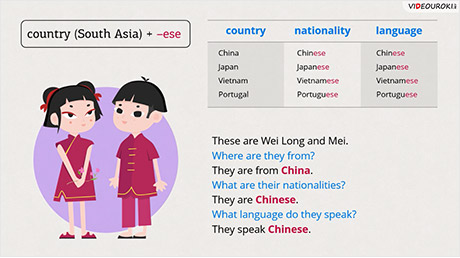



Right, everybody. We’re here to see the sand sculpture competition. You can go and look around, but I want everyone to meet at six o’clock at this sculpture of Darth Vader.
They’re so amazing! Look at the elephant!
I’ve got my camera with me. I’m going to take pictures of the sculptures.
Oh, I can’t understand what is written here. I guess, it’s in French.
Hi guys, I’m Fin. This one’s by a French artist. It says Le Cheval. That means “horse”.

Hello Fin. I’m Tom. Nice to meet you. Where are you from?
I’m from Canada. Nice to meet you too.
Do you speak French?
Yes, I’m bilingual. English and French are both official languages in Canada.
What is your nationality then?
I’m Canadian.
Do you speak any other languages, Fin?
I learnt some German at school, but I’m not fluent.
Where are you from?
What’s your nationality?
Do you speak French?
These are the questions that help us to get the information about the country where the person is from, his/her nationality and native language.
So, today's lesson is Countries, Nationalities and Languages.
We’ve organized the words into categories that can help you to remember them better.
Let's get started.
Most nationalities in English are formed with the help of the suffixes –an, -ian, -ean added to the name of the country.

Remember, that the names for many languages sound the same as nationality words.
Look:
This is Hans.
Where is Hans from? - He is from Germany.
What is his nationality? - He is German.
What language does he speak? - He speaks German.
We use the same word – German – both to indicate his nationality and language he speaks.
Germany German German
Canada Canadian Canadian
Mexico Mexican Spanish
Australia Australian English
Brazil Brazilian Portuguese
Egypt Egyptian Arabic
Italy Italian Italian
Hungary Hungarian Hungarian
Korea Korean Korean
Russia Russian Russian
the USA American English
Europe European
A lot of nationalities of South Asia end in –ese:

These are Wei Long and Mei.
Where are they from? – They are from China.
What are their nationalities? – They are Chinese.
What language do they speak? - They speak Chinese.
China Chinese Chinese
Japan Japanese Japanese
Vietnam Vietnamese Vietnamese
Portugal Portuguese Portuguese
Here is a group of Muslim nationalities that end in –i:

This is Omar.
Where is Omar from? - He is from Iraq.
What is his nationality? - He is Iraqi.
What language does he speak? - He speaks Arabic.
Iraq Iraqi Arabic
Pakistan Pakistani Urdo
Uzbekistan Uzbekistani Uzbek
The European nationalities are normally formed with the help of the suffixes –ish, -ch:

I’m Tommy. I’m from the United Kingdom. So, I’m British.
But I live in England. So you can say: I’m English.
The UK British English
England English English
Denmark Danish Danish
Finland Finnish Finnish
Poland Polish Polish
Spain Spanish Spanish
Sweden Swedish Swedish
Turkey Turkish Turkish
Holland Dutch Dutch
France French French
· Pay attention that we use the definite article when referring to nationalities that do not have a plural form. They include nationalities that end in -sh, -ese, -ch and -ss.

The Japanese are known to be very polite and educated people.
The English are known as punctual people.
· Use Ø (zero article) when referring to nationalities that have a plural form.

Italians are very hospitable and friendly.
Germans are famous for having a sweet tooth.
Canadians don’t mind cold weather.
Kristie: Hi, I’m Kristie. I’m from Scotland. I’m Scottish. I speak …English or the English, English language or the English Language?
Which is correct?
· Do not use the indefinite article or the definite article when referring to the names of languages.
English is hard.
Martin wants to learn Chinese.
· Use the definite article when the word “language” immediately follows the name of a language.
The English language is hard.
Martin wants to learn the Chinese language.
Look at the pictures.
Where are these famous people from? What are their nationalities? And what language do they speak?
1. The Queen Elizabeth is from the UK.
She is British. She speaks English.
2. Mark Zuckerberg is from the USA.
He is American. He speaks English.
3. Cristiano Ronaldo is from Portugal.
He is Portuguese. He speaks Portuguese.
4. Rafael Nadal is from Spain.
He is Spanish. He speaks Spanish.
5. Father Christmas is from Finland.
He is Finnish. He speaks Finnish.
6. Nicole Kidman is from Australia.
She is Australian. She speaks English.
7. Luciano Pavarotti was from Italy.
He was Italian. He spoke Italian.
Well, the competition was great. The sand sculptures were amazing! We took lots of photos and made new friends from other countries.
Now it’s time to come back!
Au revoir! This means “good bye” in French.
 0
0 1956
1956