Получите свидетельство
 Вход
Вход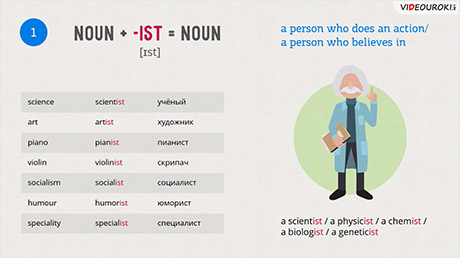



Hello, guys! Welcome to our grammar lessons!
My best friends Maddie, Kristie and Martin will help me make our lessons useful and enjoyable
In this video we look at some common English noun suffixes. We will talk about how suffixes work, how they are spelled, and how they will help you to understand English words.
At first let’s revise what nouns are like.
A noun is a word that names a person, a place or a thing.
Nouns can be abstract, concrete, common and proper.
Abstract Nouns
An abstract noun is a noun that names an idea, not a physical thing.
Examples:
Hope, friendship, love, peace, success, knowledge, trouble.
Concrete Nouns
A concrete noun is a noun that names a physical thing.
Examples:
Sofa, floor, coffee, beach, pen, rain, children.
Common Nouns
A common noun is a noun that names a general thing, not a specific thing.
Examples:
Boy, city, country, company, planet, furniture.
Proper Nouns
A proper noun is a noun that indicates the specific name of a thing. It begins with a capital letter.
Examples:
David, Maggie, London, Australia, Google, Earth.
Now we are ready to speak about the formation of nouns.
Nouns may be built in different ways but today we’ll speak about suffixes which help us form nouns from other parts of speech.
The thing is that there are no rules which help us build new nouns; we have to learn them.
But I can help you in the following way: some suffixes have a peculiar meaning.
So, let’s start.
1. –ist [ɪst]

Look at this picture. It shows a scientist. He is probably a physicist or a chemist, a biologist, or even a geneticist.
Do you see the pattern? Words that end in -ist are formed from nouns, and this suffix means "a person who does an action" or "a person who believes in."
There are many words with this suffix, but here is a list of some common ones:
science - scientist
art - artist
piano – pianist
violin - violinist
socialism - socialist
humour - humorist
speciality – specialist
2. –ment [mənt]

Unfortunately, these two people are having an argument.
The suffix –ment is used to make abstract nouns from verbs. This suffix means "action or process.”
Here are some more common words that end in -ment:
to enjoy – enjoyment - наслаждение
to move – movement - движение
to treat – treatment – лечение, обращение
to govern – government - управление
to pay – payment - оплата
to improve – improvement - улучшение
to agree – agreement - соглашение
to achieve – achievement - достижение
3. –ness [nɪs]

His happiness is very evident!
You will find many words in English that end in -ness. -Ness is used to make abstract nouns from adjectives. This suffix means "state of being" or "quality."
Here are some of the most common words with this ending. Remember that you will find many more of them, too:
busy – business – дело
ill –illness - болезнь
sad – sadness - грусть
thick – thickness - густота
kind – kindness - доброта
weak – weakness - слабость
dark – darkness - темнота
bright – brightness - яркость
4. –ship [ʃɪp]

It is important to have some strong friendships, even if you do not have lots of friends.
The suffix –ship is used to make abstract nouns from nouns and it means "state or condition of."
Here are some very common words with this suffix:
relation - relationship - отношения
leader - leadership - лидерство
member - membership - членство
owner - ownership - собственность
champion - championship - чемпионат
citizen - citizenship - гражданство
partner - partnership - партнёрство
5. –tion [ -ʃ(ə)n ]

At school we had a maths competition. We had to answer questions about addition and subtraction.
-tion is is used to make nouns from verbs. It also means "a state of being." You will also find many words that end in slight variations of this suffix, including, -sion, -ition, -ation, or simply -ion.
However, the most common is -tion.
Here are some examples with this suffix:
to inform – information - информация
to educate – education - образование
to act – action -действие
to decide – decision - решение
to situate – situation - ситуация
to produce – production - производство
to populate –population - население
6. –er /-or/[ ə] -ee [i:]

You are our first visitor today!
-er added to a verb is used for the person who does something (для обозначения действующего лица/профессии).
to visit – visitor – посетитель
to buy – buyer – покупатель
to direct – director – руководитель
to teach – teacher – учитель
to work – worker – рабочий
-er/-or are also used for things which do a particular job:
tin-opener – открывашка
projector – проектор
mixer – миксер
-er and –ee can contrast with each other, meaning:
- "person who does something" (-er)
- and "person who receives or experiences the action" (-ee)
to employ – нанимать
employer – наниматель employee – нанятый сотрудник
to address – адресовать addressee – адресат
to pay – платить payee – получатель платежа
7. -(i)ty [ɪtɪ]

Honesty is the best policy.
-(i)ty is used to make abstract nouns from adjectives. It also means "a state of being” or “quality”.
honest – honesty – честность
loyal – loyalty – верность, благонадёжность
equal – equality – равенство
flexible – flexibility – гибкость
real – reality – реальность
popular – popularity – популярность
8. -ance, -ence [əns]

There's a big difference in age between them.
-ance, -ence are used to make nouns from adjectives ending -ant, -ent.
different – difference – разница
important – importance – важность
intelligent – intelligence – интеллект, сообразительность
silent – silence – тишина
confident – confidence – уверенность
9. –ing [ɪŋ]

Look at this building! It’s amazingly high.
The suffix –ing is used to make nouns from verbs that describes an example or act.
There are many words with this suffix, but here is a list of some of them:
to build – building – здание, строительство
to learn – learning – обучение
to swim – swimming – плавание
to act – acting – игра, актёрство
to mean – meaning – значение
to understand – understanding – понимание
to drive – driving – вождение
Now it’s time to practice the rule with Martin.
Read the words in the table below. Find related words in the puzzle and complete the table.
Now check yourselves.
to fish – fishing
to imagine – imagination
to amuse – amusement
economy – economist
patient - patience
to own – owner
That`s all for today.
I hope, the information was useful to you, wasn’t it?
Join us at our grammar lessons at videouroki.net and you’ll realize that grammar is interesting.
 0
0 2349
2349