
 Получите свидетельство
 Вход
Вход




Главное управление образования и молодёжной политики Алтайского края
КГБПОУ СПО «Благовещенский строительный техникум»
The Renaissance and Modern architects
and architecture
Студент 131 группа Сереенендорж А.
Преподаватель Мурзинцева Т. Я.
Степное Озеро
2016

List of architects
Richard Rogers
Christopher Wren
Norman Foster
Robert Adam
Zaha Nadid
George Gilbert Scott
Conclusion

Christopher Wren
Sir Christopher Wren, (born Oct. 20, 1632, East Knoyle, Wiltshire, Eng.—died Feb. 25, 1723, London), designer, astronomer, geometrician, and the greatest English architect of his time. Wren designed 53 London churches, including St. Paul’s Cathedral, as well as many secular buildings of note. He was a founder of the Royal Society (president 1680–82), and his scientific work was highly regarded by Sir Isaac Newton and Blaise Pascal. He was knighted in 1673.

Christopher Wren’s structure
The present Cathedral, the masterpiece of Britain's most famous architect Sir Christopher Wren, is at least the fourth to have stood on the site. It was built between 1675 and 1710, after its predecessor was destroyed in the Great Fire of London, and services began in 1697.
This was the first Cathedral to be built after the English Reformation in the sixteenth-century, when Henry VIII removed the Church of England from the jurisdiction of the Pope and the Crown took control of the life of the church. The cathedral is one of the most famous and most recognisable sights of London. Its dome, framed by the spires of Wren's City churches, dominated the skyline for 300 years. At 365 feet (111 m) high, it was the tallest building in London from 1710 to 1962.

Robert Adam
Robert Adam, (born July 3, 1728, Kirkcaldy, Fife, Scot.—died March 3, 1792, London, Eng.), Scottish architect and designer who, with his brother James (1730–94), transformed Palladian Neoclassicism in England into the airy, light, elegant style that bears their name. His major architectural works include public buildings (especially in London), and his designs were used for the interiors of such country mansions as Syon House (1762–69) in Middlesex (now in Hounslow, London).

Robert Adam’s structure
Osterley Park is a mansion set in a large park of the same name. It is in the London Borough of Hounslow, part of the western suburbs of London.
When the house was built it was surrounded by rural countryside. It was one of a group of large houses close to London which served as country retreats for wealthy families, but were not true country houses on large agricultural estates. Other surviving country retreats of this type near London include Syon House and Chiswick House. The park is one of the largest open spaces in west London, although the M4 motorway cuts across the middle of it.

George Gilbert Scott
Sir George Gilbert Scott, (born July 13, 1811, Gawcott, Buckinghamshire, Eng.—died March 27, 1878, London), English architect, one of the most successful and prolific exponents of the Gothic Revival style during the Victorian period.
Scott was apprenticed to a London architect and designed the first of his many churches in 1838;.. Scott’s significance rests partly on the sheer number of important buildings with which he was associated. Among the approximately 850 structures that he designed, restored, or otherwise influenced are almost 500 churches, 39 cathedrals and minsters, and many buildings for colleges and universities. Because he was the organizer and director of the largest English architectural firm of the period, Scott’s own individual designs are difficult to determine.

George Gilbert Scott’s structure
The Albert Memorial is situated in Kensington Gardens, London, directly to the north of the Royal Albert Hall. It was commissioned by Queen Victoria in memory of her beloved husband, Prince Albert who died of typhoid in 1861. The memorial was designed by Sir George Gilbert Scott in the Gothic Revival style. Opened in July 1872 by Queen Victoria, with the statue of Albert ceremonially "seated" in 1875, the memorial consists of an ornate canopy or pavilion, in the style of a Gothicciborium over the high altar of a church, containing a statue of the prince facing south. The memorial is 176 feet (54 m) tall, took over ten years to complete, and cost £120,000 (the equivalent of about £10,000,000 in 2010). The cost was met by public subscription.

Richard Rogers
Richard Rogers was born in Florence (Tuscany) in 1933 from Italian parents. His father, William Nino Rogers (1906-1993), was the cousin of Italian architect Ernesto Nathan Rogers. His ancestors moved from Sunderland to Venice in about 1800, then settling inTrieste, Milan and Florence. During World War II William Nino Rogers decided to come back to England. Richard went to St Johns School, Leatherhead upon moving to England, and later attended the Architectural Association School of Architecture in London, before graduating with a master's degree from the Yale School of Architecture in 1962.
While studying at Yale, Rogers met fellow architecture student Norman Foster and planning student Su Brumwell. On returning to England he, Foster and Brumwell set up architectural practice as Team 4 with Wendy Cheeseman (Brumwell later married Rogers, Cheeseman married Foster). Rogers and Foster earned a reputation for what was later termed by the media high-tech architecture

Richard Rogers’s structure
122 Leadenhall Street is an address on Leadenhall Street in London where the 225 m (737 ft) tall Leadenhall Building is located. The commercial skyscraper, opened in July 2014, was designed by Rogers Stirk Harbour + Partners and is informally known as "TheCheesegrater" because of its distinctive wedge shape. It is one of a number of new tall buildings recently completed or currently under construction in the City of London financial area, including 20 Fenchurch Street, 22 Bishopsgate, and The Scalpel.
The site is opposite the Lloyd's building, also designed by Rogers, which is the home of the insurance market Lloyd's of London. Until 2007 the Leadenhall site was occupied by the P&O Tower (Peninsular and Oriental), a building owned by the developer British Land and designed by Gollins Melvin Ward Partnership that was completed in 1968 as a brother to the still existing Commercial Union tower, now called St. Helen's. That building was demolished in preparation for redevelopment of the site. The project, initially delayed due to the financial crisis, was revived in 2010 and Oxford Properties co-developed the property in partnership with British Land.
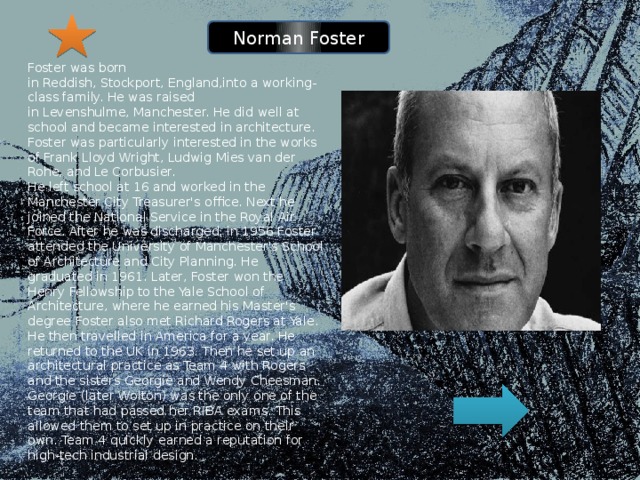
Norman Foster
Foster was born in Reddish, Stockport, England,into a working-class family. He was raised in Levenshulme, Manchester. He did well at school and became interested in architecture. Foster was particularly interested in the works of Frank Lloyd Wright, Ludwig Mies van der Rohe, and Le Corbusier.
He left school at 16 and worked in the Manchester City Treasurer's office. Next he joined the National Service in the Royal Air Force. After he was discharged, in 1956 Foster attended the University of Manchester's School of Architecture and City Planning. He graduated in 1961. Later, Foster won the Henry Fellowship to the Yale School of Architecture, where he earned his Master's degree Foster also met Richard Rogers at Yale. He then travelled in America for a year. He returned to the UK in 1963. Then he set up an architectural practice as Team 4 with Rogers and the sisters Georgie and Wendy Cheesman. Georgie (later Wolton) was the only one of the team that had passed her RIBA exams. This allowed them to set up in practice on their own. Team 4 quickly earned a reputation for high-tech industrial design.

Norman Foster’s structure
30 St Mary Axe (widely known informally as The Gherkin and previously as the Swiss Re Building ) is a commercial skyscraper inLondon's primary financial district, the City of London. It was completed in December 2003 and opened in April 2004. With 41 storeys, it is 180 metres (591 ft) tall and stands on the former sites of the Baltic Exchange and Chamber of Shipping, which were extensively damaged in 1992 by the explosion of a bomb placed by the Provisional IRA in St Mary Axe, the street from which the tower takes its name.
After plans to build the 92-storey Millennium Tower were dropped, 30 St Mary Axe was designed by Norman Foster and Arup Group [ and it was erected by Skanska, with construction commencing in 2001.
The building has become an iconic symbol of London and is one of the city's most widely recognised examples of contemporary architecture.

Zaha Hadid
Dame Zaha Mohammad Hadid , DBE (Arabic: زها حديد Zahā Ḥadīd ; born 31 October 1950) is an Iraqi-British architect. In 2004 she became the first woman recipient of the Pritzker Architecture Prize. She received the Stirling Prize in 2010 and 2011. In 2012 she was made a dame. In 2014 the Heydar Aliyev Cultural Centre, designed by her, won the Design Museum Design of the Year Award, making her the first woman to win the top prize in that competition. [ In 2015 she became the first woman to be awarded the RIBA Gold Medal in her own right.
Her buildings are distinctively neofuturistic, characterised by the "powerful, curving forms of her elongated structures" with "multiple perspective points and fragmented geometry to evoke the chaos of modern life". She is currently professor at the University of Applied Arts Vienna in Austria.

Zaha Hadid’s structure
The Heydar Aliyev Center is a 619,000-square-foot building complex in Baku, Azerbaijan designed by Iraqi-British architect Zaha Hadid and noted for its distinctive architecture and flowing, curved style that eschews sharp angles. The center is named for Heydar Aliyev, the leader of Soviet-era Azerbaijan from 1969 to 1982, and president of Azerbaijan from October 1993 to October 2003.

The Renaissance architecture
The Modern architecture
The influences
From religion
From the wars
About characterizes of construction

The Renaissance architecture
Renaissance architecture is the architecture of the period between the early 15th and early 17th centuries in different regions of Europe, demonstrating a conscious revival and development of certain elements of ancient Greek and Roman thought and material culture. Stylistically, Renaissance architecture followed Gothic architecture and was succeeded by Baroque architecture. Developed first inFlorence, with Filippo Brunelleschi as one of its innovators, the Renaissance style quickly spread to other Italian cities. The style was carried to France, Germany, England, Russia and other parts of Europe at different dates and with varying degrees of impact.

The Modern architecture
Modern architecture or modernist architecture is a term applied to an overarching movement, with its exact definition and scope varying widely. The term is often applied to modernist movements at the turn of the 20th century, with efforts to reconcile the principles underlying architectural design with rapid technological advancement and the modernization of society. It would take the form of numerous movements, schools of design, and architectural styles, some in tension with one another, and often equally defying such classification

From religion
Renaissance architecture
The return of the Pope Gregory XI from Avignon in September 1377 and the resultant new emphasis on Rome as the center of Christian spirituality, brought about a boom in the building of churches in Rome such as had not taken place for nearly a thousand years. This commenced in the mid 15th century and gained momentum in the 16th century, reaching its peak in the Baroque period. The construction of the Sistine Chapel with its uniquely important decorations and the entire rebuilding of St Peter's, one of Christendom's most significant churches, were part of this process.
Modern architecture
The religion did not influence to modern architecture

From the wars
Renaissance
Modern
Neo-Renaissance architecture is formed by not only the original Italian architecture but by the form in which Renaissance architecture developed in France during the 16th century. During the early years of the 16th century the French were involved in wars in northern Italy, bringing back to France not just the Renaissance art treasures as their warbooty, but also stylistic ideas. In the Loire valley a wave of chateau building was carried out using traditional French Gothic styles but with ornament in the forms of pediments, arcades, shallow pilasters and entablatures from the Italian Renaissance.
The concept of modernism is a central theme in the efforts of 20th century modern architecture. Gaining global popularity especially after the Second World War, architectural modernism was adopted by many architects and architectural educators, and continued as a dominant architectural style for institutional and corporate buildings into the 21st century. Modernism eventually generated reactions, most notably Postmodernism which sought to preserve pre-modern elements, while "Neo-modernism" has emerged as a reaction to Post-modernism.

About characterizes of construction
Renaissance
Modern
The plans of Renaissance buildings have a square, symmetrical appearance in which proportions are usually based on a module. Within a church, the module is often the width of an aisle.
The notion that "Form follows function", a dictum originally expressed by Frank Lloyd Wright's early mentor Louis Sullivan, meaning that the result of design should derive directly from its purpose
Façades are symmetrical around their vertical axis. Church façades are generally surmounted by a pediment and organised by a system of pilasters, arches and entablatures. The columns and windows show a progression towards the centre.
simplicity and clarity of forms and elimination of "unnecessary detail"
Doors usually have square lintels. They may be set within an arch or surmounted by a triangular or segmental pediment.
materials at 90 degrees to each other
Windows may be paired and set within a semi-circular arch. They may have square lintels and triangular or segmental pediments, which are often used alternately.
visual expression of structure (as opposed to the hiding of structural elements)
the related concept of "Truth to materials", meaning that the true nature or natural appearance of a material ought to be seen rather than concealed or altered to represent something else
use of industrially-produced materials; adoption of the machine aesthetic
particularly in International Style modernism, a visual emphasis on horizontal and vertical lines

Author’s conclusion of this presentation
At the time of Renaissance many things were born : these are openings of physic, astronomy, geographic and increasing of religion. The one of them was a progress of architecture of course. Renaissance’s architecture was born in France, Greece and Italy and so late was in Russia and Great Britain. Influences to Renaissance’s architecture:
- War Literature Connection of countryside Mind of Religion.
- War
- Literature
- Connection of countryside
- Mind of Religion.
Therefore Renaissance’s architecture was arrived from that time to our time now we call this “Modern architecture”.
Modern is a painting which is situated in simply street of 21 st century.

Thank you for
watching

List of source
https://en.wikipedia.org/wiki/Renaissance_Revival_architecture
https://explorable.com/renaissance-architecture
https://www.google.ru/search?q=What+did+Religion+influence+to+Renaissense%27s+architecture%3F&sourceid=chrome&ie=UTF-8#newwindow=1&q=What+did+The+War+influence+to+Renaissance+architecture%3F
https://en.wikipedia.org/wiki/Renaissance_architecture#Historiography
https://en.wikipedia.org/wiki/Modern_architecture









 Renaissance and Modern Architects & Architecture (7.35 MB)
 0
0 642
642 14
14 Нравится
0
Нравится
0


