Меню
Разработки
Разработки  /  Английский язык  /  Презентации  /  8 класс  /  Презентация по английскому языку "Образование"

Презентация по английскому языку "Образование"

Презентация направлена на активизацию изученной лексики, расширение словарного запаса.
02.01.2015

Описание разработки

Задачи 

образовательные

практика речевой деятельности

активизация изученной лексиеи,расширение словарного запаса

Воспитатательное

развитие интереса к изучению иностранного языка

Презентация по английскому языку Образование

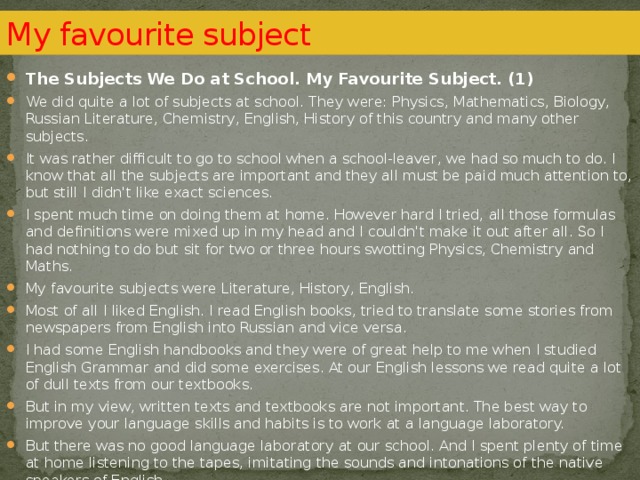
My favourite subject

The Subjects We Do at School. My Favourite Subject. (1)

We did quite a lot of subjects at school. They were: Physics, Mathematics, Biology, Russian Literature, Chemistry, English, History of this country and many other subjects.

It was rather difficult to go to school when a school-leaver, we had so much to do. I know that all the subjects are important and they all must be paid much attention to, but still I didn't like exact sciences.

I spent much time on doing them at home. However hard I tried, all those formulas and definitions were mixed up in my head and I couldn't make it out after all. So I had nothing to do but sit for two or three hours swotting Physics, Chemistry and Maths.

My favourite subjects were Literature, History, English.

Most of all I liked English. I read English books, tried to translate some stories from newspapers from English into Russian and vice versa.

I had some English handbooks and they were of great help to me when I studied English Grammar and did some exercises. At our English lessons we read quite a lot of dull texts from our textbooks.

But in my view, written texts and textbooks are not important. The best way to improve your language skills and habits is to work at a language laboratory.

But there was no good language laboratory at our school. And I spent plenty of time at home listening to the tapes, imitating the sounds and intonations of the native speakers of English.

I was working hard at my pronunciation because my teacher said that it was my weak point. Sometimes I spoke English with my friends after classes and they said I was making good progress in the language.
Содержимое разработки

Education.Primary,secondary schools.Schools in England.

Education.Primary,secondary schools.Schools in England.

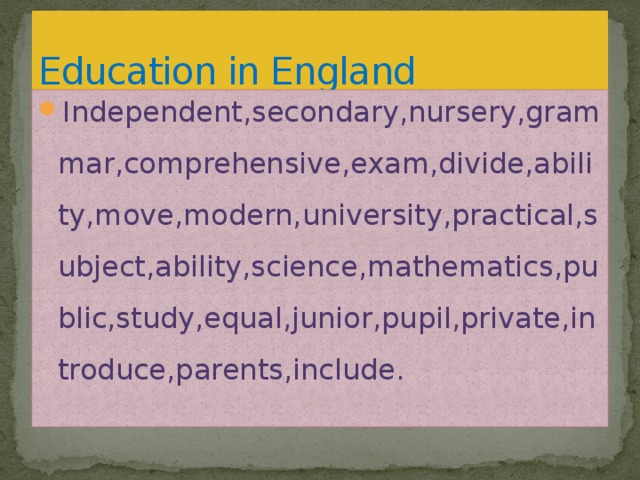
Education in England Independent,secondary,nursery,grammar,comprehensive,exam,divide,ability,move,modern,university,practical,subject,ability,science,mathematics,public,study,equal,junior,pupil,private,introduce,parents,include.

Education in England

  • Independent,secondary,nursery,grammar,comprehensive,exam,divide,ability,move,modern,university,practical,subject,ability,science,mathematics,public,study,equal,junior,pupil,private,introduce,parents,include.
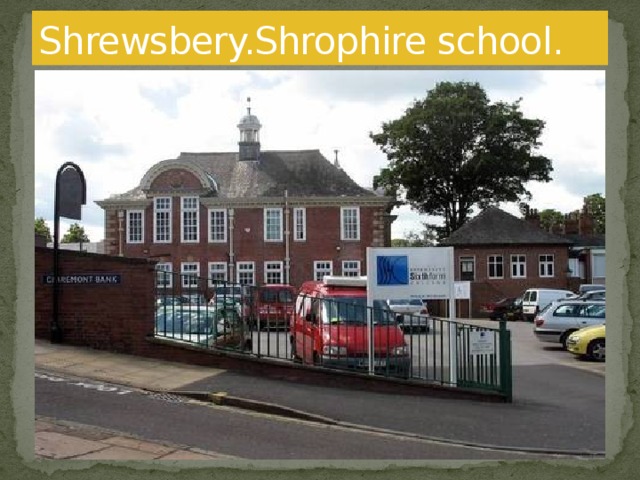
Shrewsbery.Shrophire school.

Shrewsbery.Shrophire school.

St.Barnabas Church of England School,Oxford.

St.Barnabas Church of England School,Oxford.

Wetherby,West Yorkshire secondary school.

Wetherby,West Yorkshire secondary school.

England high school.

England high school.

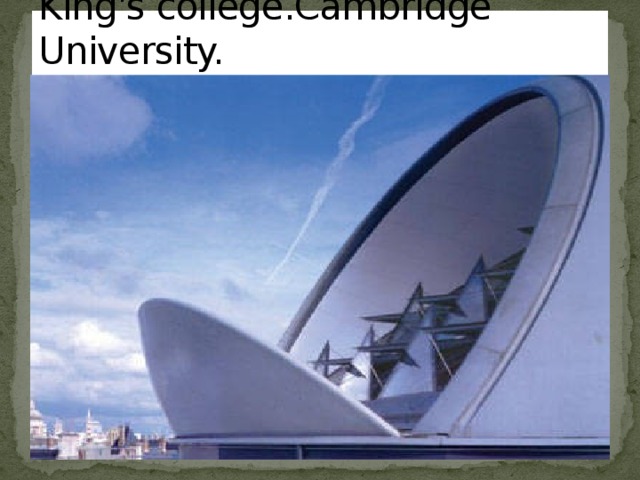
King's college.Cambridge University.

King's college.Cambridge University.

College in Aktobe

College in Aktobe

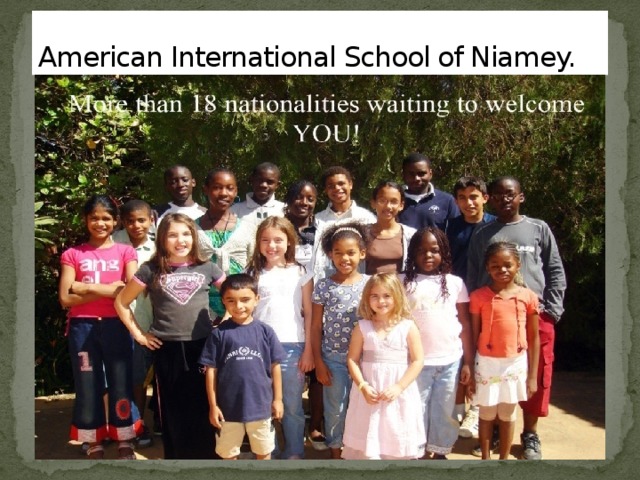
American International School of Niamey.

American International School of Niamey.

Vocabulary: Primary .Private.Minority.Compulsory.Kindergarden.Infant.Junior.Subject.Neighbour.Opportunity.Continue.Choose.Change.Educate.Comprehensive.Result.Exam.Prepare.Enter.Discipline.Timetable.Uniform .

Vocabulary:

  • Primary .Private.Minority.Compulsory.Kindergarden.Infant.Junior.Subject.Neighbour.Opportunity.Continue.Choose.Change.Educate.Comprehensive.Result.Exam.Prepare.Enter.Discipline.Timetable.Uniform .
Complete the sentences: 1.Primary schools are those …. 2.Infant schools are …. 3.Junior schools are …. 4.Comprehensive school …. 5.Grammar school ….

Complete the sentences:

  • 1.Primary schools are those …. 2.Infant schools are …. 3.Junior schools are …. 4.Comprehensive school …. 5.Grammar school ….
My favourite subject The Subjects We Do at School. My Favourite Subject. (1) We did quite a lot of subjects at school. They were: Physics, Mathematics, Biology, Russian Literature, Chemistry, English, History of this country and many other subjects. It was rather difficult to go to school when a school-leaver, we had so much to do. I know that all the subjects are important and they all must be paid much attention to, but still I didn't like exact sciences. I spent much time on doing them at home. However hard I tried, all those formulas and definitions were mixed up in my head and I couldn't make it out after all. So I had nothing to do but sit for two or three hours swotting Physics, Chemistry and Maths. My favourite subjects were Literature, History, English. Most of all I liked English. I read English books, tried to translate some stories from newspapers from English into Russian and vice versa. I had some English handbooks and they were of great help to me when I studied English Grammar and did some exercises. At our English lessons we read quite a lot of dull texts from our textbooks. But in my view, written texts and textbooks are not important. The best way to improve your language skills and habits is to work at a language laboratory. But there was no good language laboratory at our school. And I spent plenty of time at home listening to the tapes, imitating the sounds and intonations of the native speakers of English. I was working hard at my pronunciation because my teacher said that it was my weak point. Sometimes I spoke English with my friends after classes and they said I was making good progress in the language.
My favourite subject

  • The Subjects We Do at School. My Favourite Subject. (1)
  • We did quite a lot of subjects at school. They were: Physics, Mathematics, Biology, Russian Literature, Chemistry, English, History of this country and many other subjects.
  • It was rather difficult to go to school when a school-leaver, we had so much to do. I know that all the subjects are important and they all must be paid much attention to, but still I didn't like exact sciences.
  • I spent much time on doing them at home. However hard I tried, all those formulas and definitions were mixed up in my head and I couldn't make it out after all. So I had nothing to do but sit for two or three hours swotting Physics, Chemistry and Maths.
  • My favourite subjects were Literature, History, English.
  • Most of all I liked English. I read English books, tried to translate some stories from newspapers from English into Russian and vice versa.
  • I had some English handbooks and they were of great help to me when I studied English Grammar and did some exercises. At our English lessons we read quite a lot of dull texts from our textbooks.
  • But in my view, written texts and textbooks are not important. The best way to improve your language skills and habits is to work at a language laboratory.
  • But there was no good language laboratory at our school. And I spent plenty of time at home listening to the tapes, imitating the sounds and intonations of the native speakers of English.
  • I was working hard at my pronunciation because my teacher said that it was my weak point. Sometimes I spoke English with my friends after classes and they said I was making good progress in the language.
Education in Great Britain In Great Britain children start going to school when they are five and continue studying until they are 16 or older.Compulsary education begins at the age of five when children go to primary school.Primary education lasts for six years.First they attend the infant school from five to seven.  In infant schools children do not have real classes.They get acquainted with the class-room,desks,play and learn through playing.They learn numbers and how to add them.  When the children are seven they go to junior school which they attend until eleven.Boys and girls study st udy at junior school for four years .There they have classes ,read and write,do mathematics.Then they go to secondary school .  At secondary school pupils study English ,Mathematics ,Science ,Geography,History,Art ,Music,Foreign languages and physical training.

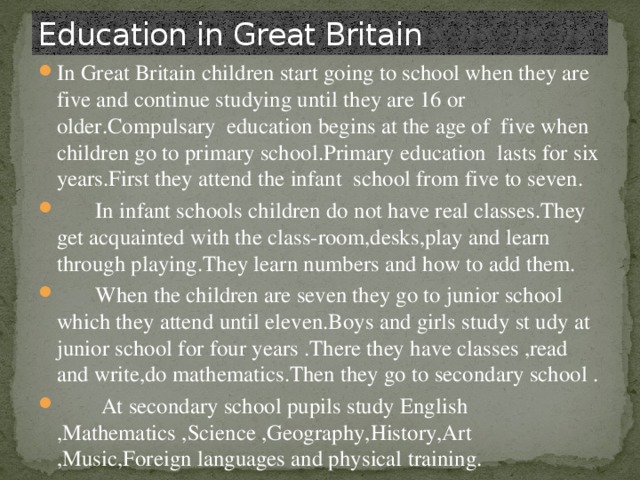
Education in Great Britain

  • In Great Britain children start going to school when they are five and continue studying until they are 16 or older.Compulsary education begins at the age of five when children go to primary school.Primary education lasts for six years.First they attend the infant school from five to seven.
  • In infant schools children do not have real classes.They get acquainted with the class-room,desks,play and learn through playing.They learn numbers and how to add them.
  • When the children are seven they go to junior school which they attend until eleven.Boys and girls study st udy at junior school for four years .There they have classes ,read and write,do mathematics.Then they go to secondary school .
  • At secondary school pupils study English ,Mathematics ,Science ,Geography,History,Art ,Music,Foreign languages and physical training.
Higher Education Out of more than three million students who graduate from high school each year,about one million go on for higher education.A colledge at a leading university might receive applications from two percent of these high school graduates,and then accept only one out of every ten who apply.Successful applicants at soch colleges are usually chosen on the basis of a)their high school records;b)recommendations from their high school teachers ; c)their scores on the Scholastic Aptitude Tests (SATs).  The system of higher education in the United States comprises three categories of institutions;1)the university,which contain a)several colleges for undergraduate students seeking a bachelors degree and b)one or more graduate schools for those continuing in specialized studies beyond the bachelor’s and to obtain a master’s or a doctoral degree;2)the technical training institutions at which high school graduates may take courses ranging from six months to four years in duration and learn a wide variety of technical skills,from hair styling through business accounting to computer programming and 3)the two-year,or community college,from which students may enter many professions or may transfer to four-year colleges.

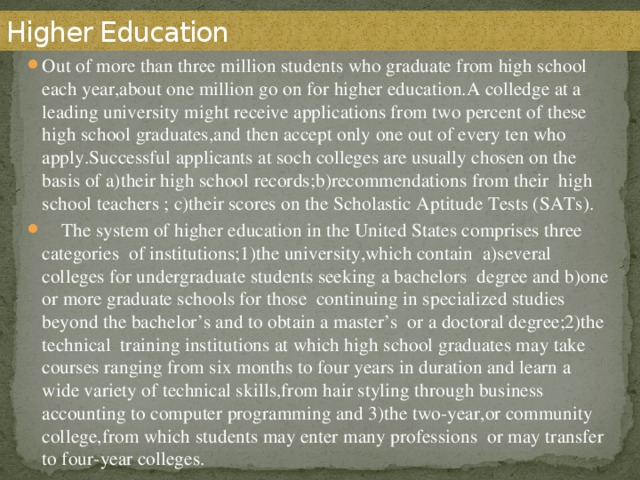
Higher Education

  • Out of more than three million students who graduate from high school each year,about one million go on for higher education.A colledge at a leading university might receive applications from two percent of these high school graduates,and then accept only one out of every ten who apply.Successful applicants at soch colleges are usually chosen on the basis of a)their high school records;b)recommendations from their high school teachers ; c)their scores on the Scholastic Aptitude Tests (SATs).
  • The system of higher education in the United States comprises three categories of institutions;1)the university,which contain a)several colleges for undergraduate students seeking a bachelors degree and b)one or more graduate schools for those continuing in specialized studies beyond the bachelor’s and to obtain a master’s or a doctoral degree;2)the technical training institutions at which high school graduates may take courses ranging from six months to four years in duration and learn a wide variety of technical skills,from hair styling through business accounting to computer programming and 3)the two-year,or community college,from which students may enter many professions or may transfer to four-year colleges.
Schools in England Schools in England  In England about 93 percent of children attend state schools.The other 7 percent attend private schools.A minority of these private schools are boarding schools where children live as well as study.Private schools are very expensive.  In Britain it is compulsory between the ages of 5 and 16 years to receive some officially recognized form of schooling.For younger children,there are a few state kindergartens,some private kindergartens and a few “nursery classes” in ordinary schools.They are optional.Primary school consists of reception class,infant school and junior school.A reception class and infant school take a year.In junior school,pupils spend 5 years.At the age of five they go to infant schools where they learn first steps in reading,writing and using numbers.

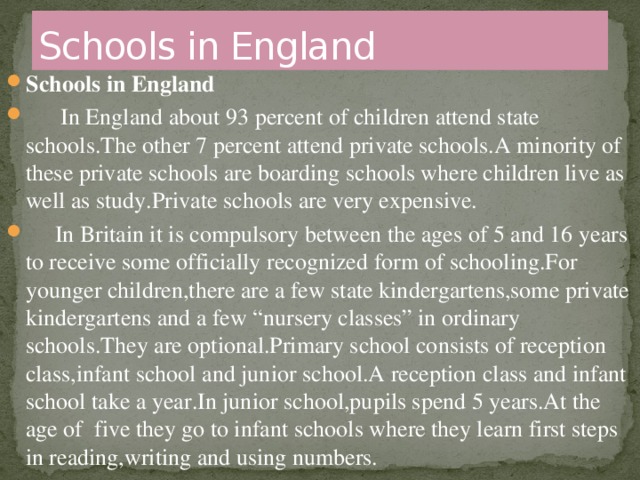
Schools in England

  • Schools in England
  • In England about 93 percent of children attend state schools.The other 7 percent attend private schools.A minority of these private schools are boarding schools where children live as well as study.Private schools are very expensive.
  • In Britain it is compulsory between the ages of 5 and 16 years to receive some officially recognized form of schooling.For younger children,there are a few state kindergartens,some private kindergartens and a few “nursery classes” in ordinary schools.They are optional.Primary school consists of reception class,infant school and junior school.A reception class and infant school take a year.In junior school,pupils spend 5 years.At the age of five they go to infant schools where they learn first steps in reading,writing and using numbers.
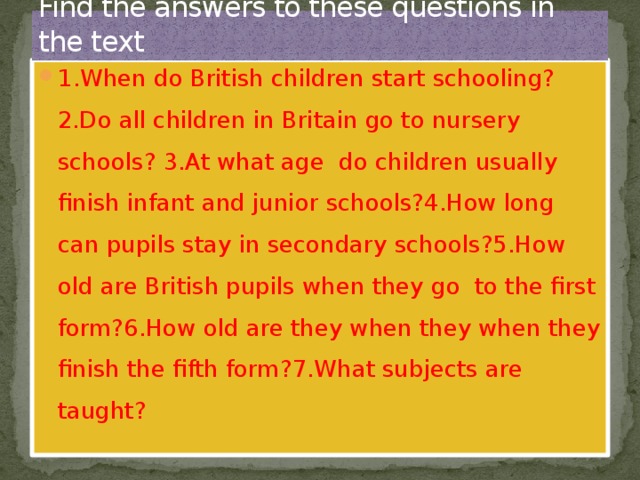
Find the answers to these questions in the text 1.When do British children start schooling? 2.Do all children in Britain go to nursery schools? 3.At what age do children usually finish infant and junior schools?4.How long can pupils stay in secondary schools?5.How old are British pupils when they go to the first form?6.How old are they when they when they finish the fifth form?7.What subjects are taught?

Find the answers to these questions in the text

  • 1.When do British children start schooling? 2.Do all children in Britain go to nursery schools? 3.At what age do children usually finish infant and junior schools?4.How long can pupils stay in secondary schools?5.How old are British pupils when they go to the first form?6.How old are they when they when they finish the fifth form?7.What subjects are taught?
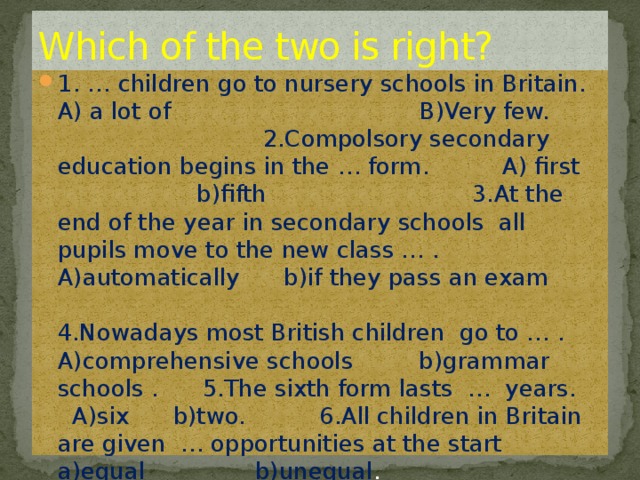
Which of the two is right? 1. … children go to nursery schools in Britain. A) a lot of B)Very few. 2.Compolsory secondary education begins in the … form. A) first b)fifth 3.At the end of the year in secondary schools all pupils move to the new class … . A)automatically b)if they pass an exam 4.Nowadays most British children go to … . A)comprehensive schools b)grammar schools . 5.The sixth form lasts … years. A)six b)two. 6.All children in Britain are given … opportunities at the start a)equal b)unequal .

Which of the two is right?

  • 1. … children go to nursery schools in Britain. A) a lot of B)Very few. 2.Compolsory secondary education begins in the … form. A) first b)fifth 3.At the end of the year in secondary schools all pupils move to the new class … . A)automatically b)if they pass an exam 4.Nowadays most British children go to … . A)comprehensive schools b)grammar schools . 5.The sixth form lasts … years. A)six b)two. 6.All children in Britain are given … opportunities at the start a)equal b)unequal .
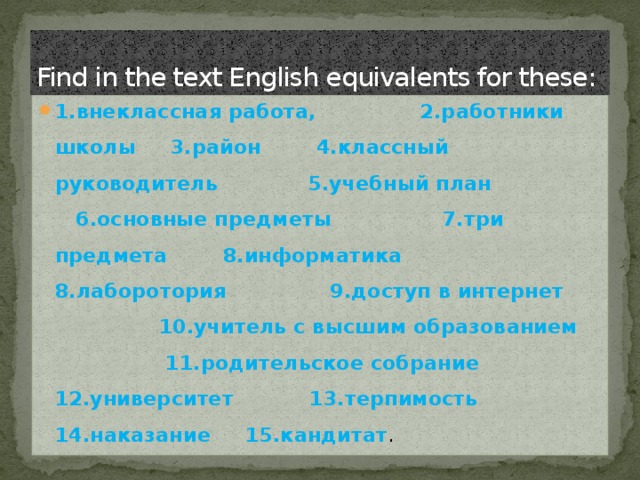
Find in the text English equivalents for these: 1.внеклассная работа, 2.работники школы 3.район 4.классный руководитель 5.учебный план 6.основные предметы 7.три предмета 8.информатика 8.лаборотория 9.доступ в интернет 10.учитель с высшим образованием 11.родительское собрание 12.университет 13.терпимость 14.наказание 15.кандитат .

Find in the text English equivalents for these:

  • 1.внеклассная работа, 2.работники школы 3.район 4.классный руководитель 5.учебный план 6.основные предметы 7.три предмета 8.информатика 8.лаборотория 9.доступ в интернет 10.учитель с высшим образованием 11.родительское собрание 12.университет 13.терпимость 14.наказание 15.кандитат .
-80%
Курсы повышения квалификации

Система управления охраной труда в учреждении образования

Продолжительность 72 часа
Документ: Удостоверение о повышении квалификации
4000 руб.
800 руб.
Подробнее
Сохранить у себя:
Презентация по английскому языку "Образование" (0.79 MB)

Комментарии 0

Чтобы добавить комментарий зарегистрируйтесь или на сайт