Меню
Разработки
Разработки  /  Английский язык  /  Презентации  /  Презентация по английскому языку "Conditional sentenses"

Презентация по английскому языку "Conditional sentenses"

Презентация познакомит с типами условных предложений в английском языке.
31.01.2016

Описание разработки

Придаточные обстоятельственные предложения делятся на предложения места, времени, образа действия, сравнения, причины, цели, следствия, уступки и условия.

Из них нужно особо выделить условные предложения, потому что они тесно связаны с использованием сослагательного наклонения глагола и часто вызывают трудности.

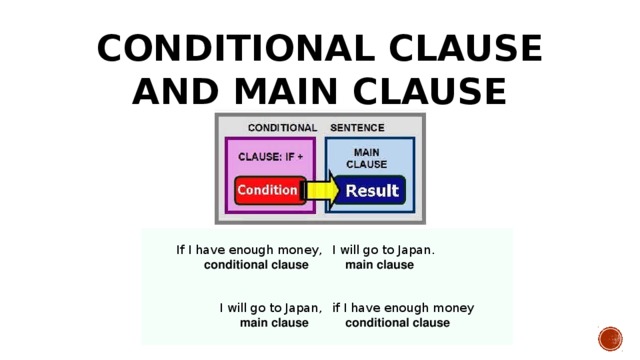
Conditional Clause and Main Clause.

If I have enough money, conditional clause

I will go to Japan, main clause

Презентация по английскому языку Conditional sentenses

if I have enough money conditional clause.

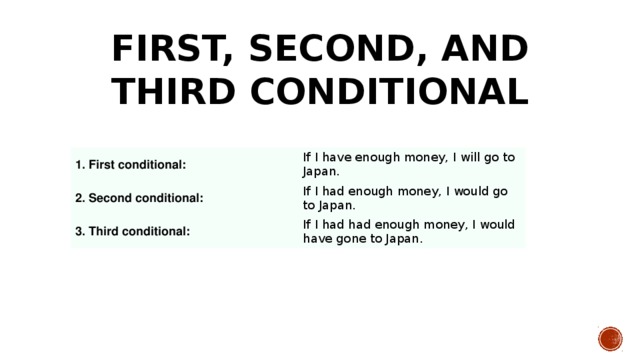
First, Second, and Third Conditional

1. First conditional:

If I have enough money, I will go to Japan.

Содержимое разработки

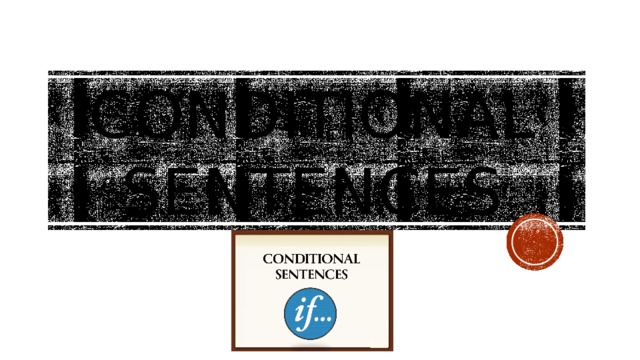
Conditional Sentences
Conditional Sentences

Conditional Clause and Main Clause If I have enough money,  conditional clause     I will go to Japan,  main clause     I will go to Japan.      main clause if I have enough money      conditional clause
Conditional Clause and Main Clause

If I have enough money, conditional clause    

I will go to Japan, main clause    

I will go to Japan.     main clause

if I have enough money     conditional clause

First, Second, and Third Conditional 1. First conditional: If I have enough money, I will go to Japan. 2. Second conditional: If I had enough money, I would go to Japan. 3. Third conditional: If I had had enough money, I would have gone to Japan.
First, Second, and Third Conditional

1. First conditional:

If I have enough money, I will go to Japan.

2. Second conditional:

If I had enough money, I would go to Japan.

3. Third conditional:

If I had had enough money, I would have gone to Japan.

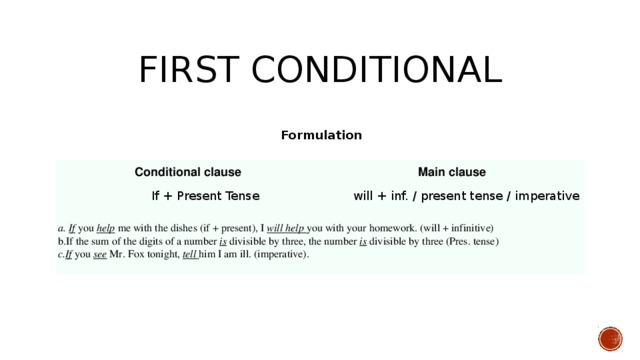
First conditional Formulation Conditional clause    If + Present Tense Main clause   If  you help me with the dishes (if + present), I will help you with your homework. (will + infinitive) If the sum of the digits of a number is divisible by three, the number is divisible by three (Pres. tense) If you see Mr. Fox tonight, tell him I am ill. (imperative).  will + inf. / present tense / imperative
First conditional

Formulation

Conditional clause

  If + Present Tense

Main clause

  •   If you help me with the dishes (if + present), I will help you with your homework. (will + infinitive)
  • If the sum of the digits of a number is divisible by three, the number is divisible by three (Pres. tense)
  • If you see Mr. Fox tonight, tell him I am ill. (imperative).

will + inf. / present tense / imperative

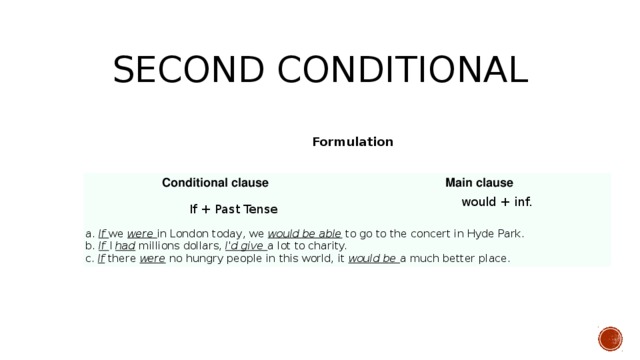
Second conditional Formulation Conditional clause  If + Past Tense Main clause a. If we were in London today, we would be able to go to the concert in Hyde Park.  would + inf. b. If I had millions dollars, I'd give a lot to charity. c. If there were no hungry people in this world, it would be a much better place.
Second conditional

Formulation

Conditional clause

If + Past Tense

Main clause

a. If we were in London today, we would be able to go to the concert in Hyde Park.

would + inf.

b. If I had millions dollars, I'd give a lot to charity.

c. If there were no hungry people in this world, it would be a much better place.

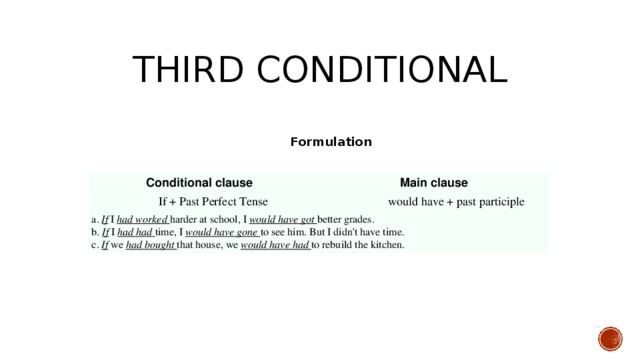
Third conditional Formulation Conditional clause  If + Past Perfect Tense Main clause a. If I had worked harder at school, I would have got better grades.  would have + past participle b. If I had had time, I would have gone to see him. But I didn't have time. c. If we had bought that house, we would have had to rebuild the kitchen.
Third conditional

Formulation

Conditional clause

If + Past Perfect Tense

Main clause

a. If I had worked harder at school, I would have got better grades.

would have + past participle

b. If I had had time, I would have gone to see him. But I didn't have time.

c. If we had bought that house, we would have had to rebuild the kitchen.

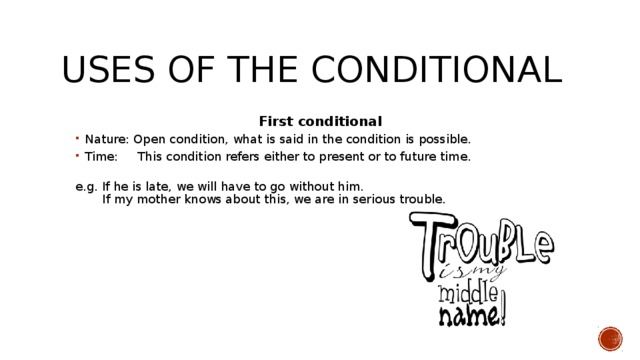
Uses of the conditional First conditional Nature: Open condition, what is said in the condition is possible. Time: This condition refers either to present or to future time.   Nature: Open condition, what is said in the condition is possible. Time: This condition refers either to present or to future time.   e.g. If he is late, we will have to go without him.  If my mother knows about this, we are in serious trouble.

Uses of the conditional

First conditional

  • Nature: Open condition, what is said in the condition is possible. Time: This condition refers either to present or to future time.
  • Nature: Open condition, what is said in the condition is possible.
  • Time: This condition refers either to present or to future time.

e.g. If he is late, we will have to go without him. If my mother knows about this, we are in serious trouble.
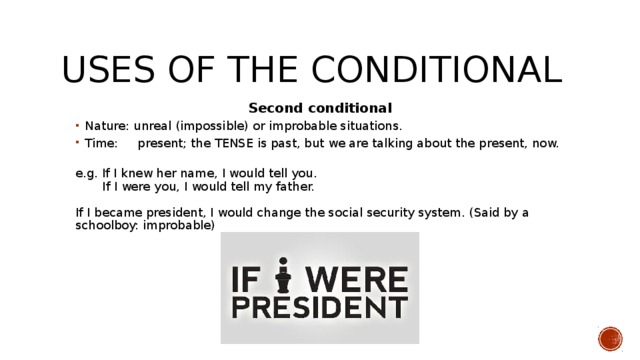
Uses of the conditional Second conditional Nature: unreal (impossible) or improbable situations. Time: present; the TENSE is past, but we are talking about the present, now.   Nature: unreal (impossible) or improbable situations. Time: present; the TENSE is past, but we are talking about the present, now.   e.g. If I knew her name, I would tell you.  If I were you, I would tell my father.   If I became president, I would change the social security system. (Said by a schoolboy: improbable)
Uses of the conditional

Second conditional

  • Nature: unreal (impossible) or improbable situations. Time: present; the TENSE is past, but we are talking about the present, now.
  • Nature: unreal (impossible) or improbable situations.
  • Time: present; the TENSE is past, but we are talking about the present, now.

e.g. If I knew her name, I would tell you. If I were you, I would tell my father. If I became president, I would change the social security system. (Said by a schoolboy: improbable)

Uses of the conditional Third conditional Nature: unreal Time: Past (so we are talking about a situation that was  not  so in the past.)   Nature: unreal Time: Past (so we are talking about a situation that was  not  so in the past.)   e.g. If you had warned me, I would not have told your father about that party.(But you didn't, and I have).

Uses of the conditional

Third conditional

  • Nature: unreal Time: Past (so we are talking about a situation that was  not  so in the past.)
  • Nature: unreal
  • Time: Past (so we are talking about a situation that was  not  so in the past.)

e.g. If you had warned me, I would not have told your father about that party.(But you didn't, and I have).

-80%
Курсы повышения квалификации

Организация дистанционного обучения для лиц с ОВЗ и инвалидов

Продолжительность 72 часа
Документ: Удостоверение о повышении квалификации
4000 руб.
800 руб.
Подробнее
Скачать разработку
Сохранить у себя:
Презентация по английскому языку "Conditional sentenses" (0.52 MB)

Комментарии 1

Чтобы добавить комментарий зарегистрируйтесь или на сайт

Наталья, 08.02.2016 04:53
спасибо!