Меню
Разработки
Разработки  /  Английский язык  /  Презентации  /  Презентация по английскому языку "Both, neither, either"

Презентация по английскому языку "Both, neither, either"

Презентация содержит правила употребления местоимений.
14.01.2015

Описание разработки

We use both, either and neither to refer to two people or thing.

Местоимение Both.

We use both, either and neither to refer to two people or thing.

Both can be used as a pronoun to refer to two things that we have already mentioned.

both = the first AND the second

I take both milk and sugar in my coffee. (= 'I take sugar. I also take milk.')

Both + Adjective + and + Adjective.

I have had a long, hard day and I’m both tired and hungry.

You can use Both or Both of before a determiner (my, his, these, the etc.) and a plural noun.

Презентация по английскому языку Both, neither, either

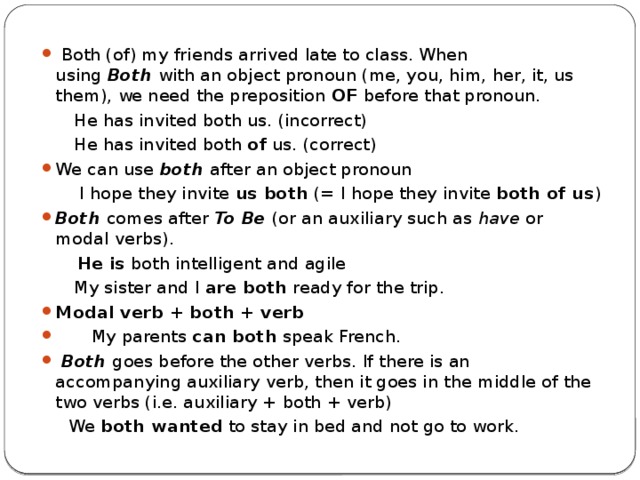
Both (of) my friends arrived late to class. When using Both with an object pronoun (me, you, him, her, it, us them), we need the preposition OF before that pronoun.

He has invited both us. (incorrect)

He has invited both of us. (correct)

We can use both after an object pronoun

I hope they invite us both (= I hope they invite both of us)

Both comes after To Be (or an auxiliary such as have or modal verbs).

He is both intelligent and agile

My sister and I are both ready for the trip.

Modal verb + both + verb

My parents can both speak French.

Both goes before the other verbs. If there is an accompanying auxiliary verb, then it goes in the middle of the two verbs (i.e. auxiliary + both + verb)

We both wanted to stay in bed and not go to work.
Содержимое разработки

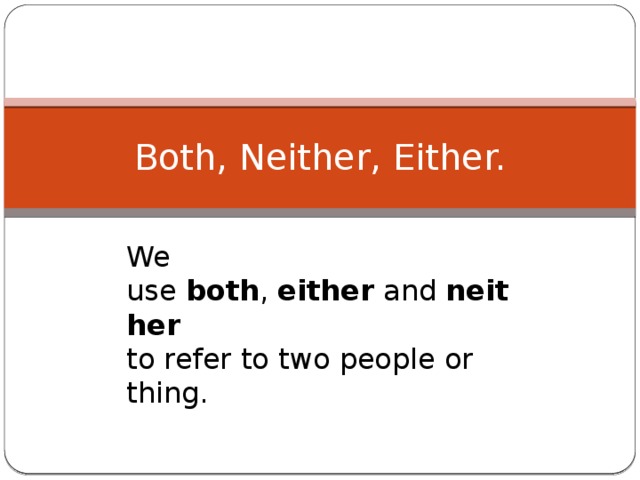
Both, Neither, Either. We use  both ,  either  and  neither   to refer to two people or thing.

Both, Neither, Either.

We use  botheither  and  neither  

to refer to two people or thing.

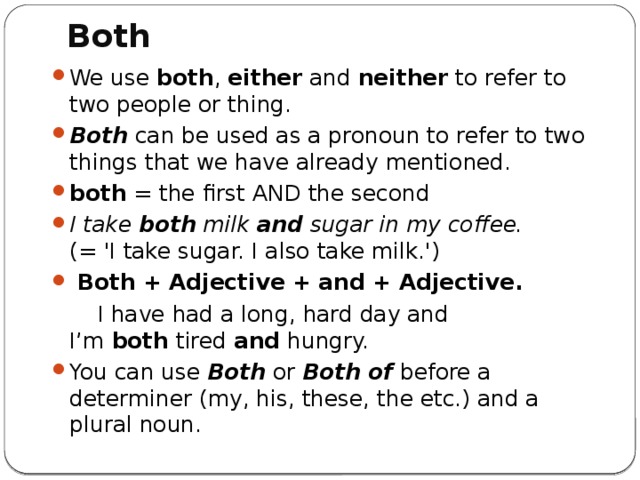
Both We use  both ,  either  and  neither  to refer to two people or thing. Both  can be used as a pronoun to refer to two things that we have already mentioned. both  = the first AND the second I take  both  milk  and  sugar in my coffee.  (= 'I take sugar. I also take milk.')  Both + Adjective + and + Adjective.  I have had a long, hard day and I’m  both  tired  and  hungry. You can use  Both  or  Both of  before a determiner (my, his, these, the etc.) and a plural noun.

Both

  • We use  botheither  and  neither  to refer to two people or thing.
  • Both  can be used as a pronoun to refer to two things that we have already mentioned.
  • both  = the first AND the second
  • I take  both  milk  and  sugar in my coffee. (= 'I take sugar. I also take milk.')
  • Both + Adjective + and + Adjective.

I have had a long, hard day and I’m  both  tired  and  hungry.

  • You can use  Both  or  Both of  before a determiner (my, his, these, the etc.) and a plural noun.

 Both (of) my friends arrived late to class. When using  Both  with an object pronoun (me, you, him, her, it, us them), we need the preposition  OF  before that pronoun.  He has invited both us. (incorrect)  He has invited both  of  us. (correct) We can use  both  after an object pronoun  I hope they invite  us both  (= I hope they invite  both of us ) Both  comes after  To Be  (or an auxiliary such as  have  or modal verbs).  He is  both intelligent and agile  My sister and I  are both  ready for the trip. Modal verb + both + verb  My parents  can both  speak French.  Both  goes before the other verbs. If there is an accompanying auxiliary verb, then it goes in the middle of the two verbs (i.e. auxiliary + both + verb)  We  both wanted  to stay in bed and not go to work.
  • Both (of) my friends arrived late to class. When using  Both  with an object pronoun (me, you, him, her, it, us them), we need the preposition  OF  before that pronoun.

He has invited both us. (incorrect)

He has invited both  of  us. (correct)

  • We can use  both  after an object pronoun

I hope they invite  us both  (= I hope they invite  both of us )

  • Both  comes after  To Be  (or an auxiliary such as  have  or modal verbs).

He is  both intelligent and agile

My sister and I  are both  ready for the trip.

  • Modal verb + both + verb
  • My parents  can both  speak French.
  • Both  goes before the other verbs. If there is an accompanying auxiliary verb, then it goes in the middle of the two verbs (i.e. auxiliary + both + verb)

We  both wanted  to stay in bed and not go to work.
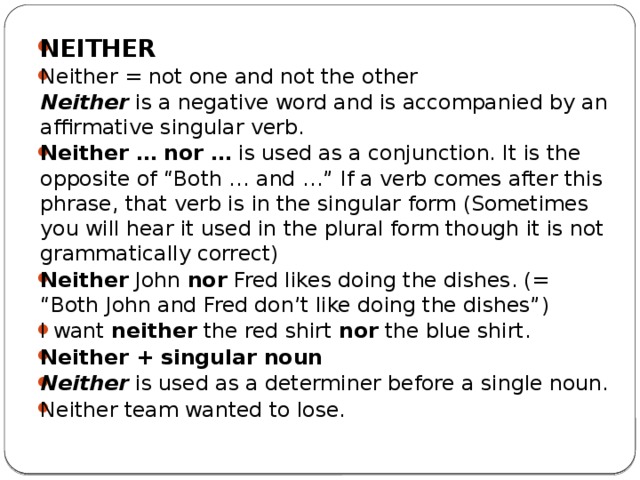
          NEITHER Neither = not one and not the other  Neither  is a negative word and is accompanied by an affirmative singular verb. Neither … nor …  is used as a conjunction. It is the opposite of “Both … and …” If a verb comes after this phrase, that verb is in the singular form (Sometimes you will hear it used in the plural form though it is not grammatically correct) Neither  John  nor  Fred likes doing the dishes. (= “Both John and Fred don’t like doing the dishes”) I want  neither  the red shirt  nor  the blue shirt. Neither + singular noun Neither  is used as a determiner before a single noun. Neither team wanted to lose.

  • NEITHER
  • Neither = not one and not the other Neither  is a negative word and is accompanied by an affirmative singular verb.
  • Neither … nor …  is used as a conjunction. It is the opposite of “Both … and …” If a verb comes after this phrase, that verb is in the singular form (Sometimes you will hear it used in the plural form though it is not grammatically correct)
  • Neither  John  nor  Fred likes doing the dishes. (= “Both John and Fred don’t like doing the dishes”)
  • I want  neither  the red shirt  nor  the blue shirt.
  • Neither + singular noun
  • Neither  is used as a determiner before a single noun.
  • Neither team wanted to lose.
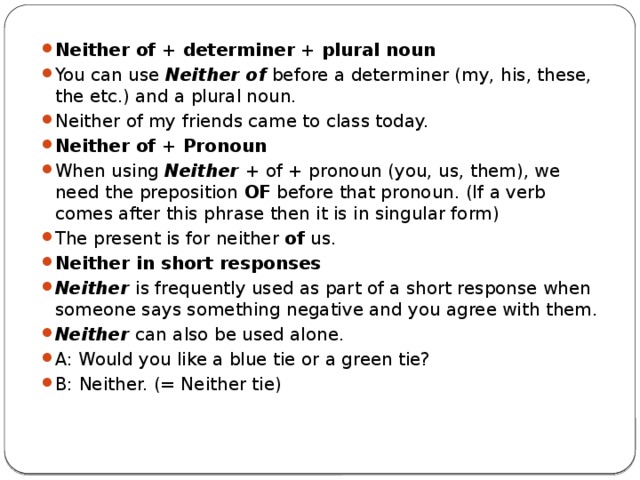
Neither of + determiner + plural noun You can use  Neither of  before a determiner (my, his, these, the etc.) and a plural noun. Neither of my friends came to class today. Neither of + Pronoun When using  Neither  + of + pronoun (you, us, them), we need the preposition  OF  before that pronoun. (If a verb comes after this phrase then it is in singular form) The present is for neither  of  us. Neither in short responses Neither  is frequently used as part of a short response when someone says something negative and you agree with them. Neither  can also be used alone. A: Would you like a blue tie or a green tie? B: Neither. (= Neither tie)
  • Neither of + determiner + plural noun
  • You can use  Neither of  before a determiner (my, his, these, the etc.) and a plural noun.
  • Neither of my friends came to class today.
  • Neither of + Pronoun
  • When using  Neither  + of + pronoun (you, us, them), we need the preposition  OF  before that pronoun. (If a verb comes after this phrase then it is in singular form)
  • The present is for neither  of  us.
  • Neither in short responses
  • Neither  is frequently used as part of a short response when someone says something negative and you agree with them.
  • Neither  can also be used alone.
  • A: Would you like a blue tie or a green tie?
  • B: Neither. (= Neither tie)
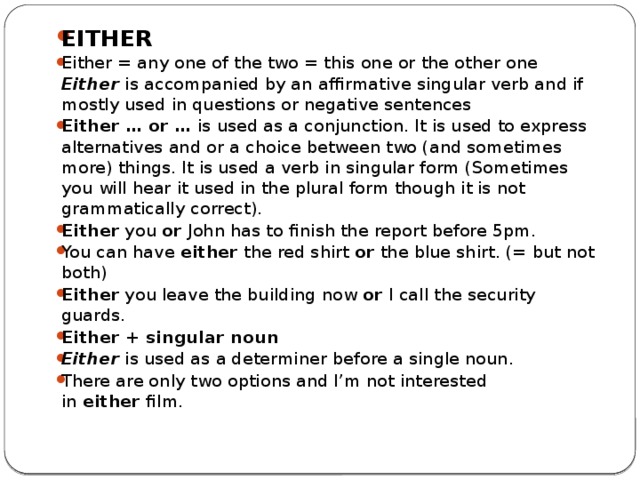
EITHER Either = any one of the two = this one or the other one  Either  is accompanied by an affirmative singular verb and if mostly used in questions or negative sentences Either … or …  is used as a conjunction. It is used to express alternatives and or a choice between two (and sometimes more) things. It is used a verb in singular form (Sometimes you will hear it used in the plural form though it is not grammatically correct). Either  you  or  John has to finish the report before 5pm. You can have  either  the red shirt  or  the blue shirt. (= but not both) Either  you leave the building now  or  I call the security guards. Either + singular noun Either  is used as a determiner before a single noun. There are only two options and I’m not interested in  either  film.
  • EITHER
  • Either = any one of the two = this one or the other one Either  is accompanied by an affirmative singular verb and if mostly used in questions or negative sentences
  • Either … or …  is used as a conjunction. It is used to express alternatives and or a choice between two (and sometimes more) things. It is used a verb in singular form (Sometimes you will hear it used in the plural form though it is not grammatically correct).
  • Either  you  or  John has to finish the report before 5pm.
  • You can have  either  the red shirt  or  the blue shirt. (= but not both)
  • Either  you leave the building now  or  I call the security guards.
  • Either + singular noun
  • Either  is used as a determiner before a single noun.
  • There are only two options and I’m not interested in  either  film.
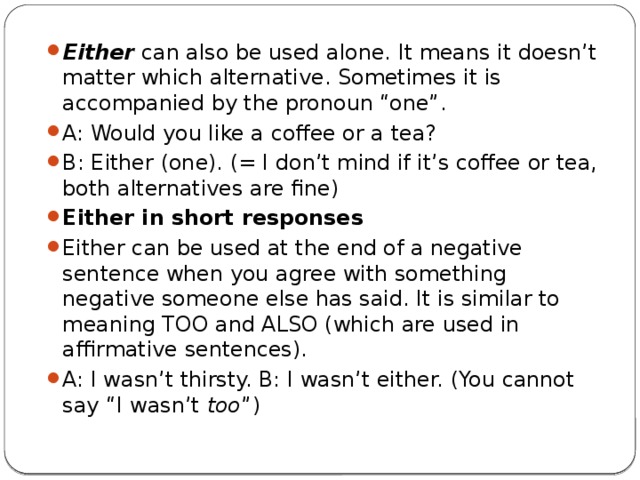
Either  can also be used alone. It means it doesn’t matter which alternative. Sometimes it is accompanied by the pronoun “one”. A: Would you like a coffee or a tea? B: Either (one). (= I don’t mind if it’s coffee or tea, both alternatives are fine) Either in short responses Either can be used at the end of a negative sentence when you agree with something negative someone else has said. It is similar to meaning TOO and ALSO (which are used in affirmative sentences). A: I wasn’t thirsty. B: I wasn’t either. (You cannot say “I wasn’t  too ”)
  • Either  can also be used alone. It means it doesn’t matter which alternative. Sometimes it is accompanied by the pronoun “one”.
  • A: Would you like a coffee or a tea?
  • B: Either (one). (= I don’t mind if it’s coffee or tea, both alternatives are fine)
  • Either in short responses
  • Either can be used at the end of a negative sentence when you agree with something negative someone else has said. It is similar to meaning TOO and ALSO (which are used in affirmative sentences).
  • A: I wasn’t thirsty. B: I wasn’t either. (You cannot say “I wasn’t  too ”)
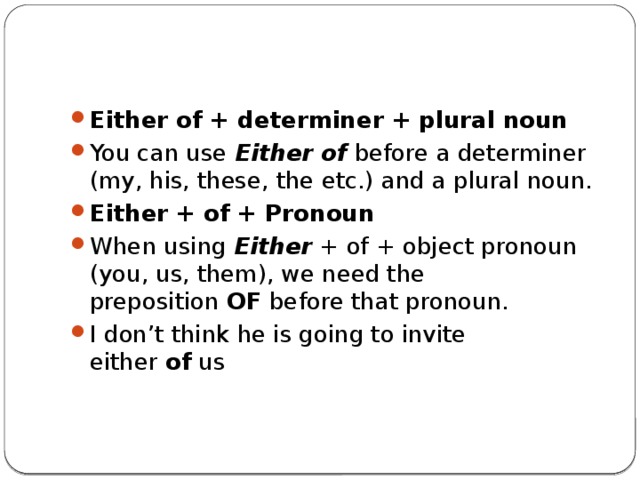
Either of + determiner + plural noun You can use  Either of  before a determiner (my, his, these, the etc.) and a plural noun. Either + of + Pronoun When using  Either  + of + object pronoun (you, us, them), we need the preposition  OF  before that pronoun. I don’t think he is going to invite either  of  us
  • Either of + determiner + plural noun
  • You can use  Either of  before a determiner (my, his, these, the etc.) and a plural noun.
  • Either + of + Pronoun
  • When using  Either  + of + object pronoun (you, us, them), we need the preposition  OF  before that pronoun.
  • I don’t think he is going to invite either  of  us
 End

End

-80%
Курсы повышения квалификации

Организация дистанционного обучения для лиц с ОВЗ и инвалидов

Продолжительность 72 часа
Документ: Удостоверение о повышении квалификации
4000 руб.
800 руб.
Подробнее
Скачать разработку
Сохранить у себя:
Презентация по английскому языку "Both, neither, either" (77.58 КB)

Комментарии 0

Чтобы добавить комментарий зарегистрируйтесь или на сайт