
 Получите свидетельство
 Вход
Вход



Physics - one of the oldest academic disciplines, the science of the properties of matter, the underlying natural science. That is why physicists call basic science, as other natural sciences (chemistry, geology, biology, and others.) Describe only a single class of material systems, which obeys the laws of physics.
More than any other science, physics associated with mathematics. Due to the fact that the mathematics provides accurate device with which the physical laws may be accurately described.
Physicists: John Dalton, Michael Faraday, Marie Sklodowska Curie, Robert Boyle, Albert Einstein, Max Planck, Paul Dirac, Ernest Rutherford, Aleksandr Stoletov forever will be among the researchers shaped the modern physical

Michael Faraday
- Born September 22, 1791 in London, in the family of a blacksmith. Soon began to work in the bookbinding workshop where became interested in reading. Michael shook article on electricity in the "Encyclopaedia Britannica", "Conversations on Chemistry" Madame Marse and "Letters on different physical and philosophical matters" Euler. He immediately tried to repeat the experiments in the books.
- A talented young man attracted attention, and he was invited to attend lectures at the Royal Institution of Great Britain. After some time, Faraday began working there as a laboratory.
- Since 1820, he has worked hard over the idea of unification of electricity and magnetism. Subsequently, it became a matter of life scientist. In 1821 Faraday rotation of the magnet for the first time carried out around the current conductor and conductor with current around the magnet, t. E. Has created a laboratory model of the motor.
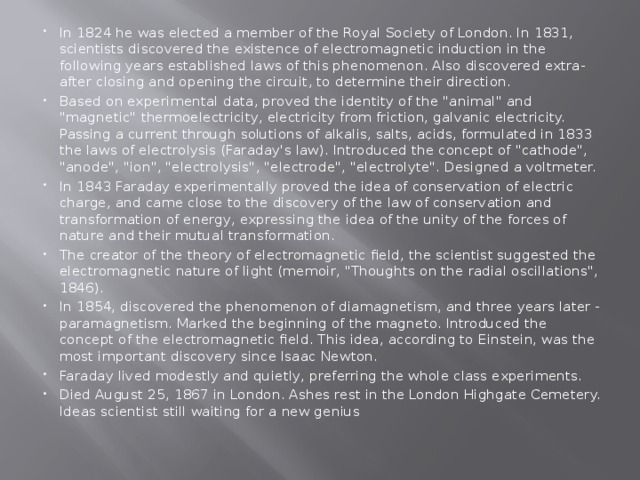
- In 1824 he was elected a member of the Royal Society of London. In 1831, scientists discovered the existence of electromagnetic induction in the following years established laws of this phenomenon. Also discovered extra- after closing and opening the circuit, to determine their direction.
- Based on experimental data, proved the identity of the "animal" and "magnetic" thermoelectricity, electricity from friction, galvanic electricity. Passing a current through solutions of alkalis, salts, acids, formulated in 1833 the laws of electrolysis (Faraday's law). Introduced the concept of "cathode", "anode", "ion", "electrolysis", "electrode", "electrolyte". Designed a voltmeter.
- In 1843 Faraday experimentally proved the idea of conservation of electric charge, and came close to the discovery of the law of conservation and transformation of energy, expressing the idea of the unity of the forces of nature and their mutual transformation.
- The creator of the theory of electromagnetic field, the scientist suggested the electromagnetic nature of light (memoir, "Thoughts on the radial oscillations", 1846).
- In 1854, discovered the phenomenon of diamagnetism, and three years later - paramagnetism. Marked the beginning of the magneto. Introduced the concept of the electromagnetic field. This idea, according to Einstein, was the most important discovery since Isaac Newton.
- Faraday lived modestly and quietly, preferring the whole class experiments.
- Died August 25, 1867 in London. Ashes rest in the London Highgate Cemetery. Ideas scientist still waiting for a new genius

Albert Einstein
- Albert Einstein is perhaps one of the most famous scientist in the field fizikiHH century. During his short biography, he revolutionized scientific thinking and is recognized as the greatest physicist who ever lived. Biography Einstein began March 14, 1879 in a Jewish middle-class family in the city of Ulm, Germany. It's like most kids do not like school, and prefer to learn at home. He did not finish high school. His family moved to Milan in 1894, and this time he decided to formally renounce his German citizenship and become a citizen of Switzerland. In 1985, he tried to join the Swiss Federal Institute of Technology (Zurich Polytechnic), but he failed the entrance exam. This time, he decided to complete his secondary education in the nearby town of Aarau. In 1896 he returned to Zurich Polytechnic, who successfully graduated (1900), and became a high school teacher of mathematics and physics.

- Later, Albert Einstein got a job at the patent office in Bern, where he worked from 1902 to 1909 During this time he wrote a surprising number of publications in theoretical physics. He wrote this in my spare time just for yourself, without the help of the scientific literature or colleagues. In the first of three articles, Einstein considered the phenomenon by which electromagnetic energy emitted by objects in discrete quantities. Einstein used the quantum hypothesis, Planck to describe the electromagnetic radiation of light. Einstein in 1905. on paper laid out what is now called the theory of relativity. This new theory states that the laws of physics must have the same form in any frame of reference. The theory also said that the speed of light is constant in all frames of reference. Later, in 1905, Einstein showed experience proves that mass and energy are equivalent. Einstein was not the first who introduced the theory of relativity. His goal was to combine the important parts of classical mechanics and electrodynamics.
- In 1905, Einstein introduced the document and received his doctorate at the University of Zurich. In 1908 he became a lecturer at the University of Bern. The following year he received another appointment as an associate professor of physics at the University of Zurich. By 1909 Einstein was recognized as one of the world's leading scientific thinkers. Later, he held a professorship at the German University in Prague and Zurich Polytechnic. By 1911, Einstein was able to make preliminary predictions about how a ray of light from a distant star, passing near the Sun, it would seem, should be slightly bent in the direction of the sun. Around 1912, Einstein began a new phase of his gravitational research, with the help of his friend Marcel Grossmann mathematics. Einstein called his new work the general theory of relativity. After a series of failed attempts, he finally published the final version of the general theory of relativity in 1915.
- Brief biography of Albert Einstein
- Einstein and Chaplin. United States, 1931
- Einstein returned to Germany in 1914, but has applied for German citizenship. In that year he was promoted to the most prestigious post of professor of the Kaiser Wilhelm Gesellschaft in Berlin. From this time forth he never held regular classes at the university. Einstein received the Nobel Prize in 1921 for his work in 1905 on the "photoelectric effect". He remained in Berlin until 1933. Later that same year, with the beginning of the rise of fascism in Germany, Einstein moved to the United States. In 1939 he sent a letter to President Franklin D. Roosevelt, which urged the United States to start the development of the atomic bomb before Germany did. This letter, and many follow-up emails, contributed to Roosevelt decided to fund what became the project "Manhattan". Einstein spent the rest of life to carry out a research position at the Institute for Advanced Study in Princeton, New Jersey. The last years of his brief biography of Albert Einstein spent in search of a unified theory, according to which the phenomena of gravitation and electromagnetism, which can be extracted from a single equation. Search was in vain. He died in 1955, and not finding the elusive theory. Although his last thoughts were forgotten for decades, physicists continue to seek the same goal that Einstein's dream - a great pioneer in the field of physical theory.

Robert Boyle
- Born January 25, 1627 in Lismore Castle (County Waterford, Ireland). In eight years, went to college at Eton. In 1638, Boyle, along with mentor traveled to Europe and studied in Florence and Geneva.
- In 1644 he returned to England and settled in his estate Stelbridzh. Doing research in the natural sciences, with also a lot of time studying the religious and philosophical questions.
- In 1654 Boyle moved to Oxford, where equipped laboratories and with the help of specially invited assistants conducted experiments in physics and chemistry. One of these assistants was Robert Hooke.

- In 1660 Boyle improved air pump invented by the German physicist O. von Guericke, and made with the help of a number of experiments: demonstrated elasticity of air, determined its specific gravity and so on. D.
- In 1662 discovered the law of changes in the volume of air pressure changes, that regardless of his set in 1676 by French physicist E. Marriott (Boyle - Mariotte).
- In 1668, Boyle received an honorary doctorate in physics from Oxford University. In the same year he moved to London.
- In 1673 the scientist published the results of experiments on calcination of metals in sealed vessels, which erroneously explained by absorption "corpuscles" fire metals. The correct interpretation of these experiments gave a century later Lavoisier. Among other works of Boyle - a study of elasticity of solids, the behavior of water during solidification, hydrostatic effects.
- Died December 31, 1691 in London.





 Известные люди науки (408.45 KB)
 0
0 596
596 16
16 Нравится
0
Нравится
0


