
 Получите свидетельство
 Вход
Вход



GH
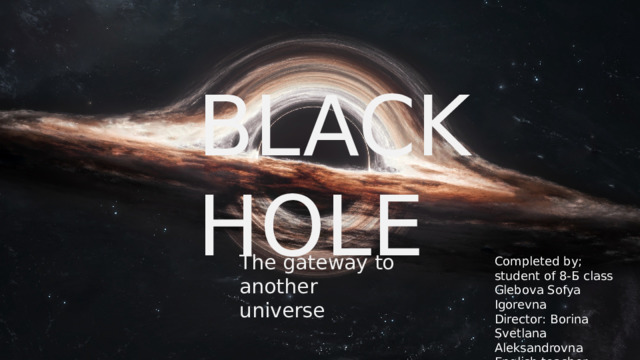
BLACK HOLE
The gateway to another universe
Completed by; student of 8-Б class Glebova Sofya Igorevna Director: Borina Svetlana Aleksandrovna English teacher
GOALS S
Find out what black holes are, and what they mean to the universe
RELEVANCE
PLAN
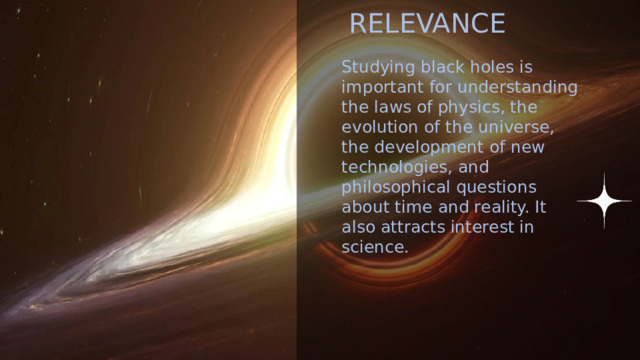
Studying black holes is important for understanding the laws of physics, the evolution of the universe, the development of new technologies, and philosophical questions about time and reality. It also attracts interest in science.
1. Understand the nature of black holes 2. Consider the properties of black holes 3. Study different types of them 4. Explore hypotheses and myths about black holes 5. Analyze the role of black hole in the space
2

.
GOALS
Find out what black holes are, and what they mean to the universe
PLAN
Black holes are objects with such strong gravity that nothing can escape from them. They are formed when massive stars collapse and have a singularity, a point of infinite density. The area around the singularity is called the event horizon. Black holes are related to general relativity and thermodynamics and have entropy and temperature..
1. Understand the nature of black holes 2. Consider the properties of black holes 3. Study different types of them 4. Explore hypotheses and myths about black holes 5. Analyze the role of black hole in the space
3

WHAT IS BLACK HOLE?
Black holes are objects with such strong gravity that nothing can escape from them. They are formed when massive stars collapse and have a singularity, a point of infinite density. The area around the singularity is called the event horizon. Black holes are related to general relativity and thermodynamics and have entropy and temperature.
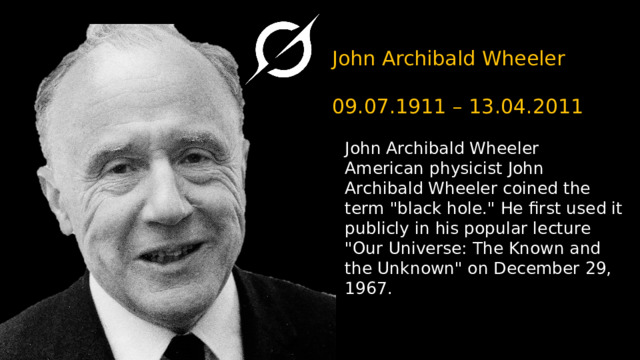
John Archibald Wheeler 09.07.1911 – 13.04.2011
John Archibald Wheeler American physicist John Archibald Wheeler coined the term "black hole." He first used it publicly in his popular lecture "Our Universe: The Known and the Unknown" on December 29, 1967.
3
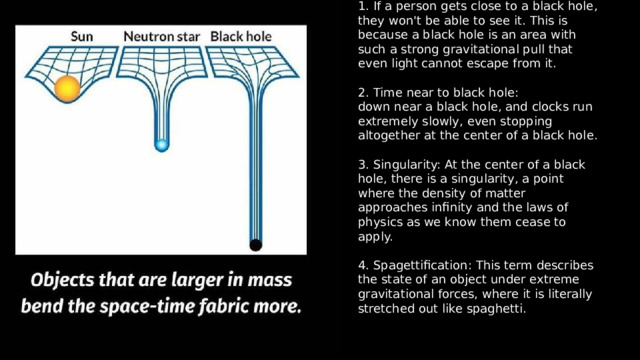
1. If a person gets close to a black hole, they won't be able to see it. This is because a black hole is an area with such a strong gravitational pull that even light cannot escape from it.
2. Time near to black hole: Time slows down near a black hole, and clocks run extremely slowly, even stopping altogether at the center of a black hole.
3. Singularity: At the center of a black hole, there is a singularity, a point where the density of matter approaches infinity and the laws of physics as we know them cease to apply.
4. Spagettification: This term describes the state of an object under extreme gravitational forces, where it is literally stretched out like spaghetti.
.
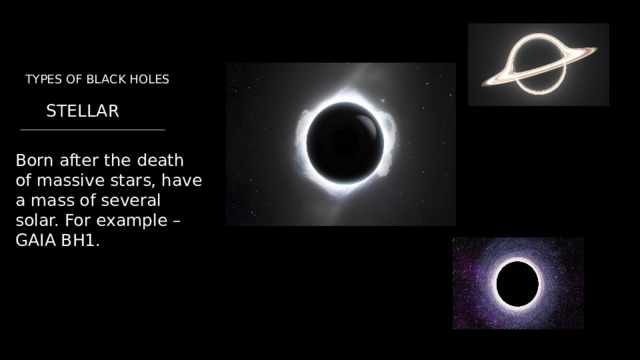
TYPES OF BLACK HOLES
STELLAR
Born after the death of massive stars, have a mass of several solar. For example – GAIA BH1.
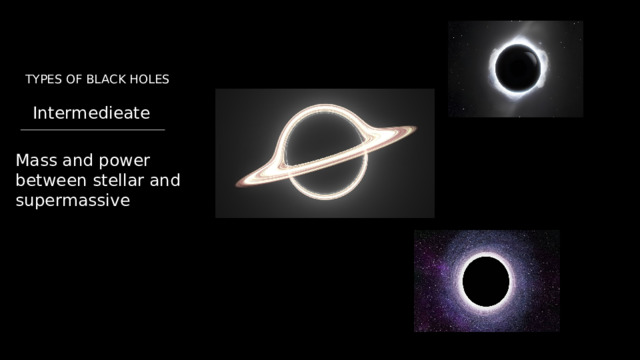
TYPES OF BLACK HOLES
Intermedieate
Mass and power between stellar and supermassive
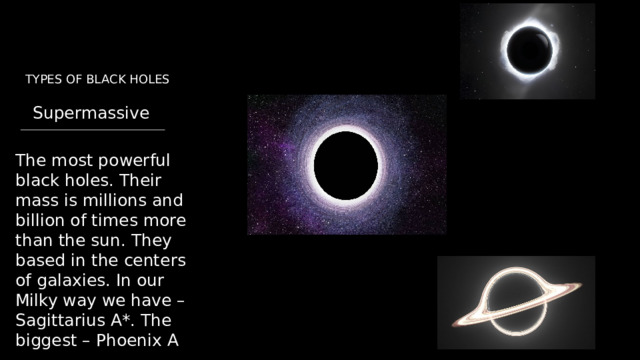
TYPES OF BLACK HOLES
Supermassive
The most powerful black holes. Their mass is millions and billion of times more than the sun. They based in the centers of galaxies. In our Milky way we have – Sagittarius A*. The biggest – Phoenix A
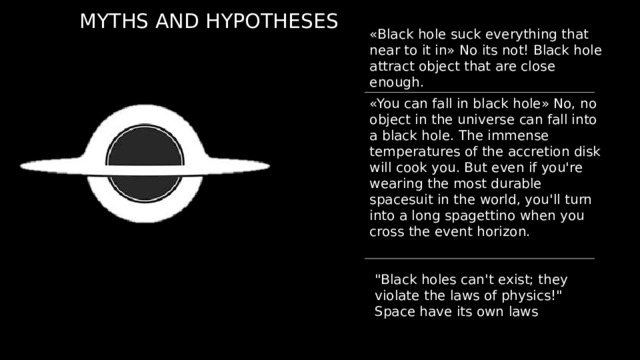
MYTHS AND HYPOTHESES
«Black hole suck everything that near to it in» No its not! Black hole attract object that are close enough.
«You can fall in black hole» No, no object in the universe can fall into a black hole. The immense temperatures of the accretion disk will cook you. But even if you're wearing the most durable spacesuit in the world, you'll turn into a long spagettino when you cross the event horizon.
"Black holes can't exist; they violate the laws of physics!" Space have its own laws
ROLE OF BLACK HOLE IN THE SPACE
Black hole play a significant role in shaping and guiding galaxies. Their gravitational pull helps to keep stars and gas in place around the centers of galaxies. They are crucial in the evolutional of the universe
CONCLUSIONS
We have achieved our goals and learned what a black hole is and what it means for the universe .

Thank for your attention








 Черные дыры - ворота в другую вселенную (4.53 MB)
 0
0 165
165 0
0 Нравится
0
Нравится
0


