Получите свидетельство
 Вход
Вход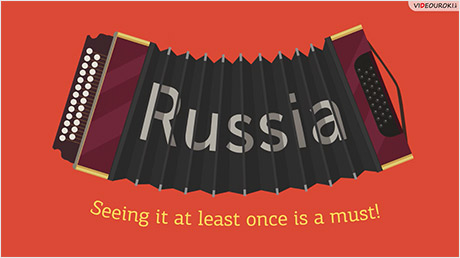



Russia is unlike any other country. Due to its unique geography and tangled history it's still a riddle, an enigma for most of Western travelers.

Seeing it at least once is a must!
In today’s lesson you’ll have a possibility of virtual tour around Russia!
The official name for Russia is the Russian Federation.
Russia shares borders with many countries, including China, Ukraine, Belarus, North Korea, Norway and others.
Russia is the largest country in the world – around 17 million square kilometers.
Pluto is the 9th planet in the solar system. The surface area of Pluto is about the same size as Russia. So Russia is like a small planet!

The capital and the largest city in Russia is Moscow. It is home to more than 8 million people. There are certainly lots of architectural and historical sites like the famous Kremlin and Red Square. But that’s only a tiny part of what Russia can offer.
Perhaps, the most interesting tour is around the prominent “Golden Ring”, which includes a number of ancient cities, such as Vladimir, Yaroslavl, Suzdal, Kostroma, Ivanovo.

St. Petersburg is Russia's second largest city and largest seaport. Known as the city of islands, there are 68 rivers, canals, and streams that run through St. Petersburg. St. Petersburg was founded in 1703 by Emperor Peter the Great as his "Window on the West."
Other big cities in Russia are Yekaterinburg, Novosibirsk, Vladivostok, Kaliningrad, Nizhny Novgorod, Kazan, Samara, Chelyabinsk, Omsk, Rostov-on-Don, Ufa, Krasnoyarsk, Perm, Volgograd, Voronezh and many others.
Russian flag
Though there is no official meaning for the colours of the flag some believe white stands for peace and generosity, blue stands for truth, loyalty and wisdom and red stands for strength, courage and love.
The National Emblem of the Russian Federation is a red square heraldic shield with rounded bottom corners and sharpened at the tip. In the center of the shield there is a double-headed eagle with loose wings and crowned with two small crowns and a large one above them.
The eagle has a scepter in the right claw and an orb in the left. A red shield on eagle's chest shows a silver rider wearing a blue cloak on a silver horse killing a lying black dragon with a silver spear.
The population of the country is around 144 million. This makes Russia the 9th largest country in the world.
Russian is the official language of Russia but there are many other languages used in various parts of the country.
The currency used in Russia is the ruble.
Geography and landscape
As the world’s largest country, Russia occupies one-tenth of all the land on Earth. It spans 11 time zones across two continents (Europe and Asia) and has shores on three oceans (the Atlantic, Pacific and Arctic Ocean).
The Russian landscape varies from vast deserts to frozen coastline, tall mountains to giant marshes. Much of Russia is made up of rolling, treeless plains called 'steppes'. The region of Siberia, which occupies three-quarters of Russia, is dominated by pine forests called 'taigas'.
Siberia is home to the coldest inhabited place on the planet - Oymyakon. On February 6, 1933, a temperature of −67.7 °C was recorded at its weather station.
Mount Elbrus is the highest mountain in Russia (and Europe), it reaches a height of 5642 metres. The biggest mountain ranges are the Urals and Altay.
Russia has around 100,000 rivers, including some of the longest and most powerful in the world. Russia’s Volga River is the longest in Europe, with a length of around 3690 kilometres. Other major rivers are: Amur, Irtysh, Lena, Ob, Yenisey.
It also has many lakes. Ladoga and Onega are Europe’s two largest lakes. Lake Baikal is the largest freshwater lake in the world. It reaches 1642 metres in depth and contains around 20% of the world’s unfrozen fresh water.
Russia's wildlife and nature
As Russia is so huge, it's no surprise that this amazing country is home to a variable flora and fauna. Its forests, steppes and tundras is home for many rare animals, including Asiatic black bears, snow leopards, polar bears, and small, rabbit-like mammals called pikas.
Russia's first national parks were set up in the 19th century to help protect and restore the country’s natural beauty. Strict nature reserves are known as zapovedniks.
Russia's most famous animal species is the Siberian tiger, the largest cat in the world. Indigenous to the forests of eastern Russia, these endangered giants can grow to over 3m long, and weigh up to 300kg.
History of Russia
The earliest human settlements in Russia arose around A.D. 500, as Scandinavians moved south to areas around the upper Volga River. These settlers mixed with Slavs from the west and built a fortress that would eventually become the Ukrainian city of Kiev.
Kiev became an empire that ruled most of European Russia for 200 years, then broke up into Ukraine, Belarus and Muscovy. Muscovy's capital, Moscow, was a small trading post until the 13th century, when Mongol invaders occupied it.
In the 1550s, Muscovite ruler Ivan IV became Russia's first tsar (Russian emperor) after driving the Mongols out of Kiev.
In 1682, Peter the Great became tsar at the age of just ten, and for 42 years he worked to make Russia more modern and more European.
In 1917, Russians, unhappy with their government, overthrew the tsar and formed a new elected government.
Just a few months later, however, a communist group called the Bolsheviks seized power. Their leader, Vladimir Lenin, created the Union of Soviet Socialist Republics (U.S.S.R.) from Russia and 11 other countries.
Famous leaders of the Soviet Union also include Joseph Stalin and Mikhail Gorbachev.
The World War II was a meaningful event for Russia. Although Russia lost more than 20 mln people, it destroyed Nazis and ended World War II as a super-power.
After the second world war in 1945, relations between the two powers (the USA and the USSR) became strained, leading to what’s known as the Cold War. After decades of conflict, the Cold War ended in 1991 with the breakup of the Soviet Union.
Today, Russia is a democracy. It is a federation of 86 republics, provinces, territories and districts, all controlled by the government in Moscow.
The head of state is a president elected by the people. Since 1991, Russia has had three Presidents – Boris Yeltsin, Vladimir Putin and Dmitry Medvedev.

Russian people and culture
There are about 120 ethnic groups in Russia who speak more than a hundred languages. About 80 percent of Russian ancestors are the Slavs who settled in the country 1,500 years ago. Other major groups include Tatars, and Ukrainians.
Russia is known all over the world for its thinkers and artists, including writers like Leo Tolstoy, Fyodor Dostoevsky and Bulgakov, Pushkin, composers such as Pyotr Ilyich Tchaikovsky, artist – Aivazovsky, Vasnetsov, Karamzin.
Russians had a lot of achievements in space explorations including the satellite, first animal in space, first human in space and Earth orbit (Yuri Gagarin) and first woman-cosmonaut (Valentina Tereshkova), first unmanned landing on the Moon, and first space station – Mir.
Naturally, there are many symbols associated with Russia.
Russian Bear
The Russian Bear is a common symbol representing many aspects of Russian life. From sporting teams to politcal parties, the bear is a common emblem. It was even the mascot of the 1980 Moscow Olympics.
Russian dolls are famous all over the world. Their official name is Matryoshka.
The first doll was made in the workshop of Mamontov in 1898. It consisted of 8 dolls, starting with a girl, then a boy, and alternating in this fashion until the last doll, a baby.
The name "matryoshka" comes from the Russian word for “mother” - «мать» (the Latin root “mater“- mother). Matryoshka is a symbol of motherhood and it has a modified egg shape.
The Russian hat, officially known as Ushanka, or simply 'ear-flap hat', is a common item bought by tourists and is often associated with Russia. Nowadays, the hat is still popular as a souvenir as well as a fashion accessory.
Russkaya Troyka is an informal symbol of Russia. It is the three horses. The Troyka is very well known in Russian literature, songs, poetry, movies and folklore. This symbol represents the hopes and dreams of Russian people. It symbolises a new life where dreams have come true, and all trouble have passed. The road is the symbol of your journey in life, and the three horses will help you get there.
The balalaika is a string instrument that resembles a guitar, but has a triangular shape and only three strings (or two in some cases). It is quiet and delicate, gently filling you with the essence of Russia.
Samovar has traditionally been the most recognized symbol of Russian hospitality and a sign of prosperity. For more than 250 years, the samovar has occupied an honored place in Russian homes in the center of the table.
National floral emblems are a Birch Tree and Chamomile.
Birch became a symbol of spring, light and love to the fatherland. The word “birch” is very ancient and is connected with the verb “to keep, to take care”, since the Slavs considered the birch as the protecting people gift of God.
Russian cuisine has the diverse flavors. The most delicious Russian dishes are borsch and pancakes.
Hospitality plays an important role in the Russian mentality and character. Once you make friends with Russian people you will surely value this unique feature of the so-called «Wide Russian soul».
 0
0 1808
1808