Меню
Разработки
Разработки  /  Английский язык  /  Уроки  /  Урок английского языка "Space travel"

Урок английского языка "Space travel"

Представлен интегрированный урок в форме исследовательского проекта с элементами экскурсии на тему "Космос. Космические путешествия".
14.05.2015

Описание разработки

Lesson objectives SWBAT:

All - understand specific information; use appropriate subject-specific flexibility to what others say at sentences and discourse level in pair, group and whole class;

Most- ask and respond with appropriate syntax and vocabulary to open-ended higher-order thinking questions on a range of general and curricular topics;

Some- understand specific information and ask do all tasks correctly;

Learning objectives(s) that this lesson is contributing to:

C1. use speaking and listening skills to solve problems creatively and cooperatively in groups;

C6. organise and present information clearly to others;

 S2. ask and respond with appropriate syntax and vocabulary to open-ended higher-order thinking questions on a range of general and curricular topics, including some unfamiliar topics

S6. use appropriate subject-specific flexibility to what others say at sentences and discourse level in pair, group and whole class;

L1. understand the main points in unsupported extended talk on a wide range of general and curricular topics, including talk on a growing range of unfamiliar topics;
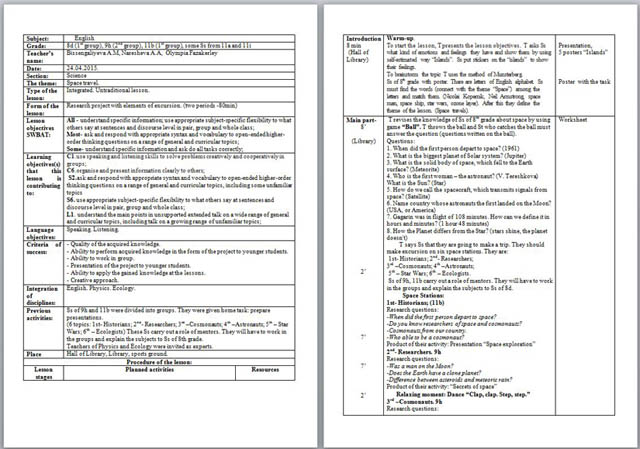
Урок английского языка Space travel

Procedure of the lesson:

Introduction 8 min (Hall of Library)

Warm-up.

To start the lesson, T presents the lesson objectives. T asks Ss what kind of emotions and feelings they have and show them by using self-estimated way “Islands”. Ss put stickers on the “islands” to show their feelings.

To brainstorm the topic T uses the method of Munsterberg.

Ss of 8th grade with poster. There are letters of English alphabet. Ss must find the words (connect with the theme “Space”) among the letters and match them. (Nicolai Kopernik, Neil Armstrong, space man, space ship, star wars, ozone layer) . After this they define the theme of the lesson. (Space travels) .

Весь материал – смотрите документ.

Содержимое разработки


Subject:

English

Grade:

8d (1st group), 9h (2nd group), 11b (1st group), some Ss from 11a and 11i

Teacher’s name:

Bissengaliyeva A.M, Naresheva A.A, Olympia Fazakerley

Date:

24.04.2015.

Section:

Science

The theme:

Space travel.

Type of the lesson:

Integrated. Untraditional lesson.

Form of the lesson:

Research project with elements of excursion. (two periods -80min)

Lesson objectives

SWBAT:

All - understand specific information; use appropriate subject-specific flexibility to what others say at sentences and discourse level in pair, group and whole class;

Most- ask and respond with appropriate syntax and vocabulary to open-ended higher-order thinking questions on a range of general and curricular topics;

Some- understand specific information and ask do all tasks correctly;

Learning objectives(s) that this lesson is contributing to:

C1.use speaking and listening skills to solve problems creatively and cooperatively in groups;

C6.organise and present information clearly to others;

S2.ask and respond with appropriate syntax and vocabulary to open-ended higher-order thinking questions on a range of general and curricular topics, including some unfamiliar topics

S6. use appropriate subject-specific flexibility to what others say at sentences and discourse level in pair, group and whole class;

L1. understand the main points in unsupported extended talk on a wide range of general and curricular topics, including talk on a growing range of unfamiliar topics;

Language objectives:

Speaking. Listening.

Criteria of success:

- Quality of the acquired knowledge.

- Ability to perform acquired knowledge in the form of the project to younger students.

- Ability to work in group.

- Presentation of the project to younger students.

- Ability to apply the gained knowledge at the lessons.

- Creative approach.

Integration of disciplines:

English. Physics. Ecology.

Previous activities:

Ss of 9h and 11b were divided into groups. They were given home task: prepare presentations.

(6 topics: 1st- Historians; 2nd- Researchers; 3rd –Cosmonauts; 4th –Astronauts; 5th – Star Wars; 6th – Ecologists) These Ss carry out a role of mentors. They will have to work in the groups and explain the subjects to Ss of 8th grade.

Teachers of Physics and Ecology were invited as experts.

Place

Hall of Library, Library, sports ground.

Procedure of the lesson:

Lesson stages

Planned activities

Resources

Introduction

8 min

(Hall of Library)

Warm-up.

To start the lesson, T presents the lesson objectives. T asks Ss what kind of emotions and feelings they have and show them by using self-estimated way “Islands”. Ss put stickers on the “islands” to show their feelings.

To brainstorm the topic T uses the method of Munsterberg.

Ss of 8th grade with poster. There are letters of English alphabet. Ss must find the words (connect with the theme “Space”) among the letters and match them. (Nicolai Kopernik, Neil Armstrong, space man, space ship, star wars, ozone layer). After this they define the theme of the lesson. (Space travels).


Presentation,

5 posters “Islands”


Poster with the task

Main part-

8’


(Library)


2’


7’


7’


2’


7’


7’


2’


7’


7’


8’

T revises the knowledge of Ss of 8th grade about space by using game “Ball”. T throws the ball and St who catches the ball must answer the question (questions written on the ball).

Questions:

  1. 1. When did the first person depart to space? (1961)

  2. 2. What is the biggest planet of Solar system? (Jupiter)

  3. 3. What is the solid body of space, which fell to the Earth surface? (Meteorite)

  4. 4. Who is the first woman – the astronaut? (V. Tereshkova)

  5. What is the Sun? (Star)

  6. 5. How do we call the spacecraft, which transmits signals from space? (Satellite)

  7. 6. Name country whose astronauts the first landed on the Moon? (USA, or America)

  8. 7. Gagarin was in flight of 108 minutes. How can we define it in hours and minutes? (1 hour 48 minutes)

  9. 8. How the Planet differs from the Star? (stars shine, the planet doesn't)

T says Ss that they are going to make a trip. They should make excursion on six space stations. They are:

1st- Historians; 2nd- Researchers;

3rd –Cosmonauts; 4th –Astronauts;

5th – Star Wars; 6th – Ecologists.

Ss of 9h, 11b carry out a role of mentors. They will have to work in the groups and explain the subjects to Ss of 8d.

Space Stations:

1st- Historians; (11b)

Research questions:

  1. -When did the first person depart to space?

  2. -Do you know researchers of space and cosmonauts?

  3. -Cosmonauts from our country.

  4. -Who able to be a cosmonaut?

Product of their activity: Presentation “Space exploration”

2nd- Researchers. 9h

Research questions:

  1. -Was a man on the Moon?

  2. -Does the Earth have a clone planet?

  3. -Difference between asteroids and meteoric rain?

Product of their activity: “Secrets of space”

Relaxing moment: Dance “Clap, clap. Step, step.”

3rd –Cosmonauts. 9h

Research questions:

  1. -How our space house is arranged?

  2. -What it is our Solar System?

  3. -What it is the world of stars?

Product of their activity: “Our universe”

4th –Astronauts. 9h

Research questions:

  1. -How it is possible to explain rising and a sunset?

  2. -How many stars are visible in the sky?

  3. -What are the constellations?

Product of their activity: “All about space”

Relaxing moment: Dance “Cowboys”

5th – Star Wars.11b

Research questions:

  1. -Films about space.

  2. -Pros and cons.

Product of their activity: “Space films”

6th – Ecologists. 11b

Research questions:

  1. -What is the connection between the person and space?

  2. -Is it possible to darn an ozone layer?

  3. -Pros and cons of space exploration

Product of their activity: “Human and space”

Reflection:

After the trips Ss of the 8d fill in worksheets where they must take notes about 6 space stations. (interesting and may be negative moments)

Self-Assessment: Ss of grades 9h and 11b analyze their presentations by filling worksheets where they write about the best moments and moments which they think must be improved next time.

Teacher’s Assessment: Teacher of Physics and Ecology (experts) give their feedback.

Worksheet


Worksheet


Worksheet

Conclusion 8’ (sports ground)

Ss and teachers go to the sports ground and organize rocket show.

Rocket


1. When did the first person depart to space? (1961)

2. What is the biggest planet of Solar system? (Jupiter)

3. What is the solid body of space, which fell to the Earth surface? (Meteorite)

4. Who is the first woman – the astronaut? (V. Tereshkova)

What is the Sun? (Star)

5. How do we call the spacecraft, which transmits signals from space? (Satellite)

6. Name country whose astronauts the first landed on the Moon? (USA, or America)

7. Gagarin was in flight of 108 minutes. How can we define it in hours and minutes? (1 hour 48 minutes)

8. How the Planet differs from the Star? (Stars shine, the planet doesn't)


Nicolai Kopernik

Neil Armstrong

Space man

Space ship

Star wars

Ozone layer


-80%
Курсы повышения квалификации

Развитие человека от рождения до смерти: психология развития и возрастная психология

Продолжительность 72 часа
Документ: Удостоверение о повышении квалификации
4000 руб.
800 руб.
Подробнее
Скачать разработку
Сохранить у себя:
Урок английского языка "Space travel" (32.11 КB)

Комментарии 0

Чтобы добавить комментарий зарегистрируйтесь или на сайт