
 Получите свидетельство
 Вход
Вход



9288km
Trans-Siberian Railway
Moscow - Vladivostok
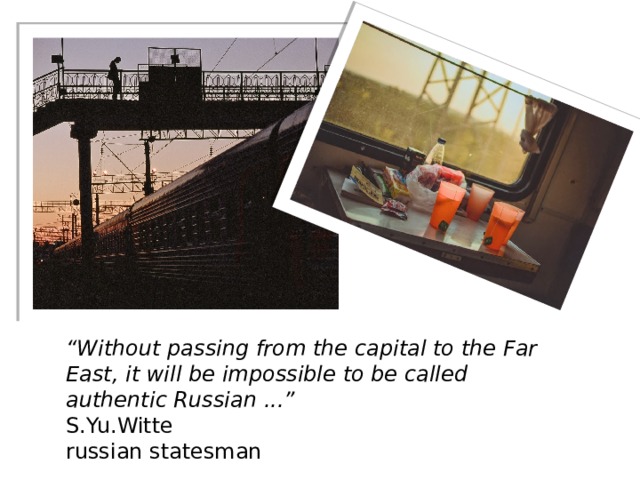
“ Without passing from the capital to the Far East, it will be impossible to be called authentic Russian ...” S.Yu.Witte russian statesman

The Trans-Siberian Railway is a legendary railway crossing the whole of Russia from west to east. Its starting point is Moscow, and the final point is Vladivostok in the Far East, from where it is close to China, Korea and Japan. The Trans-Siberian Railway (or, as it is soon called in Russia, Transsib or Transsib) is the longest railway in the world. Its length from Moscow to Vladivostok is 9,288.2 kilometers. The train moves at this distance, depending on the number of stops, from 6 to 7 days. During this time, 7 time zones will change along the way.

The Trans-Siberian Railway passes through the most interesting places of Russia. On its way lies 87 cities, of which the most attractive for tourists, in addition to Moscow and Vladivostok, are Yaroslavl (or Nizhny Novgorod, depending on the route), Yekaterinburg, Novosibirsk, Irkutsk. The Transsiberian rounds Lake Baikal from the south, and one can freely admire them from the train window. As well as gradually changing landscapes of Central Russia, the Urals, Siberia, Transbaikalia and the Far East.
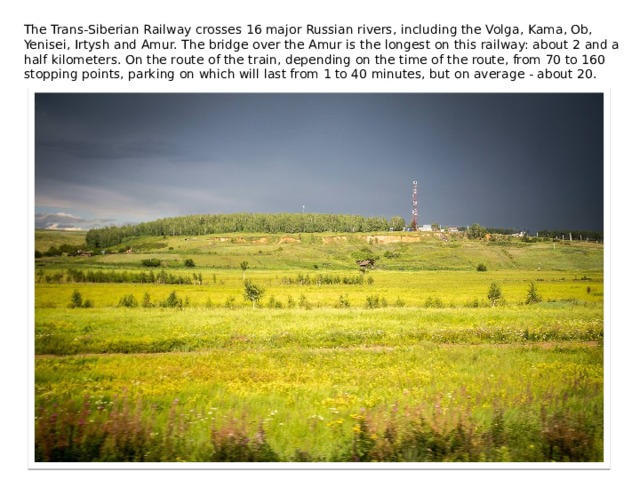
The Trans-Siberian Railway crosses 16 major Russian rivers, including the Volga, Kama, Ob, Yenisei, Irtysh and Amur. The bridge over the Amur is the longest on this railway: about 2 and a half kilometers. On the route of the train, depending on the time of the route, from 70 to 160 stopping points, parking on which will last from 1 to 40 minutes, but on average - about 20.

Tourist route, trains and budget
Traveling along the Trans-Siberian Railway can be started from Moscow or Vladivostok. Some tourists, wanting to feel the scale of the country, pass this way non-stop, admiring the views outside the window and communicating with fellow travelers.

Some tourists decide to make their tour in the country more in-depth and divide the trip by train into separate segments, stopping in the cities of interest for one or several days. In this case, a separate train ticket is bought for each stage of the trip - you cannot simply get off the train and then take another one, even if your ticket is in a different place.
Tourists usually stop in Yekaterinburg (the capital of the Urals region), Irkutsk (near Baikal) and Novosibirsk (the largest city of Siberia and the 3rd largest in Russia). Also worth visiting are Ulan-Ude (the capital of Buryatia with beautiful Buddhist temples), Nizhny Novgorod or Yaroslavl (ancient Russian cities).

For a 4-seater soft compartment in the “Russia” train, you will have to pay about 35,000-45,000 rubles ($ 500-700), and in trains No. 99 or No. 100 - 16,000-18,000 rubles ($ 250-270). A place in a second-class car (54 places in one car with practically no partitions between them) will cost approximately 10,000-12,000 rubles ($ 150-170) in the Russia train and 6,500-7500 ($ 90-110) in train No. 100. Also in the train "Russia" you can buy seats "SV" - a double coupe superior. But the price will also be "increased" - from 60000 rubles ($ 950-1000).
Comfort and survival in the train
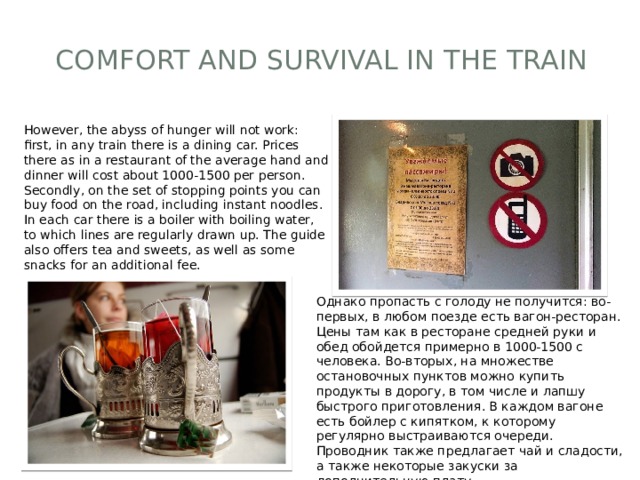
However, the abyss of hunger will not work: first, in any train there is a dining car. Prices there as in a restaurant of the average hand and dinner will cost about 1000-1500 per person. Secondly, on the set of stopping points you can buy food on the road, including instant noodles. In each car there is a boiler with boiling water, to which lines are regularly drawn up. The guide also offers tea and sweets, as well as some snacks for an additional fee.
Однако пропасть с голоду не получится: во-первых, в любом поезде есть вагон-ресторан. Цены там как в ресторане средней руки и обед обойдется примерно в 1000-1500 с человека. Во-вторых, на множестве остановочных пунктов можно купить продукты в дорогу, в том числе и лапшу быстрого приготовления. В каждом вагоне есть бойлер с кипятком, к которому регулярно выстраиваются очереди. Проводник также предлагает чай и сладости, а также некоторые закуски за дополнительную плату.
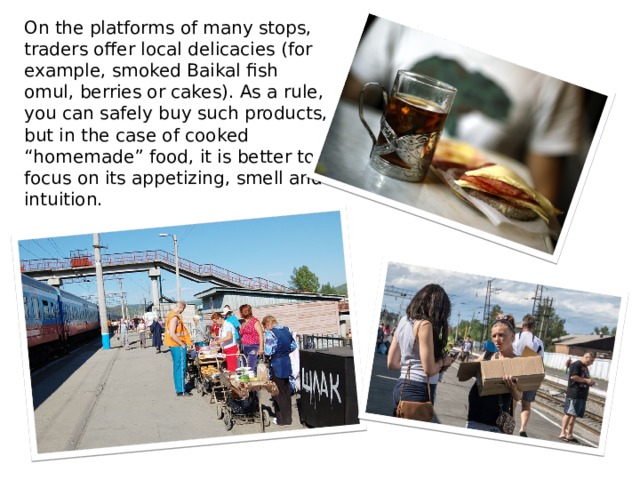
On the platforms of many stops, traders offer local delicacies (for example, smoked Baikal fish omul, berries or cakes). As a rule, you can safely buy such products, but in the case of cooked “homemade” food, it is better to focus on its appetizing, smell and intuition.

With long-distance train hygiene, everything is difficult: a shower in cars, unfortunately, is therefore not an arsenal of wet wipes and / or a towel to wipe. Usually Russians take out their own soap and toilet paper on the road.
The most convenient way to travel is in breathable clothes, ideally in a tracksuit. In case of stuffiness, a fan is very useful: in old, non-branded trains, the window may not open. Oddly enough, in a reserved seat it is easier to breathe than in a closed compartment space.
All trains have sockets. Somewhere they are located in a compartment, somewhere in the corridor. Leaving the equipment on the charge in the corridor without supervision is not worth it, it is better to always stand nearby. Sometimes the sockets may not work for some time - then it is better to try it in another car or take an autonomous charger with you.

Security
The best option travel (especially with children) - in a compartment for four. The door of the compartment can be closed from the inside with a lock and chain, which will allow you not to worry about security. However, in any case, even briefly leaving the coupe, money and valuables in it should not be left.
The inhabitants of the lower places can put their luggage on the shelf under their lying place. Those who got the upper place, put their belongings on a large shelf above the entrance door. But, if a suitcase or bag is difficult to lift up, you can always try to negotiate with your neighbor in the compartment, they usually go forward.

Placement, due to its openness, is more dangerous in criminogenic terms. On the one hand, everyone sees everything, so a thief will have to think twice whether to do his dirty deed or not. On the other hand, at night in a dream you can not feel the bag gently dragged from under the pillow. Therefore, it is better to keep all valuables under your lying place (not forgetting to take them when you go somewhere).
During the intermediate stops, you need to carefully monitor the time and immediately get on the train when the conductor gives this signal. Often, being fascinated by looking at the surroundings or talking to people from their places by traders, passengers are lagging behind the train. Adequate train schedules at some remote stopping points, it is better to avoid such adventures.

Communication
Interesting and very different companions - a significant part of the journey through such a large country like Russia. People traveling from large cities to their small homeland, enthusiastic travelers, dreamers, merchants or military personnel - a contingent of neighbors can be very different.
But the fact that an interesting acquaintance (and not one) will take place is a fact. Even the most secluded passengers socialize during a long trip and start talking to their neighbors, even despite the language barrier.

People on the train are usually open for communication, they turn to emotional and philosophical conversations. Also, do not be surprised if they are ready to share with you the food taken on the road. Treat neighbors in a compartment (or at least offer to join the meal) - this is something like the road "standards of decency" among the Russians. However, no one is obliged to offer their food or to agree to someone else. Although sometimes it can be offended. Or in case of refusal to try food, which he so persistently persuade, it becomes impossible to say no. The situation is like a drink: if you don’t like it, it’s better to come up with a reason in advance (better than a medical one) for which you cannot.

Conductors may seem harsh, but usually they are professional people who know their business. Since the conductor does not change all 6-7 days of travel, it is better to establish good relations with him. They rarely speak foreign languages on domestic trains, but sign language and smile work wonders.

The creation of Transsib was a great achievement of the Russian people. With difficulties and joys builders finished the road. They laid it on their bones, blood and humiliation, but still coped with this incredibly hard work. This road allowed Russia to carry a huge number of passengers and cargo. Each year, the Transsib road carries up to 100 million tons of cargo per year. Thanks to the construction of the highway, the uninhabited territories of Siberia were settled.
We can assume that the last meters of the Trans-Siberian Railway pass through the sea trade port of Vladivostok. This is where the Great Siberian Railway Line ends in reality. Behind more than 20 regions, territories and republics of Russia. 78 stops and 7 time zones, the longest railway on the planet, crossing almost all of Eurasia, passed.





 "Транссибирская магистраль" (6.29 MB)
 0
0 832
832 20
20 Нравится
0
Нравится
0


