
 Получите свидетельство
 Вход
Вход



St. Petersburg
The bronze tsar
and the tsarina!
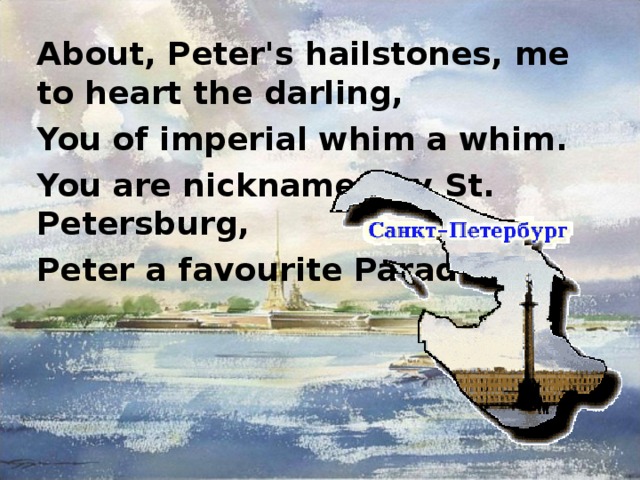
About, Peter's hailstones, me to heart the darling,
You of imperial whim a whim.
You are nicknamed by St. Petersburg,
Peter a favourite Paradise!

Plan 1. Introduction 2. Geographical position 3. Climate 4. Population 5. Sightseeing
6. Peterhof
7. The Fountains of Peterhof
8 . Conclusion
9. Control questions
10. R esource

Introduction St. Petersburg rightly regarded as one of the finest cities in Europe. The city, often called the "northern capital" of Russia - is not only open-air museum, but simply the embodiment of the last three hundred years of Russian history. The surviving 11 emperors, dozens of floods, revolution, a three-year blockade and economic reform Petersburg able to surprise even the most sophisticated traveler.

Geographical position The city area is 606 square km, and the suburbs -1439 sq. km. Main artery of the city - the Neva river. The length of the Neva River - 74 km (in the city - 32 km), the average width of the river in the city, about 600 m, depth - up to 24 m. The surface water is one-tenth of the city area. Besides the Neva significant influence in shaping the city have numerous rivers, streams and canals. The city is situated on 47 islands of the Neva delta. The biggest of them - Vasilevsky and Petrograd.

MAP St. Petersburg
o
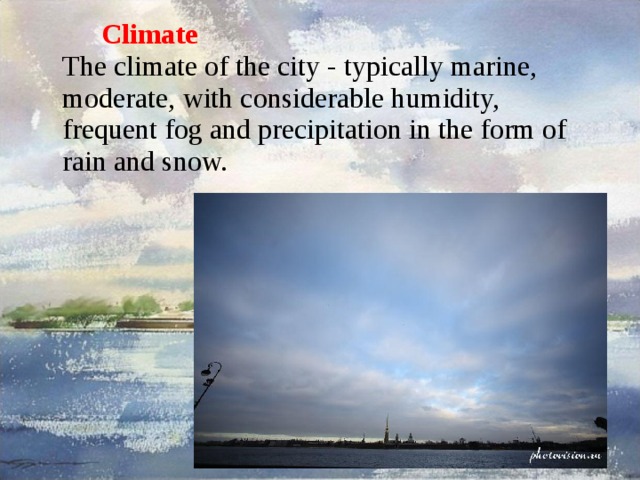
Climate The climate of the city - typically marine, moderate, with considerable humidity, frequent fog and precipitation in the form of rain and snow.

Population
Saint Petersburg is a 4th on a quantity city of Europe (after Istambul, London and Moscow), second on the quantity of population city of Europe, being not the capital of the state, and north city with a population more than million persons. The quantity of population of Saint Petersburg on being in 2008 makes 4 568 047 habitants.
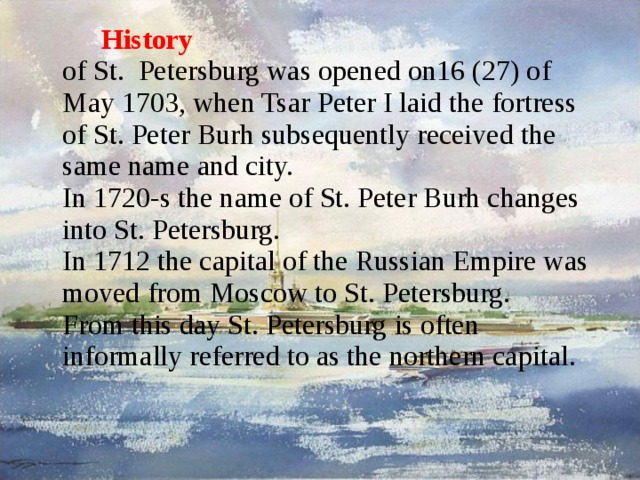
History of St. Petersburg was opened on16 (27) of May 1703, when Tsar Peter I laid the fortress of St. Peter Burh subsequently received the same name and city. In 1720-s the name of St. Peter Burh changes into St. Petersburg. In 1712 the capital of the Russian Empire was moved from Moscow to St. Petersburg. From this day St. Petersburg is often informally referred to as the northern capital.

Also he thought:
From here we will threaten the Swede,
Here the city will be put
To spite of haughty to the neighbour.
The nature here it is fated to us
To Europe to open a window…

The coat of arms The first emblem of the city of St. Petersburg came in 1712 at the red banners of St. Petersburg regiments. In 1878, was approved by the coat of arms of Saint-Petersburg province with the same symbols, but with a standard frame of a shield, typical provincial town: a red shield, a shield, a gold imperial scepter in silver, placed crosswise indirectly anchors and cats (the anchor of the three teeth). Shield crowned with an imperial crown, surrounded with golden oak leaves, joined Andrew ribbon.

And before the junior capital
Old Moscow grew dark,
As before a new tsarina
autocratic widow.
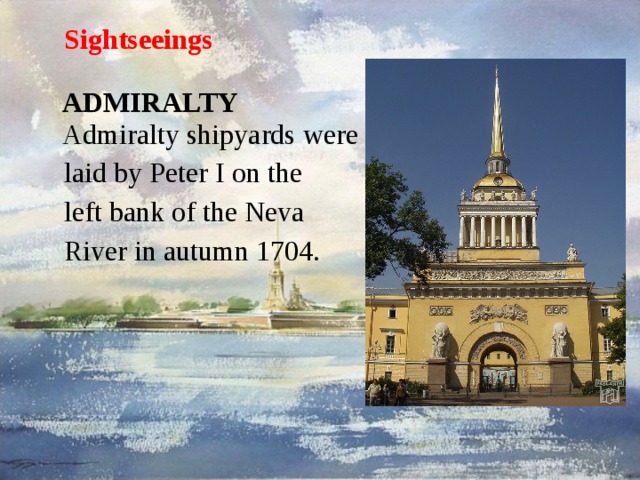
Sightseeings ADMIRALTY Admiralty shipyards were
laid by Peter I on the
left bank of the Neva
River in autumn 1704.
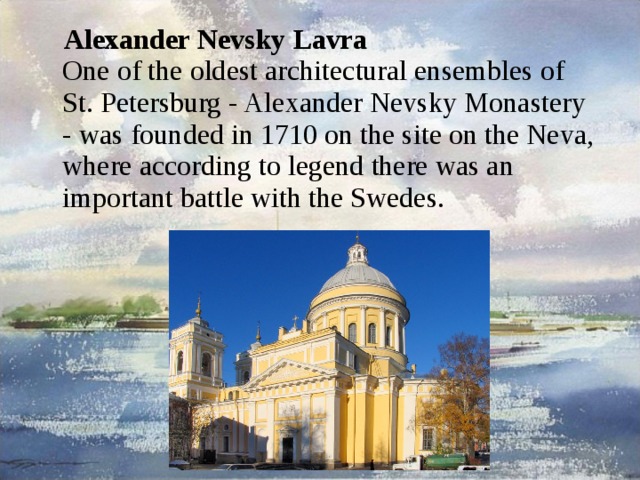
Alexander Nevsky Lavra One of the oldest architectural ensembles of St. Petersburg - Alexander Nevsky Monastery - was founded in 1710 on the site on the Neva, where according to legend there was an important battle with the Swedes.

Bronze Horseman The most famous the Bronze Horseman, cast by the sculptor Etienne Falconet, depicts Peter I on horseback.
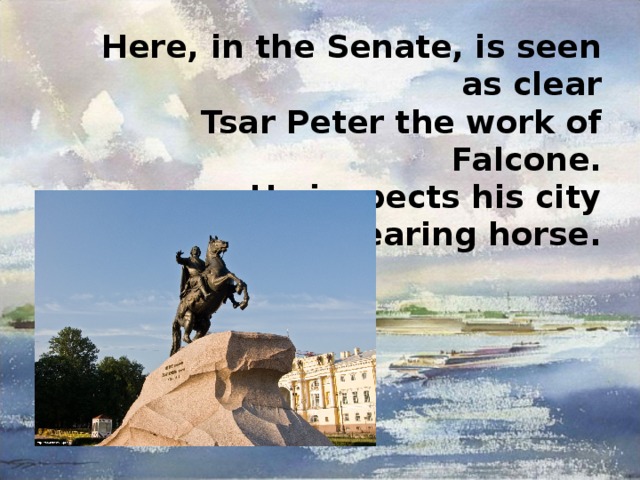
Here, in the Senate, is seen as clear Tsar Peter the work of Falcone. He inspects his city Mounted on a rearing horse.

Peter and Paul Fortress The first construction of the new Russian capital, St. Peter and Paul Fortress occupies a central place in the architectural composition of St. Petersburg. Fortress was founded on May 16, 1703.

Here Peter and Paul Fortress ... With all the ferocity of the enemy shot down - Russia is not terrible adversary.
Nevsky Prospect In 1710, the shipyard from the road to Novgorod hacked direct path, covered it with rocks and called it a great perspective dear. This was the first name of Nevsky Prospekt.

Nevsky, Nevsky. Bulks of columns.
Shine of palaces. On a chariot gate.

SUMMER GARDEN
In Peter time the Summer garden was tsar's residence, where court life of Petersburg flowed. Today the Summer garden is open for all persons interested.

… Slightly for pranks scolded
And in the Summer garden to walk drove …

White nights of Saint Petersburg
It is considered that in Saint Petersburg white nights proceed from June, 11 for July, 2; the period of very light nights lasts from the end of May to the middle of July. White nights are an original symbol of Saint Petersburg : to this time different measures are timed.

And, keeping out darkness nightly
On gold skies,
One sunset to change other
Hurries, giving nights of half a hour.
BRIDGES
Saint Petersburg is a city of bridges. The Petersburg bridges are the major constituent of his architectural look, giving an unique romantic tint to the city. The longest bridge on Neva is a bridge of Alexandra Невского (909 m, taking into account rampants), widest - Dark blue bridge on the river Мойке (99, 16,40 feet).

There is has put on Neva in granite;
Bridges hung above waters;
By rifle-green gardens
Her islands were covered …
MUSEUMS
Saint Petersburg, planned and stopped up by an emperor by Peter First as "Window to Europe", has tercentenary history which was reflected in the numerous museums of the north capital.

Russian museum
Museum of history of religion

The Hermitage
A.V.Suvorova's museum
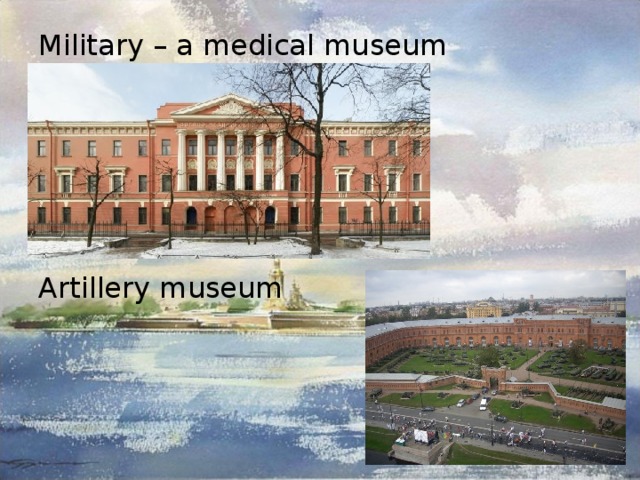
Military – a medical museum
Artillery museum
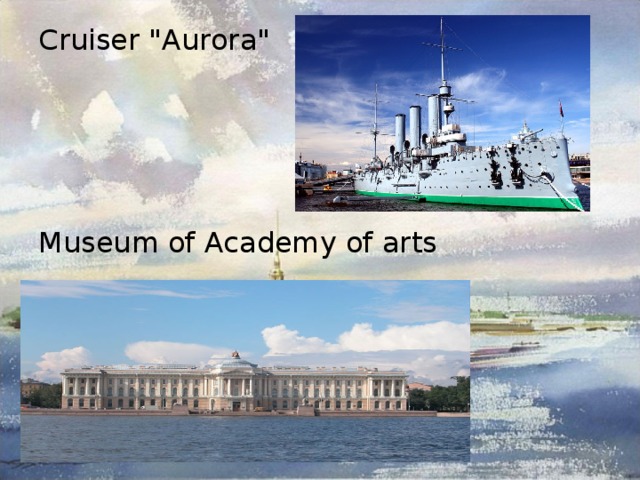
Cruiser "Aurora"
Museum of Academy of arts

PETERHOF
Peterhof is a suburb of Saint Petersburg, a state "museum is reserve", prime example of beauty of architectural complexes, parks, gardens of times of tsar's Russia. Building of Peterhof was begun in 1709 on the decree of Peter I, deciding to create a summer residence with a palace, park and fountains, reminding Versailles.

In Peterhof there is one of the most considerable in Russia complexes of architectonically-park ensembles of 18-19 вв . His kernel is a parade residence of Peter I, which the basic idea of her composition belongs to.

Again blest Peterhof
To the rains rules to flow
And bronze heroes and gods
The infantile washes persons …
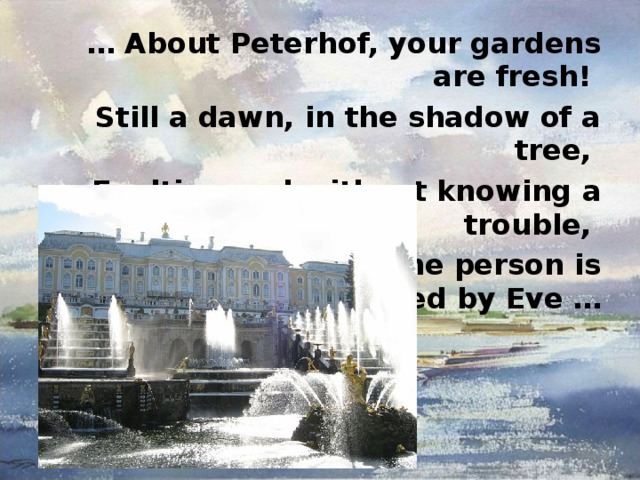
… About Peterhof, your gardens are fresh!
Still a dawn, in the shadow of a tree,
Exulting and without knowing a trouble,
On a breast Adam's the person is declined by Eve …

Large palace
A large palace, erected on verge of natural ledge on the border of the Overhead garden and Bottom park, is the most considerable architectural building of all Peterhof ensemble.
In a palace and corps related to him "after the coat" of arms there were over 50 parade apartments.
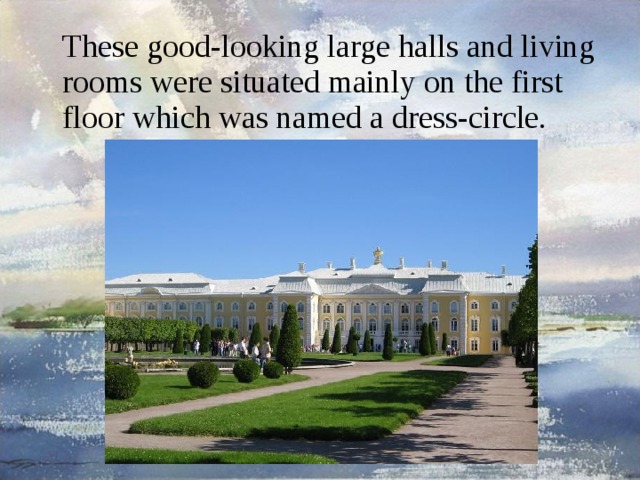
These good-looking large halls and living rooms were situated mainly on the first floor which was named a dress-circle.
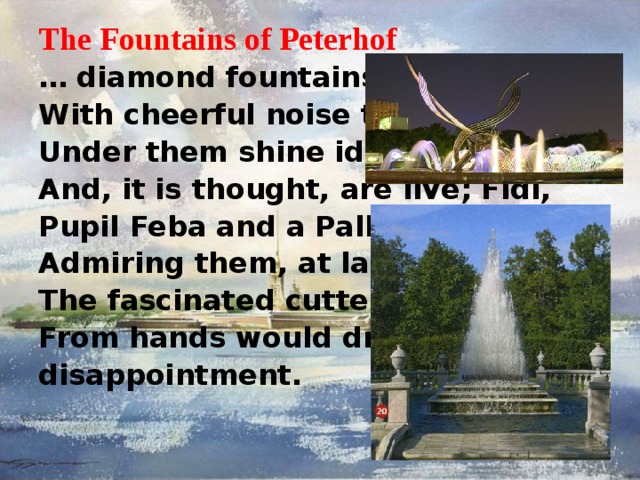
The Fountains of Peterhof
… diamond fountains Fly
With cheerful noise to clouds;
Under them shine idols
And, it is thought, are live; Fidi,
Pupil Feba and a Pallada,
Admiring them, at last,
The fascinated cutter
From hands would drop from
disappointment.

… Being split up about marble barriers,
Pearl, fiery arch
Fall, splash falls;
And streamlets in a shade wood
Hardly curl sleeping a wave.

The Fountains of Peterhof

Conclusion
Now Saint Petersburg is an enormous city, one of the most beautiful cities of the world; major industrial, scientific and cultural center of Russia, large center of transport, marine and river port.

R esource
1. http://yandex.ru
2. http://ru.wikipedia.org/wiki
3. http://ru.wikipedia.org/wiki/%D0%9F%D0%B8%D1%82%D0%B5%D1%80

The presentation was made by
group T-405.




 Saint Peterburg (3.28 MB)
 0
0 419
419 4
4 Нравится
0
Нравится
0


