Меню
Разработки
Разработки  /  Английский язык  /  Презентации  /  9 класс  /  Презентация "Architectural styles"

Презентация "Architectural styles"

В данной презентации представлены различные архитектурные стили. Работа будет интересна учителям, работающим по УМК О.В. Афанасьевой и И.В. Михеевой в 9классе.

29.01.2017

Содержимое разработки

Romanesque architecture is an architectural style of Medieval Europe characterised by semi-circular arches. There is no consensus for the beginning date of the Romanesque architecture, with proposals ranging from the 6th to the 10th century. It developed in the 12th century into the Gothic style, characterised by pointed arches. Examples of Romanesque architecture can be found across the continent. The Romanesque style in England is traditionally referred to as Norman architecture .
  • Romanesque architecture is an architectural style of Medieval Europe characterised by semi-circular arches. There is no consensus for the beginning date of the Romanesque architecture, with proposals ranging from the 6th to the 10th century. It developed in the 12th century into the Gothic style, characterised by pointed arches. Examples of Romanesque architecture can be found across the continent. The Romanesque style in England is traditionally referred to as Norman architecture .
The Renaissance (UK: /rɨˈneɪsəns/, US: /ˈrɛnɨsɑːns/, was a cultural movement that spanned the period roughly from the 14th to the 17th century, beginning in Italy in the Late Middle Ages and later spreading to the rest of Europe.
  • The Renaissance (UK: /rɨˈneɪsəns/, US: /ˈrɛnɨsɑːns/, was a cultural movement that spanned the period roughly from the 14th to the 17th century, beginning in Italy in the Late Middle Ages and later spreading to the rest of Europe.
In Baroque architecture, new emphasis was placed on bold massing, colonnades, domes, light-and-shade, 'painterly' color effects and volume. Baroque architecture was taken up with enthusiasm in central Germany , Austria and Russia .
  • In Baroque architecture, new emphasis was placed on bold massing, colonnades, domes, light-and-shade, 'painterly' color effects and volume. Baroque architecture was taken up with enthusiasm in central Germany , Austria and Russia .
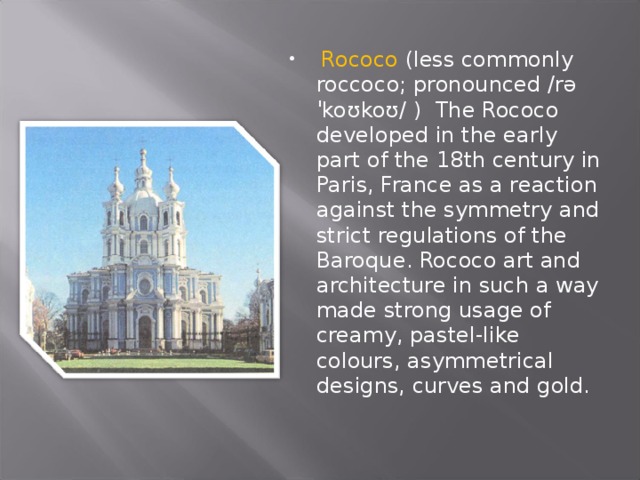
 Rococo (less commonly roccoco; pronounced /rəˈkoʊkoʊ/ ) The Rococo developed in the early part of the 18th century in Paris, France as a reaction against the symmetry and strict regulations of the Baroque. Rococo art and architecture in such a way made strong usage of creamy, pastel-like colours, asymmetrical designs, curves and gold.
  • Rococo (less commonly roccoco; pronounced /rəˈkoʊkoʊ/ ) The Rococo developed in the early part of the 18th century in Paris, France as a reaction against the symmetry and strict regulations of the Baroque. Rococo art and architecture in such a way made strong usage of creamy, pastel-like colours, asymmetrical designs, curves and gold.
The Empire style, the second phase of Neoclassicism, is an early-19th-century design movement in architecture, furniture, other decorative arts, and the visual arts followed in Europe and America until around 1830.
  • The Empire style, the second phase of Neoclassicism, is an early-19th-century design movement in architecture, furniture, other decorative arts, and the visual arts followed in Europe and America until around 1830.
Classicism , in the arts, refers generally to a high regard for classical antiquity, as setting standards for taste which the classicists seek to emulate. It places emphasis on symmetry, proportion, geometry . This style quickly spread to other Italian cities and then to France, Germany, England, Russia and elsewhere.
  • Classicism , in the arts, refers generally to a high regard for classical antiquity, as setting standards for taste which the classicists seek to emulate. It places emphasis on symmetry, proportion, geometry . This style quickly spread to other Italian cities and then to France, Germany, England, Russia and elsewhere.

-80%
Курсы повышения квалификации

Развитие человека от рождения до смерти: психология развития и возрастная психология

Продолжительность 72 часа
Документ: Удостоверение о повышении квалификации
4000 руб.
800 руб.
Подробнее
Скачать разработку
Сохранить у себя:
Презентация "Architectural styles" (8.48 MB)

Комментарии 0

Чтобы добавить комментарий зарегистрируйтесь или на сайт