
 Получите свидетельство
 Вход
Вход



Opportunities of Artificial Intelligence in learning foreign languages
Аннотация
В этой статье рассматриваются возможности искусственного интеллекта в освоении и изучении иностранных языков. XXI век - это век информационных технологий. С появлением интернета человечество, оставив позади индустриальный этап, вступило в совершенно новую эпоху, названную информационной или цифровой. У новой эры есть свои законы, возможности и проблемы.
Быстрое развитие информационных технологий и интернета улучшило коммуникационные отношения между людьми. Это, в свою очередь, привело к накоплению большой количественной информации. Обмен информацией - это не только технологическая коммуникация, но и лингвистический феномен. Использование людьми слов и фраз, понимание контекста данных и использование языка, в общем, становится важным направлением в области языковедения, и вот на стыке компьютерной науки и лингвистики возника компьютерная лингвистика.
Annotation
This article deals with the opportunities of artificial intelligence in learning foreign languages. The 21st century is the age of information technology. With the advent of the Internet, humanity, leaving behind the industrial stage, entered a completely new era, called information or digital. The new era has its own laws, opportunities and problems.
The rapid development of information technology and the Internet has improved communication between people. This, in turn, led to the accumulation of large quantitative information. The exchange of information is not only a technological communication, but also a linguistic phenomenon. The use of words and phrases by people, the understanding of the data context and the use of language, in general, become an important direction in the field of linguistics, and computer linguistics has emerged at the junction of computer science and linguistics.
Ключевые слова: искусственный интеллект, обработка естественного языка, общий искусственный интеллект, вычислительный интеллект, изучение иностранных языков.
Keywords: Artificial intelligence, Natural Language Processing , General Artificial Intelligence ,Computational Intelligence ,Learning Foreign Languages.
Artificial intelligence is a technology that can be explained by taking apart two words “Artificial” and “intelligence”. Artificial means something that is not natural but is made by human skills and intelligence means humans inject intelligence into a machine so that it can perform some complex works like humans. This means intelligence machines are able to make their own decisions according to a particular situation. Furthermore, they are endowed with learning ability, which allows them to gain experience from its errors and to learn how to solve problems. Artificial Intelligence machines also possess perception ability that makes them be able to sense the environment around it and take the decision accordingly. Some machines even can understand nature language and perform its actions accordingly [1]. On aggregate, the basic aim for constructing artificial intelligence machines is to reduce human efforts. In the modern society, people cannot live without those intelligence machines, which could do hard and dangerous works, instead people, they could interact with people to give useful advices without human experts involved in.
In this paper, it will briefly introduce the history of artificial intelligence and show some instructional activities of using an artificial intelligence program, especially in integrating oral practice and writing activities for beginning learners. This identifies the topicality of the study.
More people learn English through technology than by any other means. Out of 1.5 billion English language learners across the globe, only a fraction has the resources or access to learn the language through formal teaching. Just as the global reach of English has been accelerated by online services, so has its effect on learning. Most of this is informal learning, which in practice is how most of us learn most things. new kid on the online block, that promises to revolutionize the online teaching of English, is Artificial Intelligence. Advances in Natural Language Processing (NLP) mean that learners can have a frictionless interface with language content through voice.
Beyond this, artificial intelligence offers personalized learning. It knows who you are and can track your progress, as well as adapt delivery to your needs. Like a satellite navigation system in your car, it can use aggregated data from many learners, combined with data from your own learning journey, to deliver exactly what you need at the moment you need it.
Although artificial intelligence has a strong science fiction connotation, it forms a vital branch of computer science, dealing with intelligent behavior, learning and adaptation in machines. Research in artificial intelligence is concerned with producing machines to automate tasks requiring intelligent behavior. Examples include control, planning and scheduling, the ability to answer diagnostic and consumer questions, handwriting, speech, and facial recognition. As such, it has become a scientific discipline, focused on providing solutions to real life problems. Artificial Intelligence systems are now in routine use in economics, medicine, engineering and the military, as well as being built into many common home computer software applications, traditional strategy games like computer chess and other video games [2].
The term “artificial intelligence” was coined by John McCarthy in a famous Dartmouth College Workshop held in the summer of 1956. The research of artificial intelligence began after the Second World War. Many engineers started to design machines that have intelligence.
Artificial intelligence has become popular in various different areas, such as engineering and medical field. Artificial intelligence has now been employed in language teaching and learning and serves a variety of uses for language teaching and learning. It can be a tutor who offers language drills or skill practice and a stimulus for discussion and interaction or a tool for writing and research [3].
Artificial intelligence divides roughly into two schools of thought:
General Artificial Intelligence
Computational Intelligence
General Artificial intelligence:
General Artificial Intelligence mostly involves methods now classified as machine learning, characterized by formalism and statistical analysis. This is also known as symbolic artificial intelligence, logical artificial intelligence, neat artificial intelligence and good old fashioned artificial intelligence.
Methods include:
Expert systems: apply reasoning capabilities to reach a conclusion. An expert system can process large amounts of known information and provide conclusions based on them.
Case based reasoning
Bayesian networks
Behavior based artificial intelligence: a modular method of building artificial intelligence systems by hand.
Computational Intelligence :
Computational Intelligence involves iterative development or learning (e.g. parameter tuning e.g. in connectionist systems). Learning is based on empirical data and is associated with non-symbolic artificial intelligence, scruffy artificial intelligence and soft computing.
Methods include:
Neural networks: systems with very strong pattern recognition capabilities.
Fuzzy systems: techniques for reasoning under uncertainty, has been widely used in modern industrial and consumer product control systems.
Evolutionary computation: applies biologically inspired concepts such as populations, mutation and survival of the fittest to generate increasingly better solutions to the problem. These methods most notably divide into evolutionary algorithms (e.g. genetic algorithms) and swarm intelligence (e.g. ant algorithms).
A linguistics company is using artificial intelligence to shorten the time it takes to learn a new language. It takes about 200 hours, using traditional methods, to gain basic proficiency in a new language. This artificial intelligence powered platform claims it can teach from beginner to fluency in just a few months – through once-daily 20 minute lessons.
Learning a new language is hard. Some people seem to pick up new dialects with ease, but for the rest of us it’s a trudge through rote memorization. A never-ending stream of flashcards and nouns might not be the optimum learning experience for everyone.
The application of artificial intelligence is very popular in many different fields, such as engineering and medical care. Artificial Intelligence has also been employed in language teaching and learning. The obvious example is electronic dictionary. Language learners can learn vocabulary, phrases, and slang by using an electronic dictionary. Learners can also improve their speaking and listening skills by a speaking dictionary. With the development of artificial intelligence, learners have one more medium for language learning.
One of the first massively adopted, adaptive, online language learning services was Duolingo. Many educational experts question the quality of the learning but an estimated 30 million users are currently trying it – and here's the punch – it's free. If this is what the first, scaled, consumer service can achieve, imagine what is yet to come.
Chatbots, interfaces that allow you to talk to an application online via text or speech, are another godsend in language learning, as they bring dialogue to teaching. Duolingo has dabbled with chatbots and is likely to find that they will bring the scalable, personalised dialogue and immersion that language learning requires. We’ve already seen a chatbot anonymously replacing a teacher at Georgia Tech, and being put up for teaching awards by learners. Chatbots bring naturalistic learning, engagement and personalised dialogue.
Scaling up
One word really matters here – scale. Artificial Intelligence is many things and can be used in many ways for improving learning interfaces: creation of learning content, curation of content, control of feedback (adaptive learning), dialogue, immersion, student engagement and assessment. In the same way that the translation of languages has been revolutionised by artificial intelligence, so will its teaching and learning. Artificial Intelligence loves scale, as scaled use, and data, is what allows it to scale quality. The more you use it the better it gets. The demand for English language learning way outstrips supply. The same force that has helped increase the scale of the thirst for english skills will deliver the means of easy and cheap learning – online artificial intelligence.
Elon Musk (CEO of Tesla) and Mark Zuckerberg (CEO of Facebook) have invested in the frictionless interfaces of tomorrow. Musk’s Neuralink wants to interface directly with the brain through a ‘neural lace’ and Zuckerberg through mind reading (optically via lasers). We can already read minds (what words you’re thinking) through scanners, but these are huge and cost tens of millions of dollars. Zuckerberg wants to tap into the part of the brain that results in speech to allow you to think words that will then be typed. Musk is far more ambitious in that he wants to extend cognition. He argues that this has already happened in the sense that we have cognitive extension through the pocket-size, personal and powerful technology that is the smartphone. His aim is to allow us to acquire a new skill or language with little effort.
Fluency first
Unlike traditional approaches which utilise lessons and weekly plans, Glossika attempts to tailor learning material to your specific level and needs. Users select the topics that matter most to them and work at a comfortable pace on their desktops or smartphones. Users of flashcard apps like Anki will recognise the use of spaced repetition, in which items more difficult to the learner are repeated more often while those that are learned successfully are saved for later review.
Sound patterns and exposure
Glossika further teaches by using sound patterns to mimic the way children learn a language: by listening. Frequent exposure is utilised to focus on fluency improvement. Eschewing the grammar books makes this an ideal method for those tired of traditional learning techniques, however it may prove a bit confusing to total beginners who like to start by learning all the rules. A review of Glossika by Fluent Language suggests it works best when paired with traditional learning methods.
An evolving process
Ultimately it seems that Glossika offers a unique learning method that’s guided by artificial intelligence, however artificial intelligence only helps the user focus in on the most ideal lessons, ultimately saving precious learning time, but not on instruction itself. Of course, other applications are utilising such techniques as well. Duolingo has long had a process to help users find their ideal difficulty level for study. (It should also be noted that all this is technically “machine learning” and not “true artificial intelligence”. True artificial intelligence is much more difficult to achieve technologically and will have more profound impacts on human society. Here we use “artificial intelligence” in the colloquial sense.)
As time progresses, artificial intelligence can help language learners save time when studying on their own, however having a human language partner or a good teacher simply can’t be beat. Until artificial intelligence reaches the capabilities of conversing intelligently with humans, it will be hard to replicate the unpredictability of real human interaction, which is ultimately the core purpose of language learning.
What is certain is that such tools, especially when used in conjunction with traditional learning methods, can vastly help language learners become well-rounded in a language. Students don’t need to choose one method over another, but rather combine their most preferred method with the numerous options out there to create the best comprehensive language program for themselves.
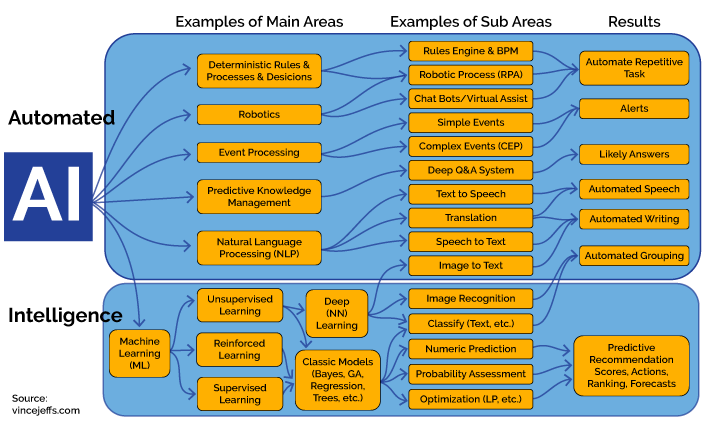 Natural Language Processing (NLP) refers to artificial intelligence method of communicating with an intelligent systems using a natural language such as English. The field of NLP involves making computers to perform useful tasks with the natural languages humans use [4].
The input and output of an NLP system can be :
Speech
Written Text
Components of NLP
There are two components of NLP as given:
Natural Language Understanding (NLU)
Understanding involves the following tasks
Mapping the given input in natural language into useful representations.
Analyzing different aspects of the language.
Natural Language Generation (NLG)
It is the process of producing meaningful phrases and sentences in the form of natural language from some internal representation.
It involves −
Text planning − It includes retrieving the relevant content from knowledge base.
Sentence planning − It includes choosing required words, forming meaningful phrases, setting tone of the sentence.
Text Realization − It is mapping sentence plan into sentence structure.
Steps in NLP
There are general five steps :
Lexical Analysis − It involves identifying and analyzing the structure of words.
Syntactic Analysis (Parsing) − It involves analysis of words in the sentence for grammar and arranging words in a manner that shows the relationship among the words
Semantic Analysis − It draws the exact meaning or the dictionary meaning from the text.
Disclosure Integration − The meaning of any sentence depends upon the meaning of the sentence just before it.
Pragmatic Analysis − During this, what was said is re-interpreted on what it actually meant. It involves deriving those aspects of language which require real world knowledge [5].
A wide variety of meaningful and interesting artificial intelligence giving learners easier access to the tools can help them develop their language skills. This Artificial intelligence technology can provide learners with more opportunities for interaction beyond the restriction from time and locations. It is hoped that language learning can be more fun and more efficient.
In most language classrooms, it is not difficult to see how to motivate students to learn and how to keep the motivation going are big issues for teachers. Oral language development is clearly a key skill for second language learners, but it does not stand alone. The relationships among the four skills of listening, speaking, reading, and writing are complex and intertwined.
Therefore, Artificial intelligence provides more opportunities and time for users to learn languages. However, there are still spaces for developing more intelligence on Artificial intelligence in order to make it more “real”. For example, speech recognition for users would be an excellent function for learners to practice speaking.. It is hoped that language learning can be more fun and more efficient. With a wide variety of meaningful and interesting artificial intelligence, giving learners easier access to the tools can help them develop their language skills.
REFERENCE LIST:
Brown, H. D.. 1994. Principles of Language Learning and Teaching[M]. 3rd ed. Englewood Cliffs, NJ: Prentice Hall.
Bump, J.. 1990. Radical Changes in Class Discussion Using Networked Computers[J]. Computers and the Humanities, (24): 49-65. Dreyfus, L.. 1992. What Computers Still Can’t Do[M]. London: The MIT Press.
Ellis, R.. 1994. The Study of Second Language Acquisition[M]. Oxford: Oxford University Press.
Greenia, 1992. Computers and Teaching Composition in a Foreign Language[J]. Foreign Language Annals.
Van Handle, D. C. & Corl, K. A.. 1998. Extending the Dialogue: Using Electronic Mail and the Internet to Promote Conversation and Writing in Intermediate Level German Language Courses.







 Opportunities of Artificial Intelligence in learning foreign languages (232.83 KB)
 0
0 706
706 6
6 Нравится
0
Нравится
0


