Меню
Разработки
Разработки  /  Английский язык  /  Презентации  /  11 класс  /  Infinitive (презентация)

Infinitive (презентация)

Презентация разработана для закрепления знаний о неопределенной форме глагола.
09.03.2016

Описание разработки

Инфинитив (неопределенная форма глагола) – это неличная глагольная форма, которая только называет действие, не указывая ни лица, ни числа.

Формальным признаком инфинитива может служить частица to, которая не имеет самостоятельного значения и часто опускается перед инфинитивом.

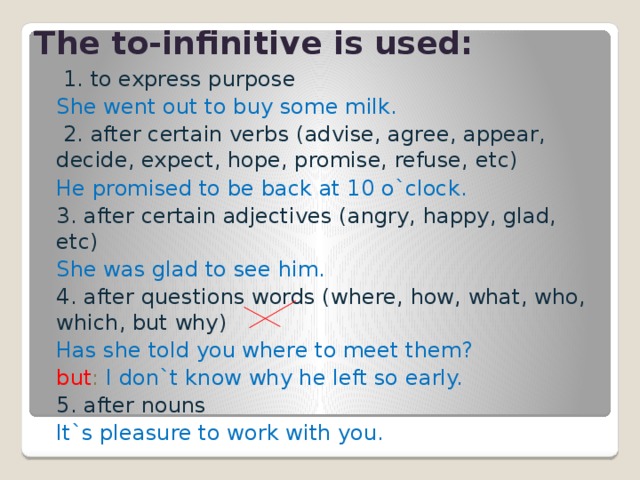
The to-infinitive is used:

1. to express purpose

She went out to buy some milk.

Infinitive (презентация)

2. after certain verbs (advise, agree, appear, decide, expect, hope, promise, refuse, etc)

He promised to be back at 10 o`clock.

3. after certain adjectives (angry, happy, glad, etc)

She was glad to see him.

4. after questions words (where, how, what, who, which, but why)

Has she told you where to meet them?

but: I don`t know why he left so early.

5. after nouns

It`s pleasure to work with you.

Содержимое разработки

INFINITIVE .

INFINITIVE

.

 Инфинитив  (неопределенная форма глагола) – это неличная глагольная форма, которая только называет действие, не указывая ни лица, ни числа.  Формальным признаком инфинитива может служить частица  to , которая не имеет самостоятельного значения и часто опускается перед инфинитивом.

Инфинитив (неопределенная форма глагола) – это неличная глагольная форма, которая только называет действие, не указывая ни лица, ни числа.

Формальным признаком инфинитива может служить частица to , которая не имеет самостоятельного значения и часто опускается перед инфинитивом.

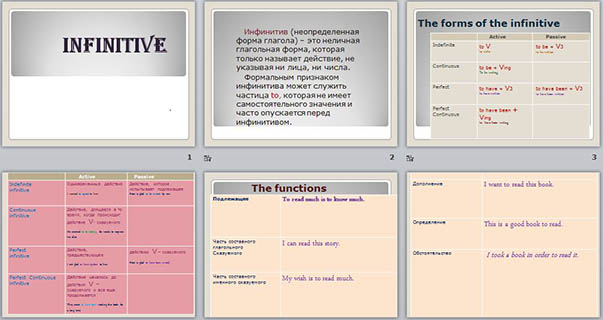
The forms of the infinitive  Active Indefinite  Passive to V Continuous to write to be + V ing  to be + V 3 Perfect To be writing Perfect Continuous  to be written to have + V 3 to have been + V ing to have written  to have been + V 3 to have been writing  to have been written

The forms of the infinitive

Active

Indefinite

Passive

to V

Continuous

to write

to be + V ing

to be + V 3

Perfect

To be writing

Perfect Continuous

to be written

to have + V 3

to have been + V ing

to have written

to have been + V 3

to have been writing

to have been written

 Active Indefinite infinitive Одновременные действия  Passive Continuous Perfect infinitive Действие, длящееся в то время, когда происходит действие V - сказуемого Действие, которое испытывает подлежащее Peter is glad to be invited by me. Perfect Continuous I wanted to speak to him. infinitive Действие, предшествующее He seemed to be looking for words to express his idea. Действие началось до действия V – сказуемого и все еще продолжается действию V – сказуемого infinitive I am glad to have spoken to him. Peter is glad to have been invited. They seem to have been reading this book for a long time.

Active

Indefinite

infinitive

Одновременные действия

Passive

Continuous

Perfect

infinitive

Действие, длящееся в то время, когда происходит действие V - сказуемого

Действие, которое испытывает подлежащее

Peter is glad to be invited by me.

Perfect Continuous

I wanted to speak to him.

infinitive

Действие, предшествующее

He seemed to be looking for words to express his idea.

Действие началось до действия V – сказуемого и все еще продолжается

действию V – сказуемого

infinitive

I am glad to have spoken to him.

Peter is glad to have been invited.

They seem to have been reading this book for a long time.

The functions Подлежащее  To read much is to know much. Часть составного глагольного Часть составного именного сказуемого  Сказуемого I can read this story. Дополнение My wish is to read much.  I want to read this book. Определение This is a good book to read. Обстоятельство  I took a book in order to read it.

The functions

Подлежащее

To read much is to know much.

Часть составного глагольного

Часть составного именного сказуемого

Сказуемого

I can read this story.

Дополнение

My wish is to read much.

I want to read this book.

Определение

This is a good book to read.

Обстоятельство

I took a book in order to read it.

Подлежащее Часть составного глагольного  To read much is to know much. Часть составного именного сказуемого Сказуемого I can read this story.  Дополнение My wish is to read much.  Определение I want to read this book. Обстоятельство This is a good book to read.  I took a book in order to read it. The functions
Подлежащее

Часть составного глагольного

To read much is to know much.

Часть составного именного сказуемого

Сказуемого

I can read this story.

Дополнение

My wish is to read much.

Определение

I want to read this book.

Обстоятельство

This is a good book to read.

I took a book in order to read it.

The functions

The to-infinitive is used:  1. to express purpose She went out to buy some milk.  2. after certain verbs ( advise, agree, appear, decide, expect, hope, promise, refuse, etc ) He promised to be back at 10 o`clock. 3. after certain adjectives ( angry, happy, glad , etc) She was glad to see him. 4. after questions words ( where, how, what, who, which , but why ) Has she told you where to meet them? but : I don`t know why he left so early. 5. after nouns It`s pleasure to work with you.
The to-infinitive is used:

1. to express purpose

She went out to buy some milk.

2. after certain verbs ( advise, agree, appear, decide, expect, hope, promise, refuse, etc )

He promised to be back at 10 o`clock.

3. after certain adjectives ( angry, happy, glad , etc)

She was glad to see him.

4. after questions words ( where, how, what, who, which , but why )

Has she told you where to meet them?

but : I don`t know why he left so early.

5. after nouns

It`s pleasure to work with you.

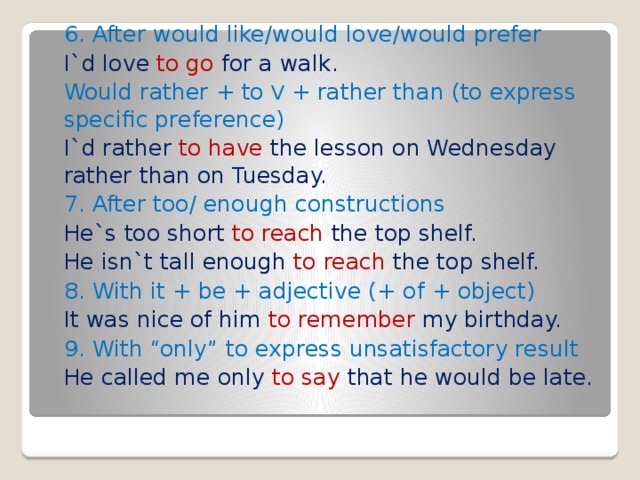
6. After would like/would love/would prefer I`d love to go for a walk. Would rather + to V + rather than (to express specific preference) I`d rather to have the lesson on Wednesday rather than on Tuesday. 7. After too/ enough constructions He`s too short to reach the top shelf. He isn`t tall enough to reach the top shelf. 8. With it + be + adjective (+ of + object) It was nice of him to remember my birthday. 9. With “only” to express unsatisfactory result He called me only to say that he would be late.

6. After would like/would love/would prefer

I`d love to go for a walk.

Would rather + to V + rather than (to express specific preference)

I`d rather to have the lesson on Wednesday rather than on Tuesday.

7. After too/ enough constructions

He`s too short to reach the top shelf.

He isn`t tall enough to reach the top shelf.

8. With it + be + adjective (+ of + object)

It was nice of him to remember my birthday.

9. With “only” to express unsatisfactory result

He called me only to say that he would be late.

The infinitive without to is used: 1.After modal verbs ( can, could, must, may, might , etc) You must be back at 12 o`clock. 2. After had better/would rather I`d rather have stayed in last night. You`d better ask your parents if you can come. 3. After make/let/see/hear/feel/watch/notice Mum let me watch TV. I made him apologise. But:  in the passive form: be made/be heard/be seen + to-Infinitive He was made to apologise.

The infinitive without to is used:

1.After modal verbs ( can, could, must, may, might , etc)

You must be back at 12 o`clock.

2. After had better/would rather

I`d rather have stayed in last night.

You`d better ask your parents if you can come.

3. After make/let/see/hear/feel/watch/notice

Mum let me watch TV.

I made him apologise.

But: in the passive form:

be made/be heard/be seen + to-Infinitive

He was made to apologise.

Phrases with the Infinitive to be honest – честно говоря to begin with – для начало to tell (you) the truth – по правде говоря; сказать вам по правде to cut a long story short – короче говоря to get back to the point – возвращаясь к сути дела to put it another way – иначе говоря to say nothing of – не говоря уже о to put it mildly – мягко выражаясь to say the least of it – по меньшей мере to begin with - начнем с того что

Phrases with the Infinitive

to be honest – честно говоря

to begin with – для начало

to tell (you) the truth – по правде говоря; сказать вам по правде

to cut a long story short – короче говоря

to get back to the point – возвращаясь к сути дела

to put it another way – иначе говоря

to say nothing of – не говоря уже о

to put it mildly – мягко выражаясь

to say the least of it – по меньшей мере

to begin with - начнем с того что

Remember:    1. The book leaves much to be desired. 2. What is to be done? Книга оставляет желать лучшего . Что делать? 3. He is difficult to deal with. 4. Who is to blame? С ним трудно иметь дело. Кто виноват? 5. I am not to blame. 6. He is hard to please. Я не виноват. Ему трудно угодить. 7. She is pleasant to look at. 8. To see is to blame. На нее приятно смотреть. Видеть значит верить. 9. I have nothing to read. 10. He was the first to come. Мне нечего читать. Он пришел первым. 11. She has nobody to speak to. 12. It is out of the question to go there. Ей не с кем поговорить. Не может быть и речи, чтобы идти. 13. To get this book, you must go to the library. Чтобы получить эту книгу, вы должны идти в библиотеку.

Remember:

1. The book leaves much to be desired. 2. What is to be done?

Книга оставляет желать лучшего . Что делать?

3. He is difficult to deal with. 4. Who is to blame?

С ним трудно иметь дело. Кто виноват?

5. I am not to blame. 6. He is hard to please.

Я не виноват. Ему трудно угодить.

7. She is pleasant to look at. 8. To see is to blame.

На нее приятно смотреть. Видеть значит верить.

9. I have nothing to read. 10. He was the first to come.

Мне нечего читать. Он пришел первым.

11. She has nobody to speak to. 12. It is out of the question to go there.

Ей не с кем поговорить. Не может быть и речи, чтобы идти.

13. To get this book, you must go to the library.

Чтобы получить эту книгу, вы должны идти в библиотеку.

The infinitive after “ help” 1. Can be used without “to” Mother helped me do the homework . 2. Can be used with “to” a) More formal Mother helped me to do the homework. b) In the passive The girl was helped to overcome her fear of flying.  с) After “not” How can I help my pupils not to worry about their exams?

The infinitive after “ help”

1. Can be used without “to”

Mother helped me do the homework .

2. Can be used with “to”

a) More formal

Mother helped me to do the homework.

b) In the passive

The girl was helped to overcome her fear of flying.

с) After “not”

How can I help my pupils not to worry about their exams?

STRUCTURES WITH HAVE HAVE + OBJECT + v  1 .  is used to show that one person makes a) They had us clean the floor. b) We`ll have you believe that I can be trusted. 2 . . is used to refer to the result we are  trying to achieve,  a) We`ll have you dancing professionally in six months. Через 6 месяцев ты у нас будешь танцевать профессионально. b) Stop that noise or you`ll have everyone coming to complain. Если ты не перестанешь шуметь, ты добьешься того, что придут жаловаться. HAVE + OBJECT + V ing

STRUCTURES WITH HAVE

HAVE + OBJECT + v

1 .

is used to show that one person makes

a) They had us clean the floor.

b) We`ll have you believe that I can be trusted.

2 . . is used to refer to the result we are

trying to achieve,

a) We`ll have you dancing professionally in six months.

Через 6 месяцев ты у нас будешь танцевать профессионально.

b) Stop that noise or you`ll have everyone coming to complain.

Если ты не перестанешь шуметь, ты добьешься того, что придут жаловаться.

HAVE + OBJECT + V ing

3 .  Is used to show that the speaker disapproves of something. a) I won`t have you sitting (sit) about and waiting when your best friend is in trouble . Я не допущу, чтобы ты сидел и ждал , когда твой лучший друг в беде. b) I can`t have they telling everyone our secrets. Я не могу допустить, чтобы они рассказывали всем наш секреты. WON`T / CAN`T + HAVE + OBJECT +  v/v ing

3 .

Is used to show that the speaker disapproves of something.

a) I won`t have you sitting (sit) about and waiting when your best friend is in trouble .

Я не допущу, чтобы ты сидел и ждал , когда твой лучший друг в беде.

b) I can`t have they telling everyone our secrets.

Я не могу допустить, чтобы они рассказывали всем наш секреты.

WON`T / CAN`T + HAVE + OBJECT + v/v ing

-80%
Курсы повышения квалификации

Развитие человека от рождения до смерти: психология развития и возрастная психология

Продолжительность 72 часа
Документ: Удостоверение о повышении квалификации
4000 руб.
800 руб.
Подробнее
Скачать разработку
Сохранить у себя:
Infinitive (презентация) (0.1 MB)

Комментарии 0

Чтобы добавить комментарий зарегистрируйтесь или на сайт