
 Получите свидетельство
 Вход
Вход



Animals Of the Antarctic continent
- Antarctica is not like other continents. It is covered with a layer of ice with a thickness of 2000-2500 m. But the cold is not the only inconvenience with which we have to put up a few of the local inhabitants. In Antarctica is very dry air, little rainfall, but many months reigns pitch darkness. Terrestrial inhabitants, in addition to penguins, there is quite. Life almost all species of animals and birds of Antarctica connected with the ocean with Antarctic water basins and partly to the marginal strip of the mainland. Antarctica is poor in land animals, mammals on the mainland does not. There are some worms, lower crustaceans, and wingless insects. The lack of wings is caused by the constantly blowing strong winds: bugs can't rise into the air. On the Islands of the Antarctic has several species of beetles, spiders, freshwater mollusks, one species of flightless moths. Freshwater fish no. Of the birds known white Plover, Pipit, one species of duck, nesting on South Georgia island.But the Antarctic waters are rich in marine and polyubopytnee species of animals.
Seals
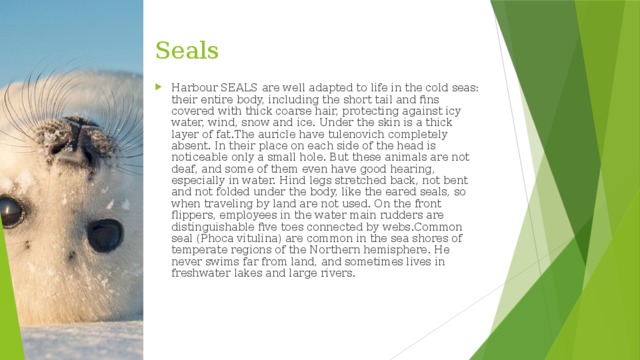
- Harbour SEALS are well adapted to life in the cold seas: their entire body, including the short tail and fins covered with thick coarse hair, protecting against icy water, wind, snow and ice. Under the skin is a thick layer of fat.The auricle have tulenovich completely absent. In their place on each side of the head is noticeable only a small hole. But these animals are not deaf, and some of them even have good hearing, especially in water. Hind legs stretched back, not bent and not folded under the body, like the eared seals, so when traveling by land are not used. On the front flippers, employees in the water main rudders are distinguishable five toes connected by webs.Common seal (Phoca vitulina) are common in the sea shores of temperate regions of the Northern hemisphere. He never swims far from land, and sometimes lives in freshwater lakes and large rivers.
Penguins
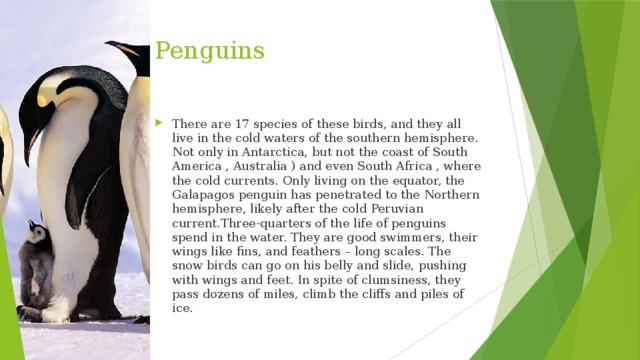
- There are 17 species of these birds, and they all live in the cold waters of the southern hemisphere. Not only in Antarctica, but not the coast of South America , Australia ) and even South Africa , where the cold currents. Only living on the equator, the Galapagos penguin has penetrated to the Northern hemisphere, likely after the cold Peruvian current.Three-quarters of the life of penguins spend in the water. They are good swimmers, their wings like fins, and feathers – long scales. The snow birds can go on his belly and slide, pushing with wings and feet. In spite of clumsiness, they pass dozens of miles, climb the cliffs and piles of ice.
whales
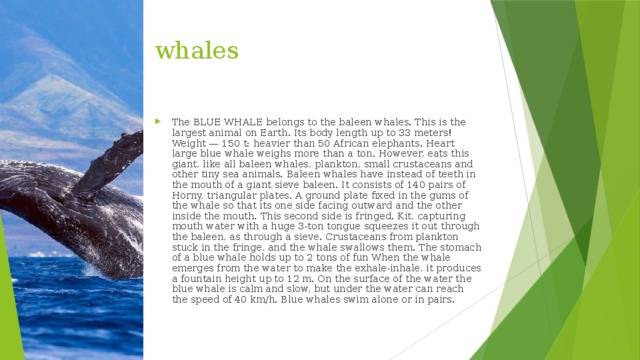
- The BLUE WHALE belongs to the baleen whales. This is the largest animal on Earth. Its body length up to 33 meters! Weight — 150 t: heavier than 50 African elephants. Heart large blue whale weighs more than a ton. However, eats this giant, like all baleen whales, plankton, small crustaceans and other tiny sea animals. Baleen whales have instead of teeth in the mouth of a giant sieve baleen. It consists of 140 pairs of Horny, triangular plates. A ground plate fixed in the gums of the whale so that its one side facing outward and the other inside the mouth. This second side is fringed. Kit, capturing mouth water with a huge 3-ton tongue squeezes it out through the baleen, as through a sieve. Crustaceans from plankton stuck in the fringe, and the whale swallows them. The stomach of a blue whale holds up to 2 tons of fun When the whale emerges from the water to make the exhale-inhale, it produces a fountain height up to 12 m. On the surface of the water the blue whale is calm and slow, but under the water can reach the speed of 40 km/h. Blue whales swim alone or in pairs.









 Animals of the Antarctic continent (432.72 KB)
 0
0 594
594 10
10 Нравится
0
Нравится
0


