Получите свидетельство
 Вход
Вход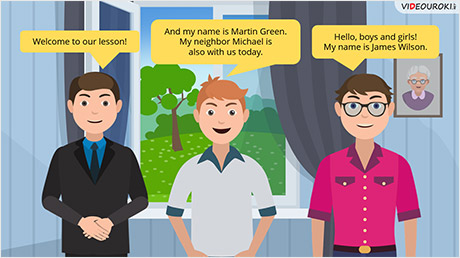



— Hello, boys and girls! My name is James Wilson.
— And my name is Martin Green. My neighbor Michael is also with us today.
— Welcome to our lesson!
— Today we would like to tell you one interesting story.
— It happened to us yesterday.
— I invited friends to my place.
— When we came, Michael started showing us his beautiful garden.
— Yes, it was amazing. There were so many flowers of different colors.
— And they smelled so good.
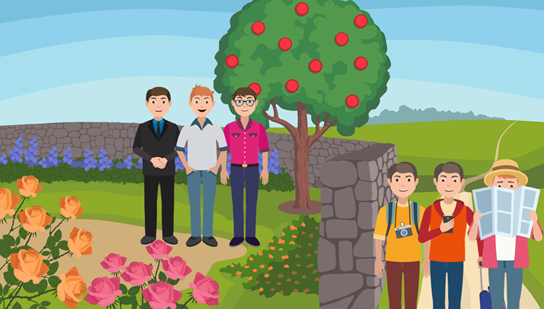
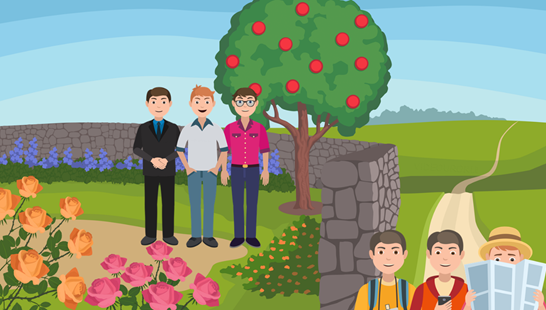
— When we were admiring the beauty of the garden, we saw three tourists.
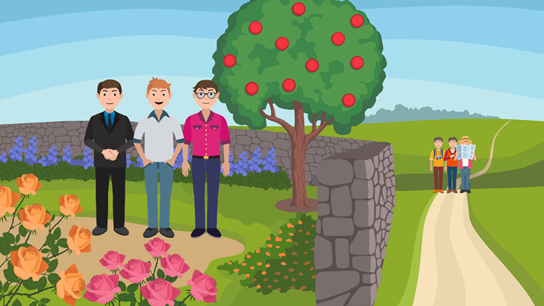
— They came closer and started talking to us.
— Listen to our conversation.
— This will help you to guess the topic of the lesson.
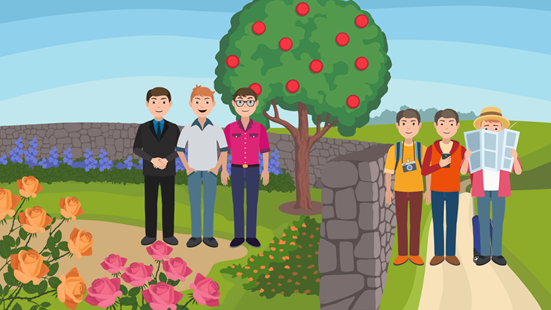
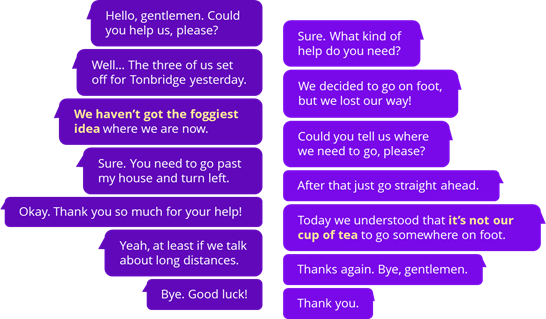
— Hello, gentlemen. Could you help us, please?
— Sure. What kind of help do you need?
— Well… The three of us set off for Tonbridge yesterday.
— We decided to go on foot, but we lost our way!
— We haven’t got the cloudiest idea where we are now.
— Could you tell us where we need to go, please?
— Sure. You need to go past my house and turn left.
— After that just go straight ahead.
— Okay. Thank you so much for your help!
— Today we understood that it’s not our cup of coffee to go somewhere on foot.
— Yeah, at least if we talk about long distances.
— Thanks again. Bye, gentlemen.
— Bye. Good luck!
— Thank you.
— Now let’s look through our dialogue once again.
— The tourists made 2 serious mistakes in their speech.
— Let’s correct these mistakes.
— First of all, you need to know that there is no phrase “We haven’t got the cloudiest idea”, instead of this phrase we need to say: “We haven’t got the foggiest idea”.
— Now let’s look at this sentence. If we don’t like something, we cannot say: “It’s not our cup of coffee”.
— We need to say: “It’s not our cup of tea”.
As you can understand, today in the lesson we will:
· talk about English expressions connected with certain situations;
And
· put the knowledge into practice.
— There are lots of different phrases, which we need to use in certain situations.
— Today we will talk about some of them.
— And we really hope that the tourists whom we met the other day will watch this video.
— This will help them not to make mistakes in the future.
— Let’s start our lesson.
And the first phrase is “It’s not my cup of tea”.
We use this sentence when we want to say that we don’t really like something.
Let’s look at the example:
— Hi, Hunter. We are going to the court near my house to play basketball. Would you like to go with us?
— Oh, no, Max, it’s not my cup of tea. I like playing football more, but thanks for asking.
— Oh, that’s a pity. See you around then.
— See you.
The following phrase is “I’m knackered”.
This sentence can be used when we want to tell someone that we are very tired or exhausted.
Look at the following example:
— Kyle, it’s so sunny and warm outside. Let’s go fishing.
— Oh, Christopher, I was busy all day long. And I’m so knackered. I’ll join you next time if you don’t mind.
— All right. I’ll go alone then. See you.
The third phrase is “I’m up to my eyes”.
We use this sentence to tell someone that we are very busy.
For instance:
— Marry, I have two tickets to the cinema. Would you like to go with me?
— Oh, Nick, I wish I could go, but I’m up to my eyes.
— Oh, no problem. We can go next time.
The following phrase is “I’m a bit hard up”.
This sentence is used when we want to say that we don’t have any money.
Let’s look at the example:
— Jennifer, yesterday I went to the store and found a beautiful dress.
— Cool! Did you buy it?
— Oh, no, I didn’t. I wanted to buy it, but I had no money. Could you lend me $175 so I could buy this dress today?
— Oh, Jillian, I’m sorry. I wish I could give you some money for the dress, but I’m a bit hard up.
The fifth phrase is “You bet”.
We use this phrase to emphasize a statement or to say that we are sure of a fact. It can also be used if we want to say that we agree with something.
Look at the following example:
— Julia, your husband will pick up Lucy after school today, won’t he?
— Oh, you bet! Don’t worry, he won’t forget about that.
— Okay, thank you so much.
The following phrase is “Touch wood”.
We usually say that in order to avoid bad luck or when we want to mention good luck that we have had in the past. This phrase can also be used to talk about our hopes for the future.
For example:
— William, how is your new washing machine? Do you like it?
— Oh, yes, I do! My wife and I don’t have any troubles with it, touch wood.
— Great! I’m glad to hear that!
Now let’s talk about such phrase as “I’m full”.
We use this sentence to tell someone that we’ve eaten so much food that we cannot eat anymore.
Let’s look at the following example:
— Mrs. Green, the cake you cooked is so delicious!
— Oh, thank you, Bobby. I’m happy to hear that! Would you like to have another piece of cake?
— Oh, I would love to eat another piece, but I’m so full!
The following phrase is “I must be off”.
We often use this phrase when we want to tell someone that we are leaving.
Look at the example:
— Carol, why are you putting your jacket on?
— Oh, I’m sorry, Michael. I must be off now. My parents allowed me to stay at your place only till 9 p.m.
— Really? Carol, I didn’t know that. In this case you need to hurry, because it’s half past 9.
— Oh, yes, Michael, you’re right! I must be quick, or my parents will be mad at me.
Now let’s talk about such phrase as “I don’t get it”.
This phrase is used very often when we want to say that we don’t understand something.
Let’s look at the following example:
— Peter, you have two daughters Brianna and Sydney. Is that right?
— Yes, absolutely. Why are you asking me about that?
— I just want to know, why do you give money only to your younger daughter? Don’t you think you should help both of them? I just don’t get it!
— Well… Maybe you’re right. I need to talk to my wife about it.
And the last phrase for today is “I haven’t got the foggiest idea”.
This phrase means that we don’t know anything at all.
Look at the example:
— Felix, look! There are lots of people in your mum’s kitchen.
— Oh my God, there are so many of them.
— Do you know who they are or why they are here?
— No, Bryan, I haven’t got the foggiest idea! Let’s ask my mum who these people are.
— Guys, we’ve told you about English expressions connected with certain situations.
— Now we would like to check your knowledge.
— We want to make sure that you will use suitable expressions in different situations.
Complete the microdialogues with the phrases from the lesson.
And the phrases are:
· It’s not my cup of tea.
· I’m knackered.
· I’m up to my eyes.
· I’m a bit hard up.
· You bet.
· Touch wood.
· I’m full.
· I must be off.
· I don’t get it.
· I haven’t got the foggiest idea.
Dialogue 1.
— Jack, I’m sure your mum is going to win the competition.
— …………………………! I think her performance is the best!
Let’s check the right answer.
Dialogue 2.
— Benjamin, I know that you are going on a trip to Italy in a few weeks.
— …………………………! I’m trying to get a visa at the moment.
Check yourselves.
Dialogue 3.
— Logan, my sister is having a birthday party tomorrow. I’m inviting you.
— Oh, thank you, Dylan. I would love to come, but …………………………!
I have two poems to write before Wednesday.
Let’s check.
Dialogue 4.
— Patrick, could you lend me some money? I’d like to buy this T-shirt for my cousin. I know he would love it.
— Oh, I’m sorry, Alex, …………………………! Can it wait till Friday? That’s when I’ll get my salary.
Let’s check the right answer.
Dialogue 5.
— Excuse me, …………………………! Do I have to pay for each of these plates or they come as a set?
— Oh, I’m sorry, but you have to pay for each of them, because they are from our new collection.
Check yourselves.
Dialogue 6.
— Chase, will you stay and watch the new horror film with me and Jennifer?
— Thanks, Devin! I’d love to but …………………………! I promised Amber to come home before 11 p.m.
Let’s check.
Dialogue 7.
— Cole, would you like to have another piece of pie?
— Oh, thank you, Adam. It’s very nice of you, but …………………………! I just can’t eat any more.
Let’s check the right answer.
Dialogue 8.
— Excuse me, where is the nearest bus station?
— Oh, I’m sorry. …………………………! I’m a tourist too.
Check yourselves.
Dialogue 9.
— Eric, would you like to go for a walk with me?
— Oh, Jason, I would love to, but …………………………! I have been working since 5 a.m. I need to have some rest.
Let’s check.
And the last dialogue.
— Kevin, I’m going to the theatre. Would you like to go with me?
— No, not really. I’m afraid …………………………!
Check yourselves.
— That’s all for today, our dear friends.
— We hope that the lesson was interesting and useful for you.
— See you soon, boys and girls.

 662
662