Меню
Разработки
Разработки  /  Английский язык  /  Презентации  /  11 класс  /  Урок-презентация "Мой край"

Урок-презентация "Мой край"

Этот материал был подготовлен к приезду в школу иностранных гостей. Поскольку зрители и слушатели не владели русским языком, учащиеся заранее подготовили рассказ о своей республике на английском. 

  Настройки   Настройки § 1 2 3 4 5 6 7 8 9 0 - = Backspace   Tab q w e r t y u i o p [ ]   Return     capslock a s d f g h j k l ; ' \   shift ` z x c v b n m , . / shift     English     Deutsch   Español   Français   Italiano   Português   Русский   alt alt     Настройки
17.09.2016

Содержимое разработки

   Karachay-Cherkessia Republic Sights of republic

Karachay-Cherkessia Republic

Sights of republic

History   Karachay-Cherkess Autonomous Oblast was created on January 12, 1922. It was split into Karachay Autonomous Oblast and Cherkess National District on April 26, 1926. Cherkess National District was elevated to an autonomous oblast status on April 30, 1928. In 1943, Karachay Autonomous Oblast was abolished and the Karachay population was deported to Kazakhstan and Uzbekistan accused of collaboration with the Nazis . Most of the Karchay territory was split between Stavropol Krai and Georgia . The remaining territory populated by the Cherkessians was known as Cherkess Autonomous Oblast until January 9, 1957 when it was re-established into Karachay-Cherkess Autonomous Oblast in its former borders due to the re-habilitation of the Karachay. On July 3, 1991, the autonomous oblast was elevated to the status of the Autonomous Soviet Socialist Republic of Karachay-Cherkessia (under the jurisdiction of the Russian SFSR ). With the dissolution of the Soviet Union in December 1991, the words

History

  • Karachay-Cherkess Autonomous Oblast was created on January 12, 1922. It was split into Karachay Autonomous Oblast and Cherkess National District on April 26, 1926. Cherkess National District was elevated to an autonomous oblast status on April 30, 1928. In 1943, Karachay Autonomous Oblast was abolished and the Karachay population was deported to Kazakhstan and Uzbekistan accused of collaboration with the Nazis . Most of the Karchay territory was split between Stavropol Krai and Georgia . The remaining territory populated by the Cherkessians was known as Cherkess Autonomous Oblast until January 9, 1957 when it was re-established into Karachay-Cherkess Autonomous Oblast in its former borders due to the re-habilitation of the Karachay. On July 3, 1991, the autonomous oblast was elevated to the status of the Autonomous Soviet Socialist Republic of Karachay-Cherkessia (under the jurisdiction of the Russian SFSR ). With the dissolution of the Soviet Union in December 1991, the words "Autonomous Soviet Socialist" was dropped from the name.
Geography   Karachay-Cherkessia Republic  is situated on the northern part of  Big Caucasus, to the east and north from Elbrus, part of North Caucasian Federal District . The length of republic territory  from north to south is 140 km, from west to east - 170 km. The  republic borders on the Krasnodar Territory in the west, the Stavropol Territory in the north and northeast,  the Kabardino-Balkarian Republic in the east, and Georgia and Abhazia in the south.

Geography

Karachay-Cherkessia Republic

is situated on the northern part of

Big Caucasus, to the east and

north from Elbrus, part of

North Caucasian Federal District .

The length of republic territory

from north to south is 140 km,

from west to east - 170 km. The

republic borders on the Krasnodar

Territory in the west, the Stavropol

Territory in the north and northeast,

the Kabardino-Balkarian Republic

in the east, and Georgia and Abhazia

in the south.

Cherkessk Cherkessk is the capital of the Karachay-Cherkessia  Republic. It is situated on the right bank of the Kuban  River. It is a railway station on the way Nevinnomysk- Dzheguta from the way Armavir-Baku. Cherkessk is divided  into three districts: central, southern and northern. The  central one consists of the most ancient buildings with  curved streets of a Cossack village. It is an industrial, administrative, and culture centre of the city. The biggest  public buildings are located here: the House of the Soviets, regional library, the Drama theatre. A park A  green island, located in the flood bed of the Kuban  River, is a part of the district. The northern district is  primarily industrial, the southern the place of manors  build up. There are put up monuments to V.I. Lenin, to  The Hero of the Civil War, to Y.F.Balakhonov in the city. Cherkessk is a cultural centre of the Republic. There  is a technological institute, the institute of economy,  history, and literature in the city. There is also a regional natural museum-reserve, established in 1918.

Cherkessk

Cherkessk is the capital of the Karachay-Cherkessia

Republic. It is situated on the right bank of the Kuban

River. It is a railway station on the way Nevinnomysk-

Dzheguta from the way Armavir-Baku. Cherkessk is divided

into three districts: central, southern and northern. The

central one consists of the most ancient buildings with

curved streets of a Cossack village. It is an industrial,

administrative, and culture centre of the city. The biggest

public buildings are located here: the House of the

Soviets, regional library, the Drama theatre. A park A

green island, located in the flood bed of the Kuban

River, is a part of the district. The northern district is

primarily industrial, the southern the place of manors

build up. There are put up monuments to V.I. Lenin, to

The Hero of the Civil War, to Y.F.Balakhonov in the city.

Cherkessk is a cultural centre of the Republic. There

is a technological institute, the institute of economy,

history, and literature in the city. There is also a

regional natural museum-reserve, established in 1918.

History of our capital Cherkessk was founded in 1804 as a Russian  military fortress on the Kuban boundary, where  Russian army under General I.I.Herman defeated 40-thousands Turkish army Batal- Pashy in 1790. In honour of this victory,  Batalpashinskaya village was established, meaning it is situated on the place Batal- Pasha defeat. The village has been an administrative centre of the Kuban region since  1880. It has become a city Batalpashinsk since  1931. In 1934 the city was renamed into Sulimov  after the chairman of the Council of People's  Commissars. Sulimov was arrested in 1937 and  the city was renamed into Ezhovo-Cherkessk after N.I. Ezhov, an executive of arrests and decimations. In 1939 Ezhov was arrested as well,  and the city has kept its second part Cherkessk,  the centre of Cherkessia. It has been the centre of the Karachayevo-Cherkess Autonomous Region  since 1957, and since 1991 it has been the capital of the Karachayevo-Cherkessian Republic.

History of our capital

Cherkessk was founded in 1804 as a Russian

military fortress on the Kuban boundary, where

Russian army under General I.I.Herman

defeated 40-thousands Turkish army Batal-

Pashy in 1790. In honour of this victory,

Batalpashinskaya village was established,

meaning it is situated on the place Batal-

Pasha defeat. The village has been an

administrative centre of the Kuban region since

1880. It has become a city Batalpashinsk since

1931. In 1934 the city was renamed into Sulimov

after the chairman of the Council of People's

Commissars. Sulimov was arrested in 1937 and

the city was renamed into Ezhovo-Cherkessk

after N.I. Ezhov, an executive of arrests and

decimations. In 1939 Ezhov was arrested as well,

and the city has kept its second part Cherkessk,

the centre of Cherkessia. It has been the centre

of the Karachayevo-Cherkess Autonomous Region 

since 1957, and since 1991 it has been the capital

of the Karachayevo-Cherkessian Republic.

  Climate The climate in the region is relatively warm, with short winters and long and warm  summers. The average temperature in January is  -3°C, and the average temperature in July is +22°C. The highest recorded  temperature is +39°C, and  the lowest is -29°C.

Climate

The climate in the region is

relatively warm, with short

winters and long and warm

summers. The average

temperature in January is

-3°C, and the average

temperature in July is +22°C.

The highest recorded

temperature is +39°C, and

the lowest is -29°C.

   Nature  Our republic is good not only for travelling and tourism. It is the place where a man can merge with nature.

Nature

Our republic is good not only for travelling and tourism. It is the place where a man can merge with nature.

 Mountains About 80% of the territory of the republic is mountainous.

Mountains

About 80% of the territory of the republic is mountainous.

Mountains, air, clean rivers and lakes, wonderful fields and forests, hospitable people are our pride.

Mountains, air, clean rivers and lakes, wonderful fields and forests, hospitable people are our pride.

 Forests cover a large part of the territory. The republic has an abundance of water resources. 172 small and large rivers flow through the republic, the largest is Kuban, Bolshoi and Maly Zelenchuk, Urup, and Laba rivers. There are about 130 glacial alpine lakes and numerous alpine waterfalls.

Forests cover a large part of the territory. The republic has an abundance of water resources. 172 small and large rivers flow through the republic, the largest is Kuban, Bolshoi and Maly Zelenchuk, Urup, and Laba rivers. There are about 130 glacial alpine lakes and numerous alpine waterfalls.

The republic's fauna includes deer, Caucasian goats, chamois, roe deer, bears, squirrels, foxes, muskrats, martens, mink, jackals, wolves, raccoon dogs, European hares, otters, forest cats, badgers, lynx, grey partridge, pheasants, Caucasian grouse, Caucasian snow cocks, and ducks. Flora includes more than 1,260 different plants (235 of them endemic).

The republic's fauna includes deer, Caucasian goats, chamois, roe deer, bears, squirrels, foxes, muskrats, martens, mink, jackals, wolves, raccoon dogs, European hares, otters, forest cats, badgers, lynx, grey partridge, pheasants, Caucasian grouse, Caucasian snow cocks, and ducks. Flora includes more than 1,260 different plants (235 of them endemic).

There are a lot of places of interest in our republic.

There are a lot of places of interest in our republic.

There is a place which every tourist wants to visit. It is the Face of the Christ on a rock in Arkhyz.

There is a place which every tourist wants to visit. It is the Face of the Christ on a rock in Arkhyz.

Nature reserves Teberdinskiy in Karachay-Cherkessia
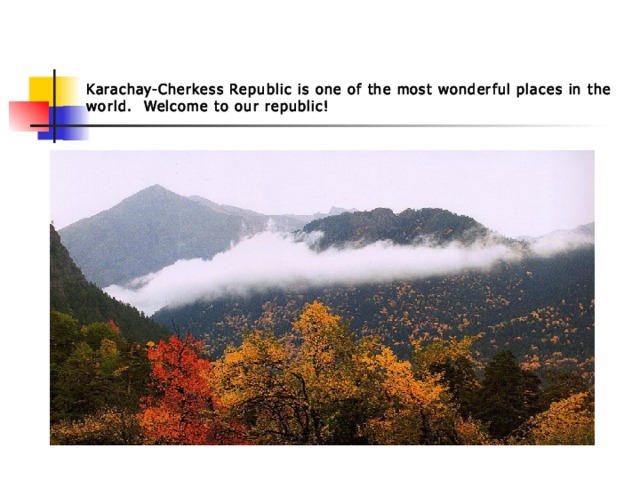
Nature reserves Teberdinskiy in Karachay-Cherkessia

Karachay-Cherkess Republic is one of the most wonderful places in the world. Welcome to our republic!

Karachay-Cherkess Republic is one of the most wonderful places in the world. Welcome to our republic!

Проект выполнили учащиеся 11 «А» класса. Цель проекта: ознакомить гостей республики с ее    достопримечательностями.     Задачи:  1. Издание буклета  2. Создание презентации    Учитель: Таха С.А.     2016 г.

Проект выполнили учащиеся 11 «А» класса.

Цель проекта: ознакомить гостей республики с ее

достопримечательностями.

Задачи: 1. Издание буклета 2. Создание презентации

Учитель: Таха С.А.

2016 г.
-80%
Курсы повышения квалификации

Порядок организации и проведения деловых переговоров как условие успешной коммуникации

Продолжительность 72 часа
Документ: Удостоверение о повышении квалификации
4000 руб.
800 руб.
Подробнее
Скачать разработку
Сохранить у себя:
Урок-презентация "Мой край" (3.53 MB)

Комментарии 0

Чтобы добавить комментарий зарегистрируйтесь или на сайт