
 Получите свидетельство
 Вход
Вход



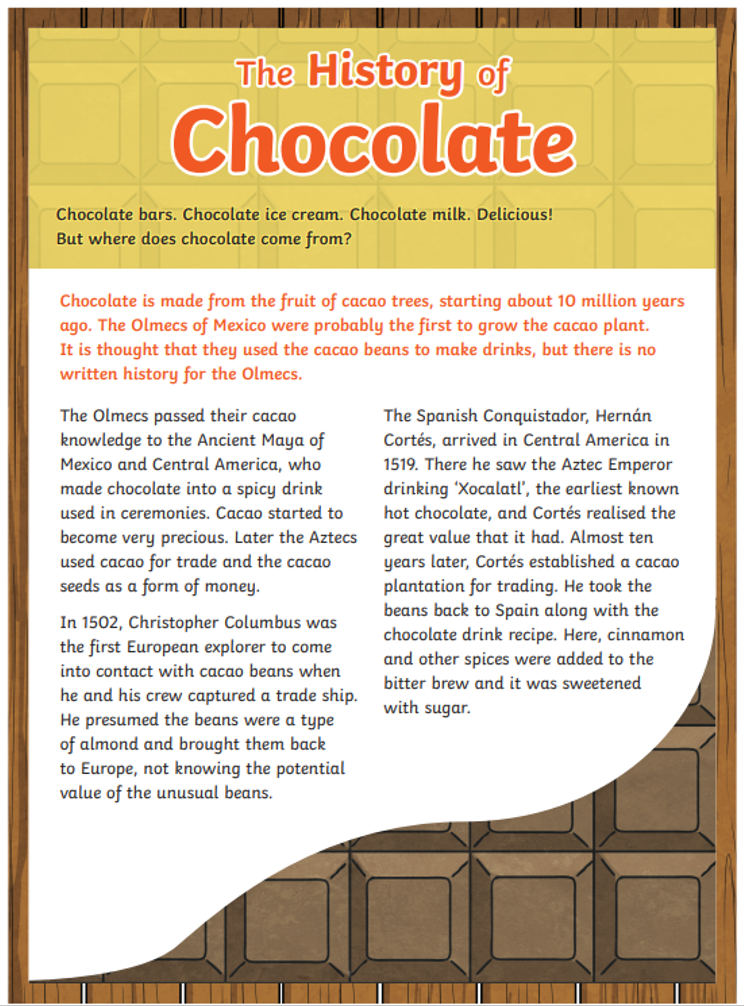

The History of Chocolate: Comprehension Test
1. Which civilization is credited with the first known use of cacao, dating back over 3,000 years?
a) The Inca
b) The Olmec
c) The Toltec
d) The Egyptians
2. How did the Ancient Maya consume chocolate?
a) As solid bars
b) As a bitter, spicy liquid
c) Baked into bread
d) Mixed with wine
3. Why did the Aztecs value cacao beans so highly?
a) Because they were poisonous to enemies
b) Because they believed it was a gift from the god Quetzalcoatl
c) Because they were used to make clothing
d) Because they could be used to grow gold
4. What European explorer first encountered cacao beans, but mistakenly thought they were "almonds"?
a) Hernán Cortés
b) Ferdinand Magellan
c) Christopher Columbus
d) Francisco Pizarro
5. How did the Spanish change the traditional recipe for chocolate when they brought it to Europe?
a) They added sugar, vanilla, and cinnamon
b) They removed the cocoa butter
c) They fermented the beans twice
d) They added flour to thicken it
6. Which group of people in Europe initially had exclusive access to chocolate during the 17th century?
a) The peasant class
b) The merchant class
c) The aristocracy and royalty
d) The clergy
7. What significant invention in 1828 by Coenraad van Houten helped transform chocolate into a powder?
a) The chocolate mill
b) The cocoa press
c) The refrigeration unit
d) The steam engine
8. What was the main innovation that Joseph Fry introduced in 1847?
a) Milk chocolate
b) The first solid, edible chocolate bar
c) White chocolate
d) Cocoa butter separation
9. Which Swiss chocolatier added condensed milk to chocolate to create the first milk chocolate?
a) Henri Nestlé
b) Daniel Peter
c) Rodolphe Lindt
d) Philippe Suchard
10. What does the "conching" process, invented by Rodolphe Lindt, do to chocolate?
a) It cools the chocolate quickly to prevent bloom
b) It creates a smooth, melt-in-the-mouth texture
c) It adds air to make the chocolate lighter
d) It separates the cocoa solids from the butter
***
▎Answer Key
1. b) The Olmec
2. b) As a bitter, spicy liquid
3. b) Because they believed it was a gift from the god Quetzalcoatl
4. c) Christopher Columbus
5. a) They added sugar, vanilla, and cinnamon
6. c) The aristocracy and royalty
7. b) The cocoa press
8. b) The first solid, edible chocolate bar
9. b) Daniel Peter
10. b) It creates a smooth, melt-in-the-mouth texture








 Reading Test "The History Of Chocolate" (1.27 MB)
 0
0 129
129 0
0 Нравится
0
Нравится
0


