
 Получите свидетельство
 Вход




MODERN TECHNIQUES IN TEACHING ENGLISH GRAMMAR TO STUDENTS.
One of several factors that makes students successful in learning English as a foreign language is determined by the methods and techniques used by the English teachers in English language teaching. Of course, the methods and the techniques applied by the teachers in the classroom vary from one teacher to another teacher. In addition, the methods and techniques used rely on the language skills and language components, the objective of teaching and learning designed, students’ English proficiency levels as well as the teachers’ knowledge and experience in implementing the methods and techniques used when teaching and learning takes place in the classroom. Grammar as one of the language components has an important role to play to support the students to be able to learn and use productive skills (speaking and writing), and receptive skills (listening, and reading). Therefore, this part limits its discussions on methods and techniques used in teaching English Grammar online.
Chapter 6. Inductive approach and deductive approaches in teaching grammar
Teaching grammar can be explicit or implicit. Implicit grammar teaching advocates think that grammar conscious grammar learning is useless. What is needed for language acquisition is just enough comprehensible input. Proponents of explicit grammar teaching believe that focus on formal grammar teaching is essential for language learners. When teachers choose to teach grammar explicitly, they follow either an inductive or a deductive approach.
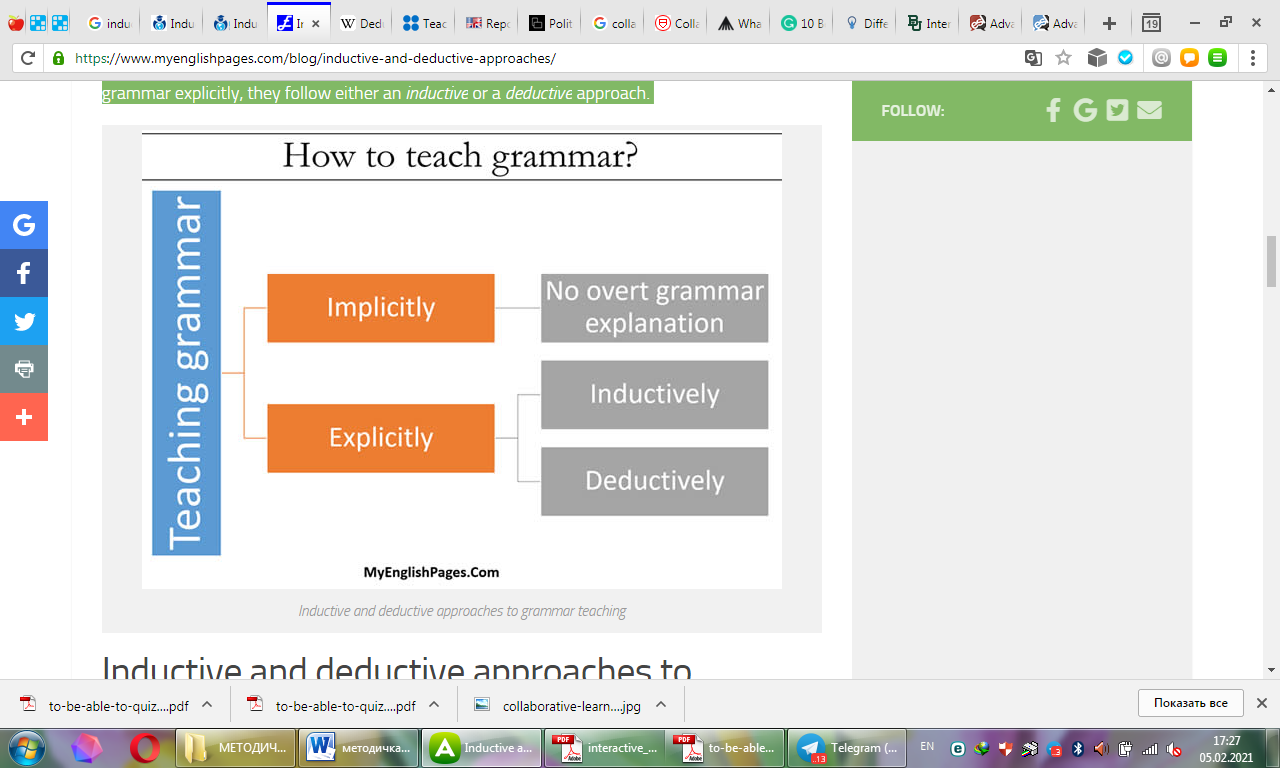
In the inductive approach, teachers start with contextualized examples of the target language and elicit the rule from the learners. Alternatively, the teacher may proceed in teaching grammar through a deductive approach by providing the learners with the grammar rule and asking them to come up with examples that demonstrate their understanding of that rule.
Inductive grammar teaching
Inductive reasoning draws conclusions from individual experiences and observations. The truth of these conclusions depends on the truth of the evidence available. In grammar teaching, inductive reasoning can be of great value. It promotes experiential learning and trains learners to actively try to discover grammar rules by themselves. Once these rules fit their mental structures, they become more memorable because of the effort deployed. The inductive grammar teaching, however, is time-consuming and requires so much effort in the preparation and organization of the lesson. It may also disappoint the type of learners who prefer traditional ways of teaching where the teacher presents and explains the rules.
Example
A teacher writes on the online board a few examples of simple present and simple past sentences. The teacher then asks the students what differences they notice in the sentences. The students discuss the differences and maybe even try converting some simple sentences from present to past on their own. Finally, the teacher explains the rule for converting sentences from past to present.
Benefits
Although inductive teaching takes longer than deductive, many educators agree it is a very efficient method in the long run. Benefits include:
Student interaction and participation.
Students rely on their critical thinking to figure out the language.
Students gain deeper understanding of the language.
Deductive grammar teaching
Teaching grammar deductively is teacher-centered. Grammar rules are explained to the learners and then tested. There are advantages and disadvantages to deductive grammar teaching. To start with, this type of teaching is time-saving and straightforward. It is easier for the teacher to present and explain a rule and ask the learners to apply it than to elicit it from them. This can also be appealing to many adult learners who prefer analytical learning to discovery approaches. The deductive reasoning, however, can pose many problems to young learners who are not equipped enough with the appropriate metalanguage. Consequently, rule-driven teaching and grammar explanations may confuse and demotivate them.
Example
A teacher writes examples of simple present and simple past sentences on the board. The teacher then proceeds to explain the differences between present and past in English. Once the lecture is complete, worksheets are handed out and students are asked to convert simple sentences from present to past.
Benefits
Although a little less effective than inductive teaching when used in TESOL, benefits to the deductive approach are:
Time in the classroom is spent only on the language principle.
Most material can be easily taught this way.
It encourages faster learning of material









 Научная статья на тему: "MODERN TECHNIQUES IN TEACHING ENGLISH GRAMMAR TO STUDENTS" (243.18 KB)
 0
 511
 2
 Нравится
0


