
 Получите свидетельство
 Вход
Вход




ancient Egyptian civilization

- Нила, Тигра и Евфрата — 4 тыс. до н. э.;
- Инда — 3 тыс. до н. э.;
- Хуанхэ — 2 тыс. до н. э.
The Nile, the Tigris and the Euphrates - 4 thousand BC; Indus - 3 thousand BC; The yellow - 2 thousand B.C.


Jean Francois Champollion (1790-1832) was a French scientist, the founder of Egyptology

The decipherment of writing - recovery understanding of an unknown writing system or language (or both).
Rosetta stone - slab of granodiorite (rock), found in 1799 in Egypt near the small town of Rosetta (now Rashid), near Alexandria, knocked on it three identical meaning of texts, including two in Egyptian language " written in ancient Egyptian hieroglyphs, Egyptian demotic script, and the one on the ancient Greek language

The cult of the Pharaoh
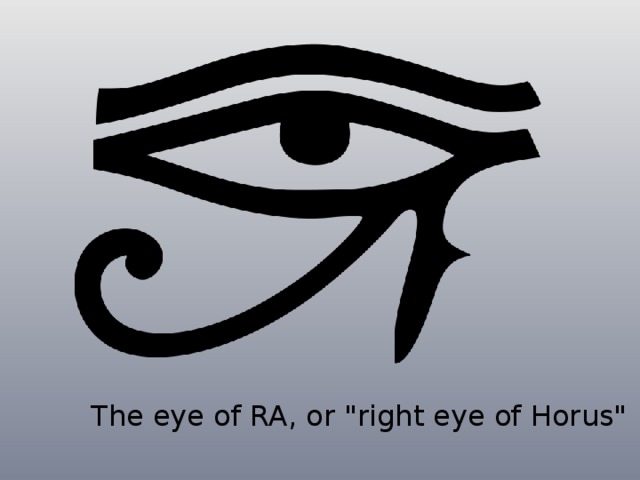
The eye of RA, or "right eye of Horus"

Amon

The attributes of the Pharaoh: The eagle on the Egyptian crown means that Pharaoh, the king, God refers to Upper Egypt. Snake (urea) on the Egyptian crown means that Pharaoh, the king, God refers to the Lower Egypt

The attributes of the Pharaoh:
- If the crown is depicted and the serpent and the eagle, this means that Pharaoh, the king, God refers to Upper and Lower Egypt (The crown appeared at the confluence of Upper and Lower Egypt into a single). The crown in the form of the solar disk belongs to the gods: RA, Atum, Amun, Amun-RA, Aah, Khonsu, Hathor.

Three crowns of Egypt: 1. The white crown of Upper Egypt 2. The red crown of Lower Egypt 3. Plant, or double crown of the United Kingdom.

Everyday, and sometimes ceremonial headdress of the Pharaoh was the handkerchief Nemes (cleft). The crown could dress over wrestler Nemes

Hook and whip. Hook symbolizes the ability to attract and retain, to choose the best, to stand in defense of justice. Whip Pharaoh symbolized clipping the worst, dark, not compatible with the Law of Maat

Herodotus galikarnassky (484 BC - 425 BC), the Greek historian, author of the first full-scale historical treatise - "History," describing the Greco-Persian war and the customs of many modern Nations. "Father of history"

Cheops, Khufu king IV Egyptian dynasty (2600-2480, BC) is famous for building the pyramids.

Thutmose III - the king of the eighteenth dynasty (1525-1474, BC) - conquered Palestine, Syria, Nubia

Amenhotep III is the king of the eighteenth dynasty (mid-fifteenth century BC) was engaged in construction activities (built the temple of Amun-RA in the Luxor and the mortuary temple with a huge statue of Amenhotep III).

Ramses II the Great - king of the twentieth dynasty that ruled Egypt in the thirteenth century B.C. for 67 years. One of the greatest pharaohs of Ancient Egypt. He was mainly assigned honorary title of A-nahta, that is "the Winner"

The religion
"Rising Sun" - Khepri or Harer, "Sun in Zenith - RA, "The sun before sunset" - Atum

Ptah - the God of water, land and global intelligence, the Creator of all things

Nun - primitive water chaos Atum Atum-RA God of air, Shu and his wife, the goddess of moisture tefnut

Heb is the God of earth and Nut the sky goddessHeb is the God of earth and Nut the sky goddess

Osiris - God of the dying and resurrecting nature. Osiris was the embodiment of goodness and it is usually called the "good God".

ISIS (ISIS) - the goddess of fertility, water and wind, magic and navigation. It represented fidelity and motherhood

The son of ISIS and Osiris - the God of the Mountains, the Sun God, conquering the forces of darkness, was worshipped in the form of a Falcon.

Symbols Of Ancient Egypt
The scarab is one of the most revered symbols of Ancient Egypt. It was believed that little beetle repeats the path of the Sun just as the Sun makes the journey across the sky, radiating light and warmth, the dung beetle rolls a ball from East to West, as the embryos matured and not born into the light. The Egyptians equated that with the Sun - fire field, bearing in itself the germ of all life

Udzhat - "Eyes Of The World", "The Eye Of Horus". According to legend, the Mountains in the battle with Seth loses his physical eyes and receives from God Thoth eyes Udzhat - eye secret intimate view of the soul. Udzhat is a character or principle of the victim, allowing the person to move towards. He was depicted in the form of an eye with a tear and a spiral underneath. Tear symbolizes sacrifice, and the spiral path of initiation to the Mysteries of the Universe, as a reminder that only through the sacrifice and dedication a person can grasp the innermost Secrets of Nature.

The Ankh is one of the most famous Egyptian symbols, Key of Life, an ancient symbol. The Academy consists of several elements: depicted at the top of the circle, symbolizing the sun, the world of the divine and eternal return of all things. Underneath the horizontal line is the horizon over which depicts the rising sun, still below the depicted vertical line representing the path to the divine light that must pass each.

The APIs Bull
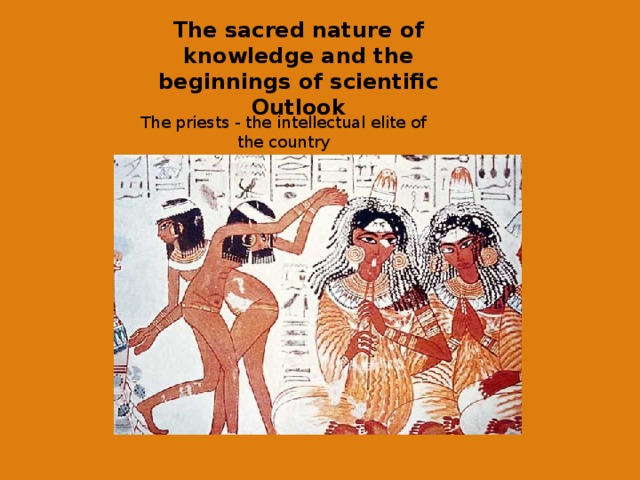
The sacred nature of knowledge and the beginnings of scientific Outlook
The priests - the intellectual elite of the country

Esoteric (from the Greek. esoterikos - inward) - secret knowledge available only to the initiated, do not have the rights to distribute them further.
Sacral (from lat. sacrum - sacred - all that belongs to the cult, the worship of the valuable ideals. Consecrated, Holy, sacred. Sacred opposed to secular.
Cylinder volume was estimated by multiplying the area of its base by the height. This operation is associated with the cylindrical measures for grain, were used to account for grain in public repositories.

The earliest pyramid of Djoser, built about 5 thousand years ago. This stepped pyramid and stands as a ladder to heaven.

the pyramid of Cheops. It was built hundreds of thousands of people for about 20 years. The height of 147 meters (now 137 m), an area of about 55 000 m

СФИНКС - фантастическое существо с телом льва и головой человека, реже животного.

The mortuary cult
The ancient Egyptians made one of the most strange revolutions. The ancient people of Egypt rose up against death and successfully defeated it. The fundamental principle of the ancient Egyptian culture was the belief in the possibility of individual immortality. Thanks to this principle, the ancient Egyptian worldview focused on the power of the Pharaoh and the gods, leaving ordinary people, calling upon the magical power of art and science, to perpetuate itself.

The ancient Egyptians made one of the most strange revolutions. The ancient people of Egypt rose up against death and successfully defeated it. The fundamental principle of the ancient Egyptian culture was the belief in the possibility of individual immortality. Thanks to this principle, the ancient Egyptian worldview focused on the power of the Pharaoh and the gods, leaving ordinary people, calling upon the magical power of art and science, to perpetuate itself.









 Ancient Egyptian civilazation (5.06 MB)
 0
0 530
530 6
6 Нравится
0
Нравится
0


